
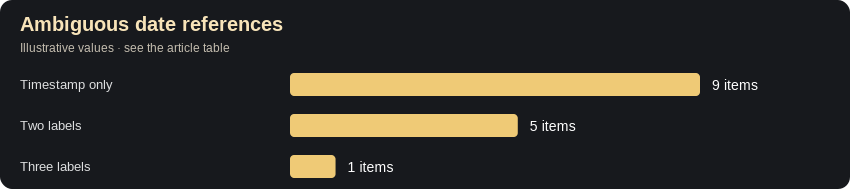
| Category | Value (items) |
|---|---|
| Timestamp only | 9 |
| Two labels | 5 |
| Three labels | 1 |
Constructed checklist scenario for this brief, not measurements, ratings, or results from cited sources. Each displayed count represents checked items in the named example.
A sign at the entrance of a marsh says a trail reopened on May 12. The website listing the trail says May 18 beneath the headline. A note at the bottom says May 22. A visitor who can see all three numbers still has to guess whether the trail was observed open on May 12, whether the story first appeared on May 18, and whether the last date refers to a factual correction or simply a change in the site's software. All the information may exist somewhere. None of it is useful until the dates acquire names.
Start with three jobs. The field date locates the observation or evidence in time. The publication date says when this report first became available to its stated audience. The correction date identifies when an acknowledged error in the report was corrected. The first belongs to the thing described, the second to the act of reporting, and the third to a later repair. They can fall on one calendar day without being interchangeable. They can be months apart without making any one of them suspicious.
The distinction matters most when people rely on a report long after its first appearance. A caretaker wants to know whether published information reflects conditions last week or last winter. A researcher wants to recover which statement earlier readers saw. A neighbor wants to understand which claim changed when two saved copies disagree. No date label can guarantee that a report will be used correctly, but a date with the wrong implied meaning can defeat careful readers who otherwise have everything they need.
Put the date near the assertion it supports
Imagine a responsible editor rewriting the marsh note. “Field visit: May 12, 2025. First published: May 18, 2025. Corrected: May 22, 2025, to identify the eastern entrance instead of the western entrance.” A sentence in the report adds that staff found the trail open during the May 12 visit. Now the reader can tell that a later calendar date is not later field evidence. The last entry also explains what the correction changes about a possible visit.
One line under a headline might hold the original publication date. A figure caption could hold the observation period if the figure's evidence differs from the article's main evidence. A correction note can be near the top when the distinction materially changes the reader's interpretation. The point is not to force all dates into a single decorative strip. It is to associate each date with the claim or action it actually qualifies.
For an item where the date is a serious limitation, the body should also make it part of the sentence. “We observed the overflow on May 12” is better than inviting the reader to join a context-free date near the title to a finding in paragraph seven. If multiple snapshots appear, name their dates separately. An article originally published on May 18 can describe evidence from six months earlier and images supplied later. A single badge cannot encode those relationships without doing violence to at least one of them.
A report does not always have a date of each kind. If editors have made no correction, there is no reason to fabricate one. If the report synthesizes archival evidence rather than describing a field visit, name the time of the records, events or observations involved. If the material is not public, say when it was first distributed to its intended audience, if known. The useful habit is to distinguish roles, not to enforce a quota of three labels regardless of the article's history.
A field date follows evidence rather than the story
A field date is the time of observation in the broadest useful sense. In a wildlife survey, it may be when a recorder captured a call, not when an analyst later identified the species. On a museum object, there may be one date for the original production and another for the modern examination. A stream sample has a collection time and potentially a later laboratory analysis time. If those events matter, give them distinct labels. “Data date” is too vague to settle which event someone meant.
Consider an editor who receives sample readings on a Friday. The readings were collected during the previous Tuesday's runoff, and the analytical report was signed on Thursday. Publishing Friday does not make the readings observations of Friday's water. The field date should attach to Tuesday, while Thursday might matter to someone asking what the lab knew before a public alert. Be precise about the chronology without demanding readers sort routine processing timestamps that have no bearing on the claim.
Some evidence covers a span rather than an instant. An air-quality monitor may collect a series across a twenty-four-hour reporting period. A plant survey may take repeat visits from March through June. A daily value may refer to a specified local window, and a monthly total to the bounds established by the dataset. Describe that period and its relevant convention. Choosing an arbitrary point, such as the day a report was exported, changes the thing the date purports to represent.
Keep dates attached to multiple sources in the right order. Imagine an article compares notes from a spring walk, photographs taken by a volunteer in summer, and an autumn instrument reading. An introductory line can summarize those periods, but the distinctive evidence still needs its own labels. If a claim comes from the summer photographs, a nearby autumn date may inadvertently imply that the feature persisted. That is an inference the source may not support. Labels belong with the observation they chronicle.
Uncertainty about field time is itself useful information. A sample label may be missing its day but preserve the month and year. A historical photo may safely be placed between two repairs without a known capture date. Write “June 1974, exact day not recorded” or “after the 1962 repair and before the 1965 survey,” if those statements are supported. Do not turn a range into its midpoint to satisfy a form. Readers can reason from documented bounds, but cannot unlearn a false date that appears precise.
A digital image timestamp can be worth investigating, but it does not prove the time of the depicted event on its own. It may be a scanning date, an export date, a device reading with an unset clock, or the time a file was copied. A statement such as “the file contains a June 3 timestamp; capture date not established” is better evidence handling than asserting the photograph was taken on June 3. If a photographer's log identifies exposure time, distinguish that attribution from the file's technical properties.
Publication is an event with an audience
The initial publication date answers when the item was first available in the edition and audience the label describes. An author's draft date does not answer that. Neither does a review date or a scheduled release date that passed without the material going live. If an article first circulated as a private document and later became public, name both events when the difference matters. “Circulated to the committee on May 8; first published publicly on May 18” gives readers a sequence they can evaluate.
The publication date supports questions about what was knowable when. A story can have an original publication date before a later development. Keeping that date helps explain why the early version lacks a fact now well known. An editor who replaces the date with today's upload date makes the artifact look as though it ignored information that was unavailable at the time. A preserved publication date also allows archived quotations and references to be matched to the correct stage of reporting.
Republishing deserves a separate label where readers might confuse it with the initial appearance. A new host may carry a report originally published elsewhere. A newsletter may reproduce an article already available in a journal. “Originally published on May 18, 2025; republished in this collection on September 7, 2026” tells the reader what happened. If the new edition incorporates substantive changes, describe that separately instead of expecting the new calendar date to imply editorial work.
There are cases where the first publication date is unknown. Migrating an archive can surface a fresh file time even when a prior release could be years earlier. A captured archive page or contemporaneous citation might establish that the report existed by a certain day without proving it was first available then. State the evidence at that level: “Publicly available by May 18, according to a saved copy; exact publication date unknown.” It is much better than putting a confident new date beside an old report and letting readers infer the wrong history.
When two teams communicate at the edge of midnight, local date and globally ordered moment may both matter. One office's Wednesday can be another's Thursday for the same release. The people affected by a local notice may chiefly care about the local date, while a sequence of transmissions may need a stated time and time zone. Record the relevant precision and distinguish conversions of one instant from distinct publication events. Do not assume two different calendar-day strings necessarily prove that material was released twice.
Corrections are answers to discrepancies
A correction states what was wrong, what is accurate now and when the repair occurred, at the precision the record supports. A mere “updated May 22” does not distinguish a corrected fact from a newly available fact. Sometimes readers need both, but the events have different meanings. A fact wrongly attributed to the wrong entrance was a problem in the earlier story. A decision to close the eastern entrance after that story appeared is later information, not a retroactive error merely because conditions changed.
Suppose a report printed that twelve specimens were recovered when the field register shows twenty-one. The correction should explain that the original number was twelve and the right number is twenty-one, if repeating the original error will help readers recognize it. If related totals or comparisons were recalculated, point to those parts too. “An earlier version misstated the count” leaves a reader unable to tell whether a spreadsheet they downloaded is still reliable. A correction note can remain short while putting the change in context.
The date the error was identified, the date it was verified and the date the correction went live can differ. For readers reconciling public versions, the live correction date is often the essential one. For a retrospective or internal review, the other dates may matter. Do not present the earliest one as a correction date if the wrong statement remained available afterward. Conversely, a correction note deployed after the main text changed should not disguise the period when readers saw changed text without its explanation.
Distinguish factual repair from routine maintenance. Fixing line spacing, replacing a decorative icon or changing a link destination without altering the substance does not normally require treating the article as newly reported. Some organizations need a full technical audit trail, and that can be kept where it belongs. A public label repeated on every technical save would eventually prevent readers from recognizing an actual correction among incidental changes.
A substantial clarification can deserve a visible note even when prior wording was not strictly false. Suppose the article originally said the survey “covered the park,” while the work in fact covered only publicly accessible trails. If the text risked a materially broader interpretation, clarify the scope and say what changed. Whether house style names the entry a clarification or a correction, the record should tell a returning reader how interpretation changed. The label is not a replacement for that explanation.
Make the checklist chart reproducible
The companion bar chart is a constructed editorial checklist, not a study of websites. Imagine one reviewer reads each of three short versions of the same miniature story and answers ten explicitly defined questions. Count an item as ambiguous when the version does not settle it. The invented counts are nine for Timestamp only, five for Two labels and one for Three labels. The figures are not observations, a reader survey, performance ratings, or results from WHATWG or W3C. They only illustrate how labeling choices can remove missing context.
Here are the ten questions, phrased so an editor can test them. What calendar year does the item concern? On what day did the field visit occur? Which evidence came from that visit? Was the finding limited to the visit rather than asserted to still hold? What date did the report first become public? Which edition or audience did that date describe? On what date did the factual correction go live? What wrong statement was repaired? What is the replacement statement? Finally, was the exact time of correction recorded? These questions fit the invented story. A reader who never needs minute-level precision would reasonably omit the last one.
| Constructed version | Questions answerable from the copy | Questions not settled |
|---|---|---|
| Timestamp only | Calendar year only | 9 |
| Two labels | Year, field visit day, evidence observed, limited scope, original public date | 5 |
| Three labels | All those above, plus public edition, correction day, previous statement, replacement | 1 |
For Timestamp only, picture a bare string, “May 18, 2025,” and a claim offering no evidence or qualifier: “The trail is open at the east entrance.” You have a year, but no label connects that date to a visit or release. For Two labels, picture “Observed May 12, 2025; published May 18, 2025” and “During the visit, staff found the trail open at the east entrance.” This version does not explicitly settle whether the publication refers to the public report or some earlier distribution, even if experience may favor the public interpretation. The checklist counts explicit answers rather than guesses.
Three labels adds that May 18 was the initial public release and that the May 22 correction changed the entrance identification from west to east. It still gives no recorded time of day for that correction. That deliberate missing answer does not imply that timestamping to the minute is a general requirement. It demonstrates the value of a stated precision limit. Good labels reduce uncertainty where supporting information exists. They need not manufacture an instant to score a perfect result on a checklist.
Notice that the last version contains more than a third date. It names the publication audience and describes the factual repair. The chart must not be explained as showing that the act of inserting a third date always removes four ambiguities. A page could contain a dozen dated notes and still fail every meaningful question if they lacked scope. This exercise shows what happens when particular questions receive particular answers. The counts are simply ten minus the number of questions each invented version settles.
Date, span, and instant are different promises
A calendar date needs a year, month and day when all three are known and relevant. An instant requires time information that places it unambiguously relative to other instants. An interval may need boundaries. Reduced precision, such as a month or a year, represents less detail rather than quietly choosing the first day at midnight. A calendar date written for a local activity may be the whole fact; converting it to a fabricated moment defeats its meaning.
Consider the notation “August 2025.” It can mean evidence recorded at an unknown date within the month, or data aggregated across the entire month. Both can be true sentences, but they do not describe the same evidence. An editor can write “photographed sometime in August 2025” for one and “total for August 2025” for the other. A calendar alone cannot supply that distinction. Date precision and the coverage of a measurement should live in separate fields when a system stores both.
An overnight record poses a similar trap. Suppose a night survey takes place from ten in the evening on June 3 to two in the morning on June 4, local time. If another person retrieves the report using a date filter, “June 3 survey” may recover only part of the data depending on how records are filed. Writing “night of June 3–4” is clear for the article. The underlying record can additionally store both known boundaries, with accurate local offsets or equivalent UTC instants when useful. A date label need not carry all that technical detail to stay honest.
A timespan can also be open at one end. A report may use the latest completed readings through September 30, but the start date is irrelevant if the claim concerns the close of a series maintained for years. In that case “data through September 30” may be the important phrase. If the result actually compares a defined summer with an earlier baseline, that starting boundary does matter. “As of” is helpful only when the sentence says what was true as of that point or what information had been considered by then.
Day-month order is another source of uncertainty. A string like 05/06/25 can refer to different dates across locales and makes a two-digit year do work it need not do. Spell out the month in public prose when there is room, and render local conventions consistently for the audience. Explicit year and an appropriate month label make printed extracts more robust. Where a numeric date is unavoidable, use clearly documented ordering. Duration and timezone should not disappear merely because a shorter string looks tidier.
What markup can preserve and what it cannot explain
The WHATWG HTML Standard's time element section explains how the element can pair visible text with a conforming machine-readable representation. A page can display a friendly date and carry the corresponding value in its datetime attribute. The structure helps software recognize a date while keeping prose natural. It does not know whether that date reports a field visit, publication, or correction. A phrase such as “Field visit:” communicates the role to a person.
For example, an article can display “Field visit: May 12, 2025,” with the date itself represented as 2025-05-12 in the time element. Another time element can carry May 18 on a line labeled “First published.” The two machine-readable values differ, and so do the adjacent human-readable labels. If a template changes only the hidden value and not the visible text, readers and software no longer receive the same information. A date audit should cover both surfaces rather than trusting one as proof of the other.
The W3C Date and Time Formats Note describes a restricted profile of ISO 8601 forms at several granularities and illustrates offsets and UTC. It is a historical W3C Note, not the governing specification for the HTML time element or a rule requiring editors to expose timestamp strings in prose. For example, the form 2025-05-22T18:30Z can describe an instant if thirty minutes past eighteen UTC is what the record establishes. A short label can still say “Corrected May 22” if that date is unambiguous for the audience and the precise instant is not necessary.
Syntax does not invent missing detail. A renderer should not set January 1 when the source records only the year unless another clearly documented convention requires a placeholder and people cannot mistake it for a known calendar day. Better to carry the stored precision explicitly. If the visible label says “spring 2025,” the team need not transform that phrase into a day just to stuff it into a machine field. Treat documented bounds and semantic uncertainty as first-class records rather than as failures of formatting.
Check formatting behavior in abbreviated cards and search interfaces under the product's control. A card that shows “May 22” under a title could be understood as first publication when it actually borrowed the date of the last factual correction. A compact label such as “Corrected May 22” makes that tradeoff far clearer, though it may still make readers miss the original first publication date if it is essential to the story. Decide which role a one-date surface is serving by design. Do not let the latest available timestamp choose for you.
Handle updates that are not corrections
A report about a field inquiry may evolve as new evidence arrives. The first published version can accurately say a sample was awaiting laboratory identification. Later, the analyst confirms its identity. That new fact may justify an evidence update. Unless the earlier statement was wrong then, the arrival of an answer is not a correction. Readers deserve to know what was learned and when, not just that an editor touched the file.
Consider the trail again. After it was observed open and a correction identified the proper gate, heavy rain caused the park to close it the following week. A line saying “Status update, May 29: trail now closed, according to park staff” prevents a reader from using the earlier observation for present travel. The report still needs its first public date and its earlier correction record if people might have relied on the wrong entrance. One more timeline entry can preserve three distinct acts without turning the article into a changelog.
Where this sort of update occurs frequently, there may be a better home for current status than a reporting archive. Put the live conditions on a designated operational page, with ownership and its own validity period, and let the article describe the historical finding. The article can link readers to current conditions, but should not imply knowledge that surveillance does not support. A reference to the page's current owner is stronger than promising the information remains accurate until somebody remembers to edit it.
Another kind of update changes interpretation rather than reported events. An organization might publicly adopt a revised analytic method that reclassifies earlier observations. If the original procedure was correctly described and the new one answers a different question, a methodological revision may deserve its own note rather than correction wording. If the revision fixes an error in the original calculation, call that out. Explain whether historical results were recalculated and how old and new results compare. A date saying “Revised” is useful when paired with the consequence of revision.
Chronologies break in ordinary handoffs
A team can know all three events and still lose them when a document passes through another system. An export might put an observation date in a column named date, and the receiving system may interpret that column as article publication. A migration could fill missing modification dates with the time every record was imported. Those defaults are convenient to write and noisy to repair. Map fields by the real-world event they represent before matching similarities in names or data types.
Build an inventory of the date-bearing surfaces under your control. The full article, condensed list card, figure caption, downloadable PDF, feed and archived edition may each carry different pieces of the chronology. In a figure lifted on its own, the field period may be more important than the publication line. In a citation record, the original edition may matter most. A date dictionary is useful when it helps those surfaces choose the right job for their label, not when it mandates the same contents everywhere.
Pay special attention to text derived from pictures or tables. A graph can acquire a creation date from the software that exported it even though it depicts data collected years ago. Captions and credits can preserve separately the collection period and when a particular rendering was prepared. Similarly, a dated archival image can be supplemented by a present-day annotation. The annotation date ought not to imply a later capture of the original scene. Evidence that is reused needs context that is reusable too.
When a publishing system generates an automatic “updated” label from its own internal edits, ask whether the label serves readers or maintainers. A maintainability signal might be valid as a technical property, yet useless for distinguishing a corrected claim from a cover-image crop. Keep editorial events as editorial events, and technical records for technical uses. Apply the same distinction across scheduled republishes, schema changes and automated text formatting.
One simple way to identify drift is to test a single story that has truly different dates in your delivery pipeline. Give the field visit, first public release, substantive update and factual correction separate days, and perform an ordinary export. Read the result aloud as if you had never seen the data model. Does it say when the event occurred? Is the latest date misleadingly placed as the story's first date? If readers can reconstruct the timeline in one version but not in another, the trouble is not that the system has too few timestamps. It is that the handoff lost their roles.
Version records earn their space
A trustworthy correction process preserves evidence of what people could read before the change, where appropriate, without necessarily making every old artifact easily mistaken for the current report. An archive can allow comparison while identifying superseded versions. A public correction notice can explain the earlier error without requiring a reader to follow an obscure archive link or inspect a file hash. Select a method proportionate to the report's use, risk and record obligations.
Sometimes a correction should travel beyond the page. If a data table was distributed in an attachment and the count in the attachment was wrong, fixing the web sentence leaves existing copies unchanged. A new file version and a correction note can help recipients identify which file is affected. The note should tell them what to reconsider, not merely that something new was issued. Version identifiers can be useful alongside human dates when same-day copies differ or a document circulated in multiple forms.
Do not assume a correction makes historical citations useless. A researcher may properly cite an older version to describe what people believed or read at the time. A present-day factual claim may instead need the corrected version. Both citations can be legitimate if the distinction is stated. Chronology lets readers know when they are relying on a source for historical reception versus current accuracy.
Some records may involve privacy or safety considerations that limit preservation or public repetition of an earlier error. A correction need not repeat sensitive material to be meaningful. It can state the affected part, what category of mistake occurred, and what was repaired, as appropriate under responsible editorial policy. The useful principle is transparency about significance and timing, not indiscriminate exposure of every prior string. A precise date cannot excuse an unnecessarily harmful note.
A correct public date can also coexist with unknown chronology inside the organization. A support ticket can show the first notice at ten in the morning; a service log can show deployment in the afternoon. There may be no independent evidence of the exact point at which all copies reflected the change. For a small publication this nuance may not matter. If chronology underlies a serious claim, state the strongest time bound the evidence supports rather than borrowing confidence from an unrelated infrastructure timestamp.
Edge cases worth testing before release
A planned release is not a past publication. A collection may be scheduled to appear on the first of a month, while a technical problem delays public access until the second. If the announcement and the actual edition are different events, label them separately. Readers comparing sources by what was publicly available cannot use the schedule as proof. This matters even when backdating would make a batch look tidier.
A field visit can produce multiple kinds of evidence collected at different moments. A conversation with a local officer in May may describe conditions in February. A photograph made in June may illustrate but not verify what was said about February. The report should attribute the original date to the period described and the interview date to the act of receiving testimony. A simple date of observation should not silently combine firsthand observation and retrospective account.
A correction can refer to an earlier correction. For instance, the first note may correct a count but leave the wrong unit. The later note corrects the unit and identifies the independent changes clearly. If the report consolidates notes, retain enough information to show when each material change was available. A single latest correction timestamp may not settle a dispute about which version a saved excerpt came from.
A year near an era boundary or a record using a different calendar deserves an explicit convention when dates are converted. An editor can reproduce the source's dating language and supply a conversion if it is supported, keeping those as separate statements. Do not silently impose a modern convention on a date whose meaning depends on historical practice. The public value lies not in making every date look alike but in enabling readers to know what relationship the dates actually have.
A local provisional condition may be accurately reported without lasting. If a field story says a trail had no standing water, a publication date a week later can mislead readers who read it as a current status. Put the claim into past tense and anchor it to the field period. If public access is concerned, a link to current arrangements can help, but should not be confused with the historical report's publication or correction. Grammar and chronology have to agree.
A small editorial test that actually helps
Take the date strings out of the draft temporarily and read the remaining labels. “Field visit,” “first published,” and “corrected” already propose three events. If the remaining text reads like three versions of “latest,” find the source of each field before you restore the values. An editor can perform the reverse check too: keep the numbers and set aside the labels to see how many assumptions the unlabeled display invites. This is a quick practical exercise rather than a judgment of the editor who originally entered the data.
Next verify each value against the record appropriate to its role. Field notes or other direct evidence support an observation period. Publication history, a verified release record or a documented edition can support availability. A correction record indicates what changed and when readers first received the repair to the extent documented. If the source is insufficient, mark the uncertainty instead of using a date from another column. The method matters less than the discipline of asking what event the evidence establishes.
Check calendars and units of time after checking meaning. If both a local date and a machine-readable form appear, compare them under the applicable offset. If the public line claims a range and the stored fields show one bound only, decide whether the record or label is incomplete. Where a day is unknown but a month is known, keep that lower precision. Precision should survive a content round trip without silently expanding.
Run a final reader exercise using an actual question. Ask one reviewer, “What day was the observation made?” Ask another, “What did the correction change?” If both answer reliably without learning your internal terms, the dates are doing useful work. If the editor has to explain that an unlabeled date is really the artifact's public availability date, rewrite the display instead of adding a glossary for the editor's convenience. A report read in isolation should not require a private conversation to make its chronology intelligible.
Leave the reader with the right kind of certainty
The point of carrying three date roles is not to recreate a filing cabinet on every page. It is to make the important distinctions before a busy reader makes them incorrectly. “Observed in May” can be enough when the exact day is irrelevant or unavailable. “Publicly released on May 18” can establish an edition without implying a same-day field visit. “Corrected on May 22 to name the east gate” can explain the repair without making the event sound new. Plain prose is often more useful here than a densely formatted badge.
A publishing team ought to be able to explain which date would change if the field evidence were newly collected, which would stay fixed when a correction went live, and which would change upon republication. If it cannot answer, it may be storing calendar strings rather than chronology. Fixing that distinction upstream makes the work easier every time evidence is reused, summarized, translated or exported.
Return to the reader approaching the marsh. The original page offered three calendar entries and no clear route through them. The repaired account says when staff observed an open trail, when that report first reached the public, and which entrance the correction changed. If access today remains uncertain, the account does not pretend otherwise. A date is evidence for a particular event. Naming the event is what allows the date to help.