| Category | Value (planned measurements) |
|---|---|
| A rubber | 6 |
| A wood | 6 |
| B rubber | 6 |
| B wood | 6 |
Illustrative only. Invented values, not taken from a source dataset or an official target. Contrast operator-by-surface confounding with a crossed allocation in a playground surface temperature comparison; distinguish design prevention from later numerical adjustment.
Two crews arrive at a playground with matching clipboards. Crew A walks to the rubber tiles; Crew B takes the wood surface. Each crew uses the same form, submits the same number of readings, and finishes within the same hour. The rubber readings come back higher. Before ordering a follow-up or interpreting the result, ask a question the spreadsheet cannot answer: what would Crew B have read on rubber, and what would Crew A have read on wood?
If nobody collected those combinations, there are two equally plausible starting places for the discrepancy. It may reflect a difference between surfaces. It may reflect a difference between crews and the procedures they carried with them, including their particular instruments. The numbers could also reflect some of each. Equal row counts do not rescue this arrangement. There is one observation design with two labels attached to each measurement, and knowing either label tells you the other. Make the design more useful by giving each crew a genuine opportunity to measure each kind of surface.
That simple move changes what the comparison can support, but it is not an all-purpose fix. The two kinds of surface also need a fair comparison in time, shade, and location. A reliable study needs a clear measurement procedure and some means of noticing when the instruments disagree. Existing playground surfaces may not have been installed in comparable areas in the first place. Crossing the crews prevents one identifiable ambiguity. It does not make a particular playground representative of all playgrounds or turn an existing site comparison into a randomized trial of materials.
Decide which question your readings should answer
Start by writing a single question you can answer with degrees, locations, and timing. “At the sampled playgrounds, how different were the temperatures of the specified rubber and wood surface locations during paired dry afternoon windows?” is much more tractable than “Which material is hotter?” The longer question describes a local comparison. It has a defined observation window and leaves space to specify exactly what qualifies as a sampled location. It would not support conclusions about a rainy morning, a different product, or an unsampled playground. That boundary is a feature, not a defect.
A causal question asks something else: how much would the temperature change if otherwise comparable units were assigned rubber rather than wood under stated conditions? If the two kinds of surface already lie in different corners of an existing play area, you cannot randomly assign those surfaces after installation. You can assign crews and observation order. That helps isolate measurement-process effects; it does not randomize the installation. An experiment with matched test panels can investigate the material contrast under a different set of conditions, but placing a panel on a uniform support does not recreate every real installation.
There is also a practical heat-mapping question. A manager may care which surfaces were hottest where people actually use them, including the layout and shade those surfaces have today. For that purpose some site differences are important parts of the answer, not nuisances to eliminate. The practical report should not hide that one reading concerns an exposed platform and another a shaded floor. It should also resist a leap from those values to a recommendation to install one material everywhere. Local hot spots can guide a closer look without identifying which change would solve the problem.
The NIST/SEMATECH engineering statistics handbook's section on selecting an experimental design distinguishes the comparative objective from objectives such as screening several factors or describing a response surface. Applying that distinction here keeps an exercise about two surface types from growing into an uncontrolled list of possible causes. Pick one primary comparison. Record other variables because they help describe its scope, detect imbalance, or explain a practical failure of the design. Do not collect a dozen fields first and decide afterward which one the study was intended to answer.
Write two versions of the intended conclusion before collecting numbers. The strongest is what an ideal comparison could support. The fallback is what you can still say if comparable patches are not available or one crew loses an entire assignment. This is useful for field planning because it turns a vague request for “more data” into a choice about which missing observation would actually help. It is also a good guard against declaring success with the first numerically striking output.
Why adjustment cannot invent the two missing combinations
Suppose the average reading on Crew A's rubber route is forty-two degrees and the average on Crew B's wood route is thirty-five degrees. These numbers are made up; they are not in the chart and describe no real playground. Now try to attribute the difference of seven degrees. In a hypothetical additive model it might be seven degrees due entirely to surface. It might be five due to surface and two due to the crew and its measurement chain. It might even be negative one due to surface and positive eight due to the crew chain, which also totals seven. The original assignment provides no internal comparison that would distinguish these decompositions.
In statistical language the two indicators are perfectly confounded in this example. A model with a surface coefficient and a crew coefficient lacks distinct information for both. If you use one indicator for rubber and another for Crew A, both columns carry the same values in every row. Software may omit a column, select one of many equivalent fits by imposing a constraint, or return a warning. An apparently tidy estimate after one variable drops out is not evidence that the remaining label explains the discrepancy. Changing the label would not change the underlying observations.
Repeating the assignment across more spots can give a more precise estimate of the combined difference. It still does not separate its components. This is the sort of problem where collecting a hundred more rows can lead to a more convincing-looking wrong conclusion. A confidence interval for the discrepancy between the two observed routes can become narrow while the material effect remains unidentified. Precision conditional on a design is not the same thing as knowing what that design has isolated.
External information can sometimes narrow the uncertainty, but only by supplying support that the original rows lack. If you establish a separate, relevant comparison between the crews, say so and explain why it applies to both materials and to the field conditions. A fixed instrument check in a lab may be useful without telling you whether both crews held the same view angle in sunlight. Adding an assumed offset from a reliability record could change a calculation. It would not be equivalent to actually observing the opposite crew on the same type of surface.
No regression can recover an operator-specific surface comparison from two empty cells using only the records in the confounded layout. An analysis can still be honest and useful: report the two observed crew-and-surface combinations, label them exactly, and treat their difference as descriptive. Outline the smallest supplemental collection that would create overlap. If the new data come in another period, do not assume that old and new rows are directly comparable. In some cases it is more informative to repeat a short balanced round than to try to connect disconnected rounds with a vague correction.
Design balance by operator and surface
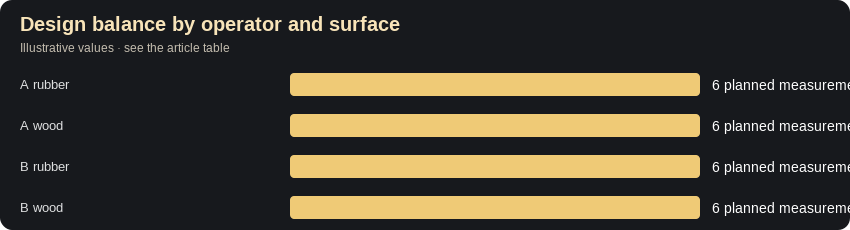
The figure describes a fictional allocation. Its unit is planned measurements, not degrees, devices, operators, or independent playgrounds. The four values are invented and are not an official recommendation about the right sample size. The queued reference to the NIST design-selection section explains the design principle; it is not a source of the numbers.
| Operator and surface | Planned measurements |
|---|---|
| A rubber | 6 |
| A wood | 6 |
| B rubber | 6 |
| B wood | 6 |
There are twenty-four planned measurements in the illustration. Each crew would supply twelve if it completed the plan, and each surface would account for twelve. The four bars show that no crew-and-surface combination is structurally missing. They do not show which patches were used, whether locations were measured more than once, which readings were taken first, or how many could actually be completed. The diagram would have the same heights even if every measurement concerned two poorly chosen patches and a single very unusual afternoon.
A specific field plan can make the distribution clearer. Imagine six blocks, each a close-in-time observation window with one identifiable rubber location and one identifiable wood location. In every block each crew aims to measure both locations. Four intended readings per block produces twenty-four across six blocks. Depending on how the sites were selected, there might still be only six paired location sets, not twenty-four opportunities to infer a new surface contrast. If the exact same pair of spots appeared in all six blocks, there would be six time repetitions of that pair and still only one pair of spots.
This is an advantage of an allocation chart rather than a limitation to conceal. It lets a reviewer check one property of the design at a glance while reserving details of time and place for a different view. Add a second diagram for order or a block table if it matters. Do not crowd the same bars with temperature changes, because counts and degrees answer different questions. If the chart is forwarded on its own, its caption should still explain that the values represent planned fictional measurements.
Choose what counts as a block rather than calling everything a replicate
A block brings together observations that share important conditions. At a playground that may be a pair of nearby patch types sampled within a short window, with geometry and exposure described. The logic is to compare surfaces while conditions that could otherwise dominate the contrast are more stable. “Same site” is too broad if one crew works in the morning and the other starts late in the afternoon. “Same time” may likewise be too broad if the rubber is in bright sun and the wood sits under a roof.
Start with a map before looking for interesting temperatures. Identify the accessible, comparable areas and draw a small sample grid or mark repeatable positions with existing nonintrusive landmarks. Document the boundary of each spot: a painted strip, seam, damp depression, or adjacent metal bracket may not belong to the surface population you meant to compare. If it does belong to your target, keep it and describe it. Select without learning the outcome if the goal is a comparison rather than deliberately finding the hottest point.
Think about which blocks you might have missed. Six playground sessions on six cool overcast afternoons might work if the question names overcast conditions. A more general planning question could require different periods, exposures, or sites. Adding a late measurement to a small convenience sample does not make the sample typical. Even a carefully balanced design must describe how it selected neighborhoods and sites. Randomized order inside a block cannot substitute for representative site selection when the proposed conclusion is site-wide or regional.
The paired design may require compromise. At a real existing site, you may be unable to find both surfaces in both sun and shade. You can measure what is present and present the limitation, or redesign around the subset of conditions with common support. If wood is always shaded and rubber is always exposed there, the material and shade contrast remains unresolved at that site even after crews are crossed. Do not treat the success of crossing one factor as proof there is no confounding left.
Wind, cloud movement, and site activity can affect how much of the plan stays comparable. Record a reason when a pair cannot be completed rather than quietly replacing the inconvenient location with whichever nearby area is easiest. If a planned block becomes inaccessible, specify in advance when to postpone, substitute a preselected block, or stop. Good measurement design includes the failures likely to occur on an ordinary workday, rather than depending on perfect attendance and weather in order to make sense.
Rotate the order or the clock becomes another operator
Suppose both crews follow the new schedule, but they always measure rubber first. Even though the allocation chart stays balanced, the wood measurements now tend to be later. During a warming or cooling interval that can create a systematic difference aligned with material. This problem can occur within a single block, especially when one route is long or when a shade boundary is moving. The primary question specifies timing for a reason: similar labels on a daily calendar do not make two minutes equivalent to two hours.
Counterbalance the first assignment when the site allows it. Within some blocks Crew A begins at rubber and Crew B begins at wood; in other blocks the assignment reverses. Both then swap while still inside the intended comparison window. If measuring truly simultaneously on two surfaces, the teams should still rotate which surface each crew gets first across blocks. If the exact same physical location must be visited one crew at a time, arrange the order so that no operator always arrives first on a given material. The two approaches meet different physical constraints, and the field plan should specify which applies.
Where feasible, randomize the allowed assignments within blocks rather than relying on a neat schedule that inadvertently tracks something else. For instance, alternation can align with a recurring school schedule or recurring days of one crew's maintenance rotation. A predetermined list can be simple: record what tails or heads would assign before arrival and generate the assignments independent of the temperatures. A restricted schedule may be reasonable if you need roughly equal first assignments and must never send two crews to a cramped location at once. Document the restriction; do not describe field order as wholly unconstrained.
Capture actual timing as distinct from intended timing. If the first set of readings takes twice as long as planned, the sequence of four observations is no longer what the block schedule promised. Store the actual time, matched-location ID, and any visible exposure change at observation. Do not reconstruct a reading timestamp from a later file upload or message received at the office. When clocks differ across devices, note the time reference used. A quick check before departure can avoid ambiguity about which crew arrived before the sun went behind a tree.
Avoid another subtle problem: repeated visits can affect the conditions being measured. It matters whether a crew shaded the spot with its body, moved a barrier, or rested something on the target surface just before the next measurement. A noncontact thermometer does not ensure the process itself is noninterfering. A repeat should mean measuring the same target under documented conditions, not making an avoidable change before the next crew arrives. If safe working conditions prevent a suitable position, mark the spot unavailable and do not encourage anyone to contort around an active play area.
What a crew label hides
A crew includes more than the person who records a number. It may bring a device, a setting, a method for deciding which part of a patch qualifies, a recording convention, and an interpretation of the protocol. If Crew A uses device X exclusively and Crew B uses device Y exclusively, a crossed crew allocation creates data to compare their combined measurement chains across the two surfaces. It cannot separate how much of a difference belongs to the people and how much belongs to the devices. Changing terminology to “device adjusted” will not disentangle them.
If diagnosing the measurement chain matters, a small extra crossing can be built into the plan. Have both crews measure common check targets using both instruments under conditions appropriate to those instruments, with instrument identities and actual settings recorded. A check should be defined before the main comparison, including what would count as a concern and what someone will do about disagreement. That is not a substitute for following device documentation. It is a simple way to learn whether an observed disagreement follows the device, the operator, a combination of the two, or none of those patterns clearly.
The NIST/SEMATECH handbook chapter on measurement process characterization provides the underlying distinctions: checking standards and control, calibration, gauge studies, and uncertainty. A field comparison does not need to reproduce every formal procedure in that chapter. It does need to know what each shorthand claim means. A consistent repeat within a crew concerns short-term precision. Agreement between crews concerns a broader part of reproducibility. Agreement against a suitable reference supports an assessment of bias under specified conditions. None of those is automatically demonstrated by a digital display reporting the same number of decimal places for both crews.
Do not ignore the fact that surface measurements depend on the measurement method. With a handheld infrared thermometer, readings can depend on the target's radiative properties, the instrument settings and viewing geometry, and what else falls within its effective measurement area. If the tool sees a mixture of rubber, shadowed wood, and a metal edge, the reading may not be useful for either intended material category. Matching the device setting across operators does not demonstrate that the setting is appropriate for both surfaces. Follow the specific instrument guidance, and where its field application remains uncertain, state the limit and seek a properly validated comparison method.
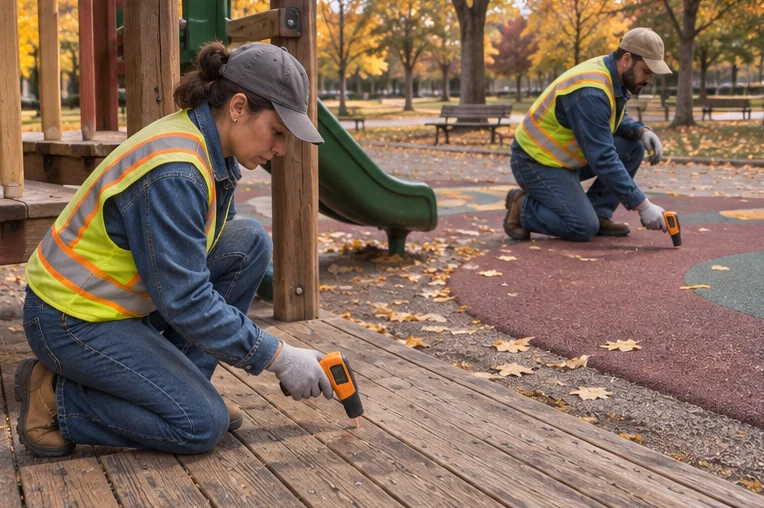
For clarity, agree on what the word wood means here. It could refer to a solid deck board, a coated board, loose wood surfacing, or a surface that includes wood and other materials. Those are not interchangeable targets. Nor is a rubber tile the same category as a composite surface whose visible top layer is a different product. Record the visible target description and avoid attributing a result to general material chemistry from an unknown installation. The hero image illustrates two crews and recognizable surface textures; it is not a photograph of an actual study or a specification of materials.
Make unambiguous recording conventions. Log the observed unit on the instrument rather than trusting a column heading that may have been copied from another survey. If conversion is necessary, keep the original value alongside the conversion. Record repeated trials as repeated trials, with their own order and links to the same target, rather than replacing an unexpected reading with a preferred one. An incorrect value can be voided with a reason, not silently deleted. These conventions make a discrepancy traceable to something ordinary, such as units or a mixed target, before it is treated as an interesting effect.
A narrow practice round can be more valuable than a long route
Run a short practice round before committing the main observations. Its purpose is not to seek the expected difference. Its purpose is to learn whether two independent crews can locate the same target, interpret the method consistently, complete a pair within the intended window, and record what changed. Ask each team to reconstruct the other team's route using only the field map and instructions. A location label that sounds precise to its author can still be unusable to the person checking the other side of the playground.
When reviewing the practice notes, look first at reasons for disagreement about target definition. On repeat, is the second crew using a similar portion of the same surface? Is a patch narrow enough that the measurement footprint consistently strays onto another object? Did the two teams interpret “dry” in the same way when the top looked dry but a nearby seam was wet? The response may call for a more specific instruction, a different observation position, or removal of a category that cannot be measured the intended way. Those are decisions to make before the main results rather than after seeing which choice moves the estimate.
Use the practice round to test a recovery plan as well. Suppose the team arrives and finds that one patch is busy. It can wait outside the area for a short agreed period, move to a prelisted pair, or omit that block. Which choice is appropriate depends on time and the sampling plan. What should not happen is to watch a crew substitute an unpaired surface because it looks convenient and count the result as though it belonged to the original pair. Write an exception code that records the reason, so an analyst can tell a late reading from a change to the target and neither from a device failure.
A rehearsal may uncover a real tradeoff. To keep the two measurements close in time, the crew may need fewer spots per block. To collect more representative locations, it may need more days rather than a longer session. The joint plan is judged by how well it answers the question given real limits, not by how many rows can be added. If the purpose is a quick local inspection, a few clearly paired observations and an honest caveat can be more useful than pushing through a crowded route just to preserve a sample size imagined in an office.
Analyze inside the comparisons the design actually created
Start the analysis with an audit of the allocation, not the outcome. Make two tables, one for planned counts and one for valid completed counts, by crew and material. Then do the same by block and time or exposure stratum when those factors matter. Equal totals at the top level can hide a failed pattern underneath. The twenty-four-row illustration could look complete while all of Crew A's usable shade work concerns wood and all of its usable sun work concerns rubber. A second audit within meaningful conditions can expose this.
For a complete block with one reading per crew on each target, subtract the wood reading from the rubber reading for Crew A and do the same for Crew B. If the study construction supports equal weighting of crews, average those within-crew contrasts to describe the paired block. This removes an additive crew offset that shifts both readings by the same amount. It does not remove a difference in how a crew's instrument responds to the two materials. Examining the crew-specific contrasts shows when they differ, a clue that deserves investigation before the contrasts are summarized as equivalent.
Here is a separate numerical example for that distinction; these are fictional temperatures, not the allocation chart. In a block Crew A reads forty-one on rubber and thirty-six on wood. Crew B reads thirty-nine on rubber and thirty-four on wood. Each crew reads a five-degree contrast, consistent with a two-degree difference between their measurement chains in this block. Now imagine Crew B instead reads thirty-seven on rubber and still reads thirty-four on wood. The corresponding three-degree contrast differs from A's five. An additive offset alone cannot describe all four readings in that version. Timing, target choice, instruments and procedure are reasonable things to investigate. The numerical pattern does not itself identify the cause.
The block comparison also gives you a way to notice an effect that matters but is drowned out in a grand average. If the rubber-minus-wood difference is large for exposed locations and small under similar shade, an overall number representing their particular mixture could hide the contrast people care about. Any report of exposure-specific estimates should show their support and avoid elevating a tiny subset of unusually complete observations into a stable property of all installations. Separate descriptive plots are useful if they retain the pairs and make clear what kinds of blocks contributed to each pattern.
Keep the independent units in view when expressing uncertainty. Four readings in one block do not provide four independent samples of the surface contrast. Repeat snapshots at one location do not suddenly provide evidence from additional locations. If several blocks come from the same playground, they may be more similar than blocks from different playgrounds. Uncertainty methods must fit the level at which units vary and were sampled. For a short operational report, showing all paired blocks and their scope may be more defensible than a narrow interval based on a false independence assumption.
Two kinds of missing record require different decisions
An assignment absent from the design is not the same as an assignment that failed in the field. Under the original plan no rubber readings were intended for Crew B, and no wood readings were intended for Crew A. The absence follows from the design and leaves no internal overlap. Under the crossed plan all four combinations were intended. If Crew B's last wood measurement is missing, the field file can still contain observations of that combination elsewhere. The new question becomes whether those observations support a comparison under the same range of conditions, not whether there is no overlap anywhere.
Consider three incidents. A device loses power randomly during transport, a shaded site is inaccessible exactly when school lets out, and glare makes one particular target difficult to measure. Each can leave the same blank cell but offers a different reason to worry about the remaining records. If lost observations mostly reflect a particular exposure condition, their absence changes the set of conditions represented. If omission is connected to which units can be accessed, the report may speak only about accessible locations. If a device malfunctions, all observations linked to it during the affected window may need review, not just the row where it stopped producing a reading.
Avoid defaulting to a rule that all incomplete blocks are worthless or that every one is usable. With a missing fourth reading, one crew may still have a valid rubber-minus-wood comparison within the block; the other may not. The block could contribute to some descriptive summaries but not to a paired comparison of the crews. Predefine those roles. When complete blocks become a small subset of the plan, show what was lost and consider whether the original question still makes sense. A report should not preserve identical table shapes at the expense of disclosing why the estimates changed.
There is a valuable kind of repair that is not numerical. If a comparison remains important and the original conditions recur, send both crews back for a short confirmatory round measuring both surfaces, not just the neglected combination that would make the cumulative bar heights match. That can create observable links within the new conditions. Keep the rounds visible, especially if the protocol or time window changed. A new balanced round can speak directly to the narrowed question even when the old observations have to stay descriptive.
What the supervisor should be able to reconstruct
At the end of the day, give a supervisor the field plan and one line from the table. They should be able to tell which block and target the reading came from, why it met the inclusion rule, which crew and instrument produced it, and what happened before and after it. If a photograph was collected, it should document the target without identifying bystanders or showing private details that are irrelevant to the measurements. If the field map is approximate, say so and explain what would allow a return to the same location.
Reviewing the work should not require reading temperatures to infer which row was supposed to be rubber. Category names should refer to the documented target, not to outcome patterns. A suspected swapped label should be flagged and checked against the route log, photographs if available, or other original notes. It should not be quietly corrected because one reading falls closer to the expected hotter category. That practice makes the result circular: the apparent pattern tells you which records to keep, and the kept records then demonstrate the apparent pattern.
The team should also agree on a version policy. Save the original readings, preserve any manually entered change with a reason, and make a separate summary derived from the accepted records. Label the units and sign of contrasts on that summary. A column named “difference” often gets copied into a deck without the line that explains which value was subtracted. A header such as rubber minus wood, with its temperature unit, remains intelligible after a screenshot. Similarly, a spreadsheet identifier should distinguish two shared targets from two superficially similar patches on opposite sides of the site.
The most helpful final report includes enough information that a reasonable reader can disagree productively. If someone thinks a result comes from shade, the report should show whether there were comparable shaded and exposed blocks. If someone suspects the device, it should describe which instruments moved between crews and what the check found. If a patch is unusual, the report should let others see how it affected the descriptive results. This is more useful than issuing a single temperature difference followed by caveats no one can tie to a row.
Use the right answer for the right decision
A crossed crew design strengthens a comparison when biased allocation was one of the main threats. It does not translate a surface reading into a safety conclusion on its own. A brief site comparison may inform where to make additional observations or which installation detail warrants attention. It does not measure an individual's actual contact, establish a hazard threshold, or replace assessment by the organization responsible for the site. Keep any such decision separate from the question of whether the two teams produced reasonably comparable data.
There is also a useful result that does not settle the material question. Suppose the crossed field round shows persistent disagreement between crews measuring nominally identical targets. That result redirects effort toward the measurement process before more locations are added. The next question might be about the instrument pair, target definitions, or the order of the route. The crossed design is valuable precisely because this problem is visible. Under the original split the disagreement would simply have joined the apparent material difference without announcing itself.
When choosing a follow-up, assign its budget to the uncertainty you actually need to reduce. Repeated readings at the same target primarily add information about measurement consistency under that target's conditions. New locations bring information about how the comparison varies over the playground. New sites are more useful if the real question concerns a range of installations. Adding another qualified crew can expose differences in how written instructions are interpreted. These resources are not substitutes merely because each brings the same number of new rows. A second wave should say which uncertainty it targets and leave enough overlap with the first wave to tell whether it answered that question.
Likewise, crews can agree well without telling you that material was the cause of a local difference. If they both reproduce a high reading on an exposed patch, the repeated observation may be credible even though the reason for it remains unresolved. If the design provides no comparable shaded rubber and exposed wood, that limitation belongs in the result. Report the useful observation and resist treating the phrases “repeatable reading,” “credible local contrast,” and “identified material effect” as synonyms. Each requires a different layer of evidence.
If a team only has time for one improvement, crossing operator and surface is a good starting point when the initial split gives each crew just one material. Make that crossover a real comparison rather than a checkbox: close timing, mapped locations, consistent procedure, and a plan if the circuit fails. Then audit whether the design survived contact with the field. An adjustment can account for measured differences when the observations provide overlap. The schedule is what creates the overlap in the first place. Give both crews both kinds of surface, and give the final number only the claim those observations can support.