| Category | Value (millimeters) |
|---|---|
| Flower A | 3 |
| Flower B | 7 |
| Flower C | 11 |
Illustrative values, not sourced observations. Fictional measurements; no biological threshold inferred.
Hold a ruler beside a tubular flower and you can put a number on the mouth. Hold still a little longer and you may see a bee approach it. Those are two different observations. A ruler tells you whether an entrance looks narrow or broad under a stated definition. A visitor tells you how one animal used, or did not use, one flower on one occasion. Linking the observations takes care. The bees in the bed are not tiny ball bearings: they can approach from different angles, reach with a mouthpart or travel by a route you did not expect. The petals are not rigid plumbing either.
Corolla means the petals taken together. In some flowers a tube is visible with a definable entrance; in others the petals form an open cup, lip or irregular opening. Width in this article refers to a specified inner span at the opening, not the full flower across its lobes, the depth to nectar or the room available farther inside. A person who measures width from a photograph should be able to show the endpoints and the local scale. A person who predicts access should specify what part of the visitor would have to go through the opening. A visitor list requires actual observation, including the possibility that no one comes while you watch.
The goal is a practical exercise in making these claims separately. You can do it on a small group of easily reached blossoms without picking them, touching insects or rearranging habitat. Take measurement photographs that another reader can audit, mark the occasions when a dimension cannot be recovered and then make a watch plan. Appearance becomes a hypothesis about routes of access. It does not become a substitute for testing how the flowers are used.
Set landmarks before looking for a difference
Imagine a flower shaped like a trumpet. A blue flare spreads to either side of a smaller opening that leads inward. Putting the ruler between the tips of that flare will produce a perfectly repeatable description of display width if you always do it the same way. It will not produce the size of the entrance. Begin by drawing the two edges of the opening you mean. Specify whether you are tracing the inside or the outside boundary of the petals. If two lips overlap or you cannot see the true edge from the front, record the ambiguity. A precise ruler does not cure a vague definition.
For a clearly oriented, roughly oval entrance, record width and height along agreed axes. If a flower lacks a natural horizontal axis, choose an explicit convention, such as the longest visible inner span and its perpendicular through the midpoint, and keep it consistent. A maximum span around a notch is not a universal measure of fit. A short span or an obstruction can be decisive for a particular direction of approach. A useful record carries both the dimension and a short description of the shape. This helps avoid treating a round seven millimeter opening as equivalent to a long slit of the same measured width.
The inner continuation matters. Imagine two funnels with equal mouths. One tapers gently toward a deposit of nectar; the other narrows immediately behind the opening. The same head might fit the front of both while only a tongue fits deeper into the second. You can note a constriction visible in a side view without treating the front measurement as if it described the entire tube. If the narrow point cannot be observed without damaging a plant, leave it unknown. A field demonstration can often answer a narrower question about the visible entrance without being converted into a destructive survey of the whole flower.
An evolutionary study of floral form, Within-species floral evolution reveals convergence in adaptive walks during incipient pollinator shift, illustrates why investigators characterize several traits separately, including display dimensions, tube length and entrance dimensions. Its measurement distinctions are useful for this exercise; its findings do not supply a universal visitor threshold for a different plant. Choose dimensions to describe the specimen and the question you actually have. You are not obligated to imitate a complete research protocol to show the difference between a wide display and a wide opening.
Think also about which stage is being measured. An opening can look different in a newly opened flower, a mature flower and one closing or wilting. Plan your sampling of open flowers rather than filling a spreadsheet in whatever order yields the most dramatic widths. Record a stage label using observable features appropriate to the plant, with an uncertain value when needed. If a flower visibly changes between measurement and watch, that is relevant information; it is not necessarily a mistake. A measured width has a time as well as a specimen code.
Use a ruler where the camera can make sense of it
Choose a small scale with visible increments. Position it near the flower, alongside rather than across the mouth, and as close as practical to the plane of the intended measurement without touching or bending the petals. A reference farther forward will project larger in the image and tend to make the opening read too small if used as though it were in the same plane. A scale behind the flower will tend to bias the result in the other direction. Separate depth and perspective effects from actual size differences by keeping the arrangement as flat to the camera as the flower permits.
Frame the face using a stable position, aiming the camera as nearly perpendicular to the entrance plane as possible. A ruler sharp in the image does not certify that the flower is front-on. An oblique view may shorten one span and leave another less affected, transforming a nearly circular mouth into an ellipse on screen. Check the outline and use a second image from a sensible view when the opening is tilted or its plane is difficult to identify. If the two views answer different questions, keep them as distinct views rather than averaging incompatible widths.
Avoid using a ruler in one photograph to scale a flower in another unless you have a deliberately controlled setup that preserves scale and can demonstrate it. Phone cameras can switch lenses, adjust cropping or generate macro images at different working distances. A copied image can be resized at export. Even on a tripod, the same number of pixels does not always represent the same length in a scene that moves. The scale belongs in the actual measurement frame. Preserve the original photograph, particularly if you make a presentation crop that cuts away the evidence for calibration.
Check the background and exposure. White inner edges can be lost against bright sky; dark folds can merge into shadow. Sharpness at the ruler ticks and at the flower boundary needs to be adequate for both ends of the measurement. Avoid pressing the plant into a new shape merely to make a clean photograph. You can take several properly oriented frames when a breeze intermittently steadies, but select the measurement frame by criteria such as visible edges and scale placement. Do not choose the frame only because it gives the value you expected.
Keep the reference and flower relatively close in the frame and away from badly distorted edges. For a simple educational watch, this is often more informative than trusting that a camera app corrected a complex scene. A lens and mounting arrangement that worked well on a wide opening may not resolve a three millimeter span usefully. Test the lower end of the practical range before committing the whole project to one setup. There is no scientific requirement to make an unreadable specimen yield a number. A record can say that the flower was observed but the opening was not measurable with the chosen setup.
Convert pixels to millimeters without overpromising precision
Use two known reference ticks and record the interval they represent. If a ten millimeter region spans two hundred pixels in a particular image, there are twenty pixels per millimeter in that neighborhood and plane under the chosen approximation. An entrance spanning one hundred forty pixels would then give seven millimeters in that image. This is a fictional arithmetic example. It does not mean the measured width is known exactly or that the calibration applies everywhere in the picture. Keep the actual span of reference ticks visible so a reader can repeat the calculation rather than relying on your attached label.
Moving a cursor a pixel is not the only source of uncertainty. If each petal boundary is diffuse over several pixels, two careful readers may choose different locations. If the apparent scale varies with the depth of a curved petal edge, a single conversion assumes nearer and farther landmarks can be treated as if they sit in one plane. Handheld movement can obscure the true edge in a way no software can reverse. Test how sensitive the answer is to plausible endpoint choices. When those choices change a dimension by more than a tenth of a millimeter, reporting three decimal places is a display choice, not a gain in evidence.
Separate repeating the digitization from repeating the photograph. Two people marking the same image can reveal whether the landmarks are clear and whether the scale calculation is consistent. They do not reveal how much a different camera angle shifts the result. Taking the same open flower twice with an independently repositioned reference can reveal problems with the setup, provided the flower has not appreciably moved or changed between frames. Those repeats estimate process variation, not variation among flowers. Do not count them as new biological specimens.
Record your rounding rule and retain more precise internal values only as needed to reproduce calculations. For an informal survey a whole millimeter may be plenty if the policy treats measurements near a boundary as uncertain. Comparing two flowers that differ by less than the practical resolution deserves a note rather than a ranking. A useful example report might say that one face was around seven millimeters wide with repeat readings close to that value, but its height could not be recovered because a fold was obscured. Honest asymmetry in what you know is more useful than a complete table of guesses.
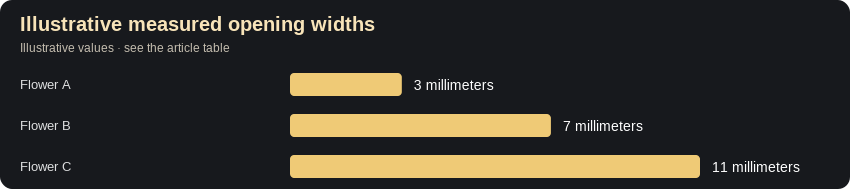
Illustrative measured opening widths
The bar chart and table use invented numbers for three hypothetical individual flowers. The bars are widths at a defined entrance, in millimeters. They are not source measurements, species averages, access categories or biological thresholds. The designations A, B and C are neutral labels, not identifications.
| Example flower | Opening width (millimeters) |
|---|---|
| Flower A | 3 |
| Flower B | 7 |
| Flower C | 11 |
The differences are four millimeters from A to B, four from B to C and eight from A to C. That describes the numbers, not the separation among pollinator groups. A three millimeter mouth may be probed by a slender mouthpart while a much wider flower has rewards out of reach. There is no basis for saying that C is more visited, more accessible by any route to every animal, or better pollinated than A. Nor does the chart convey an uncertainty interval or variation within one flower type. It displays one number per fictional example so the dimension can be understood without attaching a visitor story to it.
If you replace these values with field records, keep the sampling unit in view. A bar could show the width of one blossom, the median of several flowers or the average across plants, and those are different summaries even if they return the same height. When the sample is small, show individual measurements with the plant codes or describe the range. Report why any records could not be measured. A chart showing only the cleanest unobstructed openings can make a garden look more uniform than it is if the awkward examples are systematically different.
Predict an action rather than naming a pollinator
A useful accessibility statement says what would have to happen for a resource to be reached. If nectar is deep and a visitor does not enter the mouth, it may need a sufficiently long and appropriately shaped mouthpart to reach that location. If the visitor must insert its head, the relevant cross section and orientation become important. A leaf-side puncture or natural opening may allow access that bypasses the entrance entirely. A prediction can be specific about a route while remaining agnostic about the species that will try it.
Use broad descriptions when that fits the evidence. A visitor may have a visually slender proboscis or may have been seen pushing part of its head into a flower. Those are useful records when you cannot identify it taxonomically. The identification should not come from how the flower looks. The USDA Forest Service pollination brochure discusses groups of visitors and characteristic flower traits. Such associations can orient a naturalist's attention, but treating them as a checklist of the animals a particular plant must receive would use them for a purpose a watch has not tested.
Some flowers are flexible enough for an animal to change the entrance as it uses it. Do not compare a static width to the size of a visitor as though the width were that of a fixed metal hole. If an animal pushes against a lip, you can record that motion without trying to infer the force. If the corolla shifts in the wind or closes on a colder afternoon, record its state. A model built around a stable opening is most persuasive while the opening is actually stable. For some plants a visitor's handling behavior is one reason the geometry needs context rather than an excuse to ignore it.
The reward must be specified too. Entry into the mouth may matter for reaching nectar while pollen is presented somewhere else. Some visitors may come to collect pollen and never reach the nectar. Others may perch or inspect without a visible resource interaction. If you cannot observe which resource was acquired, separate the visible act from the presumed motive. You can have a high quality record of a visitor inserting its mouthparts with no claim that it drank. This is especially valuable when a narrow tube hides everything but the first movement.
Schedule a watch for the plants you measured
Use codes that are recognizable without approaching the flower again. A sketch showing a branch, a nearby path and a pair of distinctive neighboring leaves can be sufficient in a small garden. If you need tags, use them only with the site manager's approval and place them where they will not cover the flower, alter the stem's position or invite visitors to step into the bed. Record when the specimen was photographed and when it was watched. If the stem disappears after maintenance or the flower closes, retain its measurement but mark why there is no visitation observation for that session.
Set a fixed interval and decide which flowers are in view before the timer starts. An eight-minute watch of one unobstructed flower and an eight-minute watch of six overlapping flowers cannot be compared without regard for different opportunities. You could watch one specified target at a time or define a set small enough for one observer to see reliably. If you use a video setup, make sure the planned field of view can capture the event types you intend to score. Footage that shows a landing on a broad lobe may not resolve what happened inside the entrance. In that situation the visit is observable while the access route remains unknown.
Set a rule for switching observations. For example, on each visit to the site, alternate whether you begin with the first or second plant in a pair, and wait a similar time between recordings and watches. A consistent schedule does not make the flowers identical, but it can prevent every narrow flower from being observed in cooler shade and every broad flower in the first afternoon sun. If a party passes between you and the bed, note the missed interval. Treat an unobserved minute as lost effort rather than describing it as a minute with no visitors.
Record weather and other context only to the precision you can support. A rough flag for breeze, calm or gusts can be sufficient for a teaching exercise. Watch for a flower becoming hard to see every time its stalk swings, since this affects detection and can also affect handling. Write whether the observation concerns sunlit flowers, intermittent shade, or a persistently shaded part of a bed. After a few sessions, those details can explain why the record is sparse without implying that the animals refused the flowers for a reason related to width.
The Forest Service's native plant garden guide provides context about gardens supporting different groups of flower visitors. It is a reminder to leave space in the field form for flies, beetles, bees or visitors you could not classify rather than assuming the only relevant observations are the most familiar bees. You can work at a coarse taxonomic level provided the labels match what you can identify. A valid statement about broad categories is preferable to a database full of confidently named insects inferred solely from where they landed.
Give each event a description that can be scored twice
A visitor may approach and then fly away without contact. That is an event, if you had already chosen a rule for which approaches count. It is not a visit under a contact-only rule. Another visitor may land on a petal but never reach the mouth. A third may probe in the opening and leave with no visible indication of resource use. Keeping those rows distinguishable makes later summaries possible. If the form provides only a place to say that a bee visited, do not expect to recover which of these events occurred later.
What if a bee enters the mouth from the side and a petal blocks the view? You can write that the bee's head was visible at the entrance, that the opening then obscured it and that its depth of entry could not be determined. An uncertain outcome is not the same as a failed attempt. Similarly, an animal landing outside the mouth may be able to forage regardless of whether you could tell how. The note should be useful to a second observer reviewing the same scene, who may otherwise be tempted to fill in the missing action from their experience of similar flowers.
Avoid counting repeated frames or movements within one sustained event as separate visits. Decide what visibly terminates a visit, such as leaving the designated floral unit, and what constitutes a new one. Alternation between flowers on a single branch can produce many observations without involving a new individual. If the same recognizable bee returns seconds later, it may contribute a separate visit under the event rule, but that does not turn the visit count into a count of distinct animals. State whether you are comparing events, flowers on which a route was observed, or plant individuals. Each denominator answers something else.
If someone can review a few recordings, show them the scoring rules without telling them which dimensions you expected to matter. Ask them to mark uncertainty, not just agreement. You might discover that two people consistently agree about petal contact but disagree about entry depth. Simplify the latter category or change the camera angle on a future watch rather than forcing an agreement from ambiguous evidence. A discrepancy between scorers can teach you more about measurement limits than a perfectly consistent record built by one person applying an unspoken rule.
Examine the flowers that did not fit the story
Imagine that the broadest flower attracts many approaches and that several animals position themselves near the mouth. Yet the only unambiguous probing of a deep reward occurs at the smallest opening. Before calling that contradictory, return to the geometry and the question. You might have measured an outside lip on the largest flower, or watched it from an angle that hid the relevant behavior. You might have found that a narrow mouth admitted a slender mouthpart while a wide but very deep tube had a reward the visible animals could not reach. These are competing explanations, not a list of outcomes your data automatically establish.
Conversely, suppose no visits were observed at a narrow flower even though a similar small flower nearby was busy. The width alone does not tell you what discouraged visitors. Flower age, past reward removal, field of view, neighborhood bloom or time of day could be relevant. Check whether your sample was inadvertently chosen from flowers that were easy to frame rather than from the blossoms being used. If opening width changed before the watch, compare current state before interpreting the earlier photograph. You may find that the effect you thought belonged to a dimension actually belonged to sampling.
Do not confuse comparing within one plant type with comparing across species. A study of widths among flowers of the same kind can help keep some features more similar, but width may still track stage, location, height or a shared condition on one plant. A study across several species can pair very different colors, scents, rewards and times of bloom with the different widths. It can show an association in the garden you measured without isolating the cause. Label the scope and choose replicate plants rather than relying on several blossoms from one individual as though all of them were independent examples of a species.
Guard against a category boundary that moves when results disappoint. If you called widths narrow or wide by rules agreed before the watch, do not silently change the cut after seeing an interesting visitor. Better still, retain the numbers and indicate whether any bins are simply for display. When adjacent measured values are close relative to image uncertainty, keep the possibility that their order could be reversed. An appealing division on a graph is not necessarily a barrier an animal encounters. Tell the reader which observed routes can establish evidence of access and which categories only describe geometry.
Work through two records before comparing the whole bed
Consider a fictional pair. A tubular plant in the open has three flowers in frame. All are open, but only two have clear inner margins and a scale at the necessary plane. The two measured widths are six and eight millimeters. The third flower faces away so its width is not available. During a fixed watch you can track the visits to every flower, including the one that could not be measured. Every contact can contribute to a summary of activity on that plant. A comparison involving opening width, however, has to leave out the unknown width or report it separately. Assigning it the mean of the other faces would conceal the very reason it is missing.
At the second plant, a breeze lets you photograph two stable moments when one flexible mouth looks different. One image has a bent ruler and the other has a clear scale along the entrance plane. First distinguish why the records differ. The bent ruler is a quality problem if its marks or plane cannot be used. But a mouth changing its shape as the stalk moves may be a real condition of the watch. Choose whether you are characterizing a standard viewing state or describing movement under field conditions. One measurement can represent the former without representing all possible exposed states during the watch.
You now have a small comparison in which the best visible preparation did not yield the most complete width and visitation dataset. That is the expected state of many low-cost observations. Make a narrow table of usability: which observations can be included in the geometry analysis, which in the visitation analysis, and which in the comparison requiring both. If the overlap is small, that is a concrete reason to plan fewer plants and better views next time. A missing-data code gives the redesign something to work with; a number borrowed from another flower does not.
Distinguish opportunities, attempts and outcomes
Suppose an observer wants to compare the proportion of attempts ending in apparent insertion rather than the raw number of insertions. The denominator now needs a defined attempt. A spectator might call any slow flight over the display an attempt. A stricter protocol might require visible alignment of the mouthparts near the entrance. The same flight could therefore contribute to the first ratio but not the second. The interpretation belongs next to the definition: the strict version says what happened after an observable close positioning, not what happened to every animal that noticed the flower.
At equal timed effort, a flower that receives thirty approaches may supply more insertion events than one that receives three, even if insertion is much less frequent among attempts. Show both quantities if the distinction matters. If you just want to know whether a route occurred, one confirmed example may suffice to document it under those circumstances. Estimating how common it is requires more opportunities, and a claim that it never occurs requires stronger evidence than an empty watch. Notice how each question asks for a different record even though the visual behavior is the same.
Changes in the flower during the watch complicate the denominator. An opening that folds shut for half the interval is not available in its measured open state for the entire time. You can report observation duration and separately indicate when the relevant entrance was visibly open. Avoid assuming that simply dividing by those minutes corrects for everything: the time when it was closed might also have coincided with weather, visitor activity or a disturbance. The useful result might be a record of state changes and visits rather than a single favorite rate.
Design a second round that tests a chosen idea
Decide what you learned from the first watch before changing the setup. If the interesting pattern is a difference in probing within one plant type, sample multiple individuals and note stage and height under a shared definition. If the interesting pattern is that narrow flowers invited exterior handling, plan a viewing angle that can distinguish the outer surface from the entrance. Do not import a complex experiment merely because you now have credible photographs. A second observation that is capable of discriminating between two plausible behaviors may be all you need.
Label comparisons involving dimensions other than width. A new side view might measure visible tube length along an approximation of the central axis. A bent tube does not necessarily have a straight path to its lowest visible point; a straight-line measurement should say it is a straight line. A second photograph that shows an internal obstruction might be more useful than a more precise opening measurement. If the relevant path cannot be seen, avoid using the difference between two exterior dimensions as though it gave the depth to the reward. You can document anatomy honestly without giving it a precision the photograph lacks.
When several patterns show up, protect the distinction between discovery and a planned comparison. If you had no expectation about petal color, then noticed one temporarily favored color during a late watch, put it in the notes as a hypothesis. At the next watch, choose comparable flowers and timing before collecting observations. Do not describe the first observation as though it tested a plan not yet conceived. This is especially important in a garden with many colors, widths and visitor groups; some grouping is likely to look compelling just because you had many to choose from.
Finally, keep the purpose in sight. A garden educator may only need a few photographs showing that a lobe span and an entrance span are different measures, plus a watch illustrating that diverse animals can use flowers. A gardener deciding among plantings may want repeated local observations through the bloom period and guidance on suitable native plants, not a ranking by one measurement. Neither purpose benefits from turning illustrative widths into universal biological thresholds. The better result is a modest comparison that the next person can repeat on a real flower, alongside a clear record of what was actually seen.
Know how far the conclusion can travel
Successful entry, acquiring a reward and moving pollen to a receptive flower are different events. Even seeing contact between an insect and a reproductive structure may not establish how much pollen was deposited or whether the same individual later contacted another flower. If your study records approaches and entry positions only, say so. It can still be useful for deciding how to explain flower structures to visitors or where to place a future camera. Calling every observed visitor an effective pollinator would be replacing an unmeasured outcome with an attractive label.
Think of a display board for the garden. It might pair a scale photograph with a second illustration showing several possible routes to a resource. Give the images different captions: the first has a named landmark and a recorded width, and the second shows candidate actions rather than direct evidence. Then put a small field tally nearby that says which actions were actually seen, with watch effort and an explanation of uncertain views. This format is stronger than putting silhouettes of predicted insects beside each bar, which encourages readers to assume size alone determined exactly who visited.
If you want to carry results to another garden, carry the method before carrying the observed proportions. Plants of the same named kind can be in different stages, observers can see from very different positions and the visiting animals may not be the same. A narrow entrance that hosted one kind of behavior at one site is a good prompt for a paired watch at the other, not a promise about what you'll see. A reusable dataset includes measurement rules, conditions and limits, not just a stack of records with a numeric width and a visitor name.
Return to the simplest useful sentence: this opening had this visible span, measured in this plane on this occasion. Then add a second sentence describing a thing an animal was actually observed doing or a prediction you intend to test. If neither is supported, leave it out. You can still draw a picture worth looking at, tell readers what features to notice and help the next observer make a better record. Treating a measurement as a measurement gives both the flower and the visitor a chance to surprise you.
A useful archive gives comparable perspectives different names. The front view is the image from which width was derived; the context view shows where a subject sits in the bed; the behavior clip records what an animal did. One file need not do all three jobs. When an identification changes, keep the specimen code, time and measurement intact and update the name with a short explanation. That way a reader can revisit a conclusion about plant identity without losing a valid record of the opening or an observation whose taxonomic scope was stated cautiously from the start. This also keeps illustrations from being mistaken for unmeasured views of the specimen.
Sources and illustration note
- USDA Forest Service: The Simple Truth, an introduction to pollination and characteristic traits.
- USDA Forest Service: Attracting Pollinators to Your Garden Using Native Plants, native garden and visitor context.
- Within-species floral evolution reveals convergence in adaptive walks during incipient pollinator shift, original research distinguishing multiple floral measurements.
All plotted measurements are fictional. Any generated hero image is an editorial illustration, not a scaled measurement, species record or photograph of this exercise.