| Category | Value (contacts) |
|---|---|
| Head | 5 |
| Back | 8 |
| Side | 4 |
| Unresolved | 3 |
Illustrative values, not sourced observations. Contacts are hypothetical and no plant reproductive outcomes were measured.
A bee enters a flower, dips its head, and backs out. On the way out, its upper thorax appears to brush a projecting anther. The observation is interesting even if we never learn what happened to a single grain. We can name the structures that appeared to meet, record the direction of travel, and say whether the contact was on entry or exit. We cannot tell from the encounter alone whether pollen left that anther, stuck to the insect, survived grooming, reached a compatible stigma, or contributed to a seed. Those are separate events. The point of describing contact geometry is to make the visible part of the story useful without filling in the invisible part.
Imagine two photographs from a garden. In one, an insect is deep in a narrow bloom, so close to the camera that its outstretched rear legs are sharp while its head and the center of the flower are hidden. In another, the whole insect is visible from the side, the anther is sharply outlined, and there is clean space between it and the insect. The first is an engaging portrait but weak evidence about head contact. The second may support a better negative observation for that particular instant. Neither tells us what happened a tenth of a second earlier. Use even the best picture to answer a question its angle and timing can actually resolve.
This guide concerns ordinary, noninvasive field observation. It is not a scheme for identifying pollinators by looking at flowers, assigning conservation value to insect groups, or estimating reproductive yield. The workflow is designed for a student with a phone, a garden volunteer with a notebook, or a naturalist who wants records that another person can interpret. Those uses benefit from a description that is plain enough to write in the field and specific enough that a second viewer could disagree with it for a reason.
What actually meets what?
Start at the flower rather than the list of possible insects. Petals form the corolla in flowers that have a differentiated corolla. The anther is the pollen-bearing part of a stamen. The stigma is the surface that receives pollen. There may be other structures that guide, support, conceal, or obstruct a visitor. A conspicuous petal edge can be confidently identified in a clip in which the much smaller reproductive structures cannot. Contact with the petal is a real observation but a different one. If the plant or angle prevents identification, record a visible structure as unidentified instead of choosing the organ that best suits the expected story.
Several visually similar encounters might mean different things. An insect may stand on a lower petal as it faces the flower's center without brushing any reproductive structures in view. Its upper thorax might meet a projecting anther as it moves forward. A stigma could touch its head only when it pivots to leave. The insect might use the same exit route on another visit, but at an angle that puts the wing rather than the thorax in the path of the structure. Notes such as “bee on flower” capture the first fact common to all these encounters, but discard everything useful about the distinctions.
A reference drawing helps when a flower is difficult to describe. Sketch its opening, the visible positions of the relevant reproductive structures, and a landmark such as an asymmetrical petal. This does not have to be finished artwork. The purpose is to make “above the opening,” “left of the projecting anther in the camera view,” and “along the outer wall” refer to something stable. If the flower moves in a breeze, structures should retain their names and relative places in the sketch. Do not redraw a moving flower as if its screen coordinates were its anatomy.
The flower can sometimes make a meaningful boundary hard to define. What looks like one broad landing surface may be an inflorescence with many small individual flowers, each presenting its own possible point of contact. Define whether the unit in your notes is the whole head or an identifiable floret before counting. A visitor that walks over five parts of one head might represent one arrival and five local interactions; neither convention is inherently better, but silently alternating between them makes the resulting counts meaningless. When florets cannot be distinguished in the image, keep the unit at the level you can reliably see.
Use three coordinate systems explicitly. Camera coordinates describe what appears on the screen. Flower coordinates describe orientation relative to the opening or a physical landmark. Insect coordinates describe the visitor's anatomical surface. “Right” could mean any of these. If a bee turns, the body surface facing camera right might switch from side to back while the camera does not move. “Visitor's lateral thorax brushes anther during withdrawal toward the opening” is more reusable than “right side touched.” A very short annotation can carry the same information: side, anther, withdrawal, lateral view.
The USDA Forest Service pollination brochure is useful for learning how flower traits suggest which animals might visit and what they might do there. Apply those patterns as hypotheses, not labels: a tubular shape gives you a reason to watch how visitors approach its opening, not permission to identify a visitor from the tube alone. The agency's native-plant garden guide provides practical garden context and describes multiple groups of flower visitors. In an observation log, start with the visitor actually seen, and retain broad identities when the footage does not support more.
Separate the links in the chain
The first link is arrival. There is a visitor present at a stated flower or floral unit. The next is physical contact with a stated structure. The next is pollen removal from a donor, which requires different evidence. Then there is pollen retention on a particular body region. Then there is contact with a recipient's stigma, possible deposition, and finally potentially biological consequences such as germination, fertilization, or seed production. Although the sequence is natural to tell as a story, it does not have to proceed smoothly. A good field note makes it possible to stop the story where the evidence stops.
A meaningful mechanical question is where a donor structure contacts one visitor and where a recipient structure contacts a comparable visitor. If the sites coincide anatomically, the observations identify a potential route worth checking. They don't demonstrate that a donor preceded a recipient, that either structure was ready at the relevant time, or that appropriate pollen was present. Even a bee conspicuously dusted in something yellow may be carrying material from another plant, or pollen may be concentrated in a different region than the one contacted by the stigma. Describe visible material separately without using it to replace a pollen identification.
The apparent route sometimes fails a first geometric check. In a pair of well-observed visits, the anther touches the dorsal thorax and the stigma touches the underside of the head. Any transfer between those surfaces would need an additional step not shown by the two contacts, or the two observations might represent just two of several routes visitors use. This is more informative than a blanket “pollinates” claim: it suggests watching for alternative postures, a second stigma contact, or other stages of a flower's development. A mismatch is a reason to ask a sharper question, not a reason to declare transfer impossible.
The value of the distinction has been tested using endpoints well past attendance. King, Ballantyne, and Willmer's original study considered pollen deposited on stigmas after individual visits and found why a visitation record alone was an insufficient substitute. It is the study's independent deposition endpoint that earns that interpretation. Our contact notes are not a cheaper measurement of the same endpoint. They answer a narrower question and can be a sensible precursor to a carefully designed study, particularly when you are trying to decide which comparisons deserve the cost of actual deposition measurements.
Another research example shows the network consequence of changing the endpoint. Ballantyne, Baldock, and Willmer examined both visitation and pollen deposition in a heathland plant community. A line connecting an insect and a plant means one thing when the underlying record is a visit and another when it reflects a deposition measure. A garden sketch where lines simply connect seen visitors to flowers is perfectly legitimate if labeled as such. Drawing thicker lines or using an impressive network layout does not transform those lines into verified transfer or ecological benefit.
Sometimes the biological endpoint itself needs interpretation. The presence of pollen on a stigma need not mean that it was deposited by the visitor currently in view. Pollen reaching the stigma need not be pollen able to produce fertilization. A later fruit or set of seeds is an outcome, but by itself cannot identify which visitor caused it or distinguish among several potential routes. As you read research, check what was measured, when it was measured, and what comparison was used. Do not turn the word “effectiveness” into a universal quantity without seeing how the authors defined it.
Make a narrow recording rule before the first visit
For a small exercise, define one contact event as a visually supported meeting between a named reproductive structure and one visitor surface, beginning when they meet and ending when they separate. This is an observation convention, not a biological standard. Keep a short continuous brush as one event rather than giving it a count for every frame. Treat a later clearly separated second touch according to the same rule on every visit. If the two cannot be distinguished because the key frames are missing, mark the interval as ambiguous. A recording rule is successful when it resolves routine cases and exposes the difficult ones without bending to fit them.
Keep a separate visit identifier. One visit may contribute no scored contacts, one, or several. Define its beginning and ending from things that can actually be seen: a visitor enters the framed floral unit and later leaves it, for example. A sudden clip beginning with an insect already embedded in a flower is not a complete visit. You may still describe a visible contact, but you cannot use that partial visit as if it offered a full opportunity to see both approach and exit. A visitor disappearing behind a leaf is not necessarily the same as a visitor leaving the plant.
Decide what you will do at boundaries before counting. Suppose the head and thorax appear to touch in rapid succession, but you cannot see an intervening separation. You can collect both candidate labels in a note, then record a region as unresolved if your chart requires one unique category. If separate contacts really can be distinguished, record separate rows with a shared visit identifier. Build this convention for ease of audit, not to favor the most common expected region. If legs, wings, or underside contacts appear often, track them explicitly instead of putting them in a miscellaneous bin because you first expected a sample of bees to use their heads and backs.
Defining a visit does not solve individual identity. Often there is no defensible way to know whether a visitor returning from outside the frame is the same insect. Even a distinctive mark may be hidden when it returns. Call the events separate visits if that is what the introduction and exit criteria say; do not call them separate insects. For repeated activity, preserve the time and plant identifier so a reader can see the concentration. If ten contacts all occurred on one flower within a short interval, the headline cannot plausibly present those records as ten independent demonstrations of a typical behavior.
A concise log keeps the essentials distinct: session and flower ID; visit ID; video timestamp; flower structure; body region; travel direction; contact confidence; and a reason when something is unresolved. Useful supporting fields include visitor identification level, a visible material note, and camera position. A “not assessed” outcome field is often a help, especially when the log is later exported without explanatory prose. The absence of an outcome measurement is not a zero. Nothing in the spreadsheet establishes a lack of transfer unless the relevant outcome was actually measured in a design that could detect it.
Reserve an honest code for contact status. “Clearly seen contact” means the structure and visitor surface can be followed into the meeting without a plausible alternative separation. “Possible contact” means the evidence could fit a touch or a near miss. “No contact seen in this view” means usable observation without claiming hidden surfaces were noncontacting. “Unobservable” means you did not have a useful view for that question. These flags need not be chart categories. They describe a different dimension of the record than body region, and mixing the two leads to claims you cannot reconstruct later.
For example, a visible touch may still have unresolved body region because a blurred wing masks the boundary between the head and thorax. Conversely, a clear view of the insect's head does not necessarily show whether that surface touched a stigma behind it. Two confidence judgments are therefore useful: one for the event and one for the anatomical label. In a small notebook, use a mark for an event passing the contact rule, followed by region or “?” for the anatomical part. The question mark does not wipe out the event; it says what part you could not determine.
Record direction as an observed phase
Direction can turn a contact from a curiosity into a repeatable description. An insect may meet the same structure on entry, during a stationary feeding posture, during a turn, or on exit. Entry and exit should not be inferred from the apparent orientation of the body. An insect can withdraw backward from a flower while still facing inward. If a clip shows only a single frame, position may be visible while direction remains unknown. A useful table lets direction be unknown without dropping the rest of the record.
Start with what the insect moved relative to: toward the opening, away from it, across the opening, or turning in place. For a broad, open flower, choose a recognizable center or fixed landmark rather than imagining a narrow entrance where none exists. A visitor walking over the center then around the edge can produce a direction change without having left the floral unit. Write “across center, then along edge” where a simple in-or-out distinction is not appropriate. The flower's structure should shape the description, not force the same narrative for every bloom.
Do not confuse movement of the organ with movement of the visitor. An anther can shift toward a visitor under the movement of a petal or the flower as a whole. The visitor can lean, rotate, or brace on a surface that bends. If you can see only the separation close, “anther and dorsal surface meet” is safer than an active verb implying which one caused it. A good clip may preserve enough before-and-after context to show a change in posture. A very tight shot that begins at contact is often the wrong clip for deciding its cause.
There is also a difference between direction and force. A visitor pushing against a structure can be visually suggested by deflection or by a change in posture; measured force is a separate quantity. The apparent speed of movement is similarly dependent on camera angle, ordinary playback, and any slow-motion encoding. Record “rapid in normal playback,” or give times only when the clip allows a time comparison, rather than declaring a particular movement strong or fast on the basis of drama. In a field contact study, direction often has greater comparative value and is easier to describe consistently.
How the view changes the evidence
A profile view is a sensible first angle if the goal is to see whether a structure projects into the path of an insect approaching the flower. The image can also be misleading. A petal in the foreground and an insect behind it can occupy the same projected patch of the frame. The second image plane does not encode their depth. Where possible, look for separate outlines before and after the candidate contact and a coherent motion of the involved structures. An apparent overlap that could occur at different depths is not enough. Keep the event possible until the evidence improves rather than promoting it because there are no other angles.
A view from the opening reveals which side of the visitor aligns with an off-center structure. It may hide the inside of a tube precisely when contact becomes likely. A top view sometimes clarifies a lateral approach but can conceal the underside of the head. Choose views for complementary questions. If you record from opposite sides on different days, you have evidence about separate visits rather than a three-dimensional reconstruction of one event. Two synchronized cameras on the same event can help establish order or rule out projection overlap, but clips without matching views should not be fused into a less uncertain record than either permits.
Focus and exposure make some outcomes more observable than others. In sunlight, the broad edge of a petal may be well defined while the small reflective tip of an anther is washed out. In shade, the stigma could disappear into the flower even as the nearby body hairs look sharp. An operator tempted to track the moving insect may take the relevant organ out of the frame. Preview the region that has to stay sharp. A steady view of a chosen flower and its opening may yield fewer dramatic clips but more interpretable encounters than a continuous chase around the garden.
A fixed setup can simplify observation while creating a sampling boundary. Identify not only what is visible, but what you are likely to miss from your fixed position. For example, visitors that move along the outside wall nearest the camera may be easy to classify; ones that go over the far edge become silhouettes behind the opening. If most unresolved visits feature the far route, the missing records are telling you something about coverage. The right fix may be a second viewing angle for the next session rather than simply taking more footage from the first angle.
Let a brief unedited interval surround any highlight you save. A later reviewer can see the approach, establish whether contact is new, and check when separation occurred. A close-up from the middle of a longer session should preserve its original time and visit identifiers. Digital sharpening, interpolation, slow motion, and crops can make a clip easier to watch without making the underlying detail more reliable. Keep the original accessible for disagreement. If a motion effect creates frames that never existed, do not use those invented frames to score the instant at which contact occurred.
The amount of material need not be vast. Start with a short pilot in which you count the number of intervals that can actually answer your question. Take the recordings back indoors before designing a long survey around them. If a pilot shows that the same body region is obscured in almost every clip, adding more hours from the same angle may chiefly reproduce the same limitation. Improving the protocol can matter more than increasing the sample. Keep the pilot separate if you make substantial changes to the scoring rule after reviewing it.
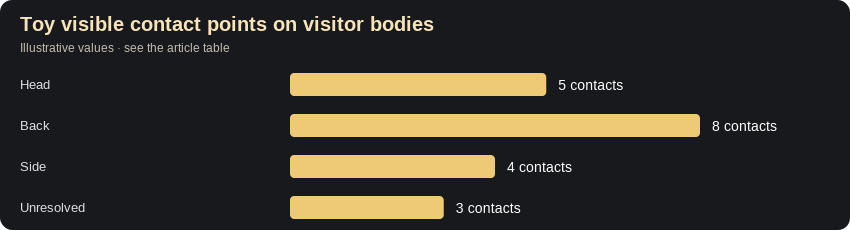
Chart: Toy visible contact points on visitor bodies
The chart and table use invented contact records, not sourced observations. All rows represent hypothetical visible contacts under a simplified recording rule. “Unresolved” means a touch was visible but the body region was not resolved. It does not mean that a visit was observed without any sign of contact. The toy set happens not to contain a separately identified leg, wing, or underside case. A real dataset should not remove those classes merely to resemble the example.
| Body-region category | Contact count |
|---|---|
| Head | 5 |
| Back | 8 |
| Side | 4 |
| Unresolved | 3 |
In this example the bars sum to twenty contacts, with seventeen region assignments and three unresolved records. The Back count is eight of twenty contacts if the statement is about the entire toy set, or eight of seventeen if the statement is specifically about records with resolved body region. Neither fraction is the fraction of visits involving a back contact. That would require the number of visits and the number of distinct visits with at least one back contact. If two back contacts came from one visit, the contact count would rise by two and the visit-level numerator by one.
There is a tempting but unavailable interpretation: eight bars' worth of back contact sounds like evidence that the back is the principal route of plant reproduction. It is not. There is no partition by plant species, organ, direction, visitor identity, or exposure in the example. Perhaps all eight back contacts are anther contacts and none of them involves any observed stigma. Perhaps the camera angle strongly favors the back. Perhaps the three unresolved touches are not region-blind at all, because interactions at the sides are harder to resolve. All of these are compatible with the table.
Use the illustrated values to practice a basic missingness exercise. If all three unresolved touches were later identified as side contacts, the Side count would become seven while Back would stay eight. If all three were identified as head contacts, Head and Back would tie at eight. Those are hypothetical reclassifications, not adjusted estimates. The exercise shows how the treatment of a small number of unresolved records changes the claim one can safely say. It does not estimate how likely either reclassification is. In a real table, audit unresolved reasons before trying to model them.
When reporting a contact count, specify what can get into the denominator. A log of candidate contact snippets is not a survey of all visits. A survey of one flower over short sessions is not a census of the bed. A camera view that excludes the outside of a corolla does not capture every type of floral interaction. The safest caption says what was counted and who or what could have been missed. An attractive graph of a small local record is fine when it is explicit about what it represents; the problem begins when its label substitutes a broad natural-history conclusion for a limited observation.
The unit can also change what makes a useful second figure. A simple region-by-organ cross-tabulation can help a reader look for overlap between donor and recipient contacts. A time strip may explain when different phases occur within a visit. A coverage chart, showing where and when view quality was adequate, may be more useful than either if many records are incomplete. These views answer distinct questions and need their own denominators. Nothing forces all valid records to appear in one picture, but every figure should make its inclusion rule visible.
Work a garden comparison without confusing it with an experiment
Suppose a volunteer wants to compare the approach to two shapes of flower in the same garden. The open design has an obvious place to stand. The other flower has a narrow opening and is approached obliquely. A loosely arranged scene might put the open flowers near a sunny path and the narrower ones under a hedge. If more contact is seen on open flowers, the apparent effect could be geometry, visitor composition, light, observer position, or all four. Rather than declaring the shapes comparable by appearance, give each plant group repeat visits through similar time windows and document what could not be matched.
A focused comparison might ask whether clearly visible approach-phase anther touches are more often dorsal in clips from one type of flower. Keep visitor categories broad where needed, but remember that a change in which animals show up can change the contact profile. Comparing the same broad kind of visitor across plants is often more informative than mixing groups without keeping identities. A broad kind such as a large bee-like insect is still not a species. Within it, shape and behavior may vary. If the available footage is too sparse for a clean comparison, report what each set shows rather than forcing a summary difference.
Write the possible alternatives before comparing counts. An overhead view may expose the back in one flower type more consistently than in the other. An older flower may hold organs differently from a younger one. A previous visitor may change the condition of a bloom or the position of a movable structure. If visitors arrive from different compass directions because the flowers face differently, their trajectories relative to the camera will vary even for visits that are mechanically similar. The alternatives are not just caveats for the last paragraph. Each one can motivate a change in how the next round is recorded.
One of the biggest improvements is distinguishing opportunity from outcome. A volunteer might record ten visits with the necessary structures and visitor surfaces both visible, and seven visits with enough geometry hidden that a touch could not be scored. In a hypothetical comparison of visibility, those seven are evidence about method coverage, not positive or negative contact observations. If your main result is drawn from the ten assessable clips, give the assessable count and preserve the rest as missing for that question. A person trying to repeat the work will know which losses to expect from the camera setup.
Photograph the undisturbed flowers before or after observation, ideally without changing their position. The reference frames make it easier to check structural labels and compare intact flowers to ones that have torn petals, bent stems, or unusual openings. An apparently consistent visitor pattern could depend on a damaged entry route unique to one photographed bloom. That makes it interesting, not representative. Moving petals to get a better view during observation is a different setup and can change the geometry you are trying to document. Keep observation records separate from any demonstration with a repositioned flower.
Record enough diversity of plants and times that a reader can tell whether a pattern travels. If you lack replicates, language can still be precise: “In this recorded session on this flower, several back contacts were visible during exit.” That sentence is not embarrassed about its scope. A stronger generalization needs a broader sampling base. Even repeated sessions from a single patch should not suddenly become a statement about an entire region. Preserve nested identifiers so you can summarize by visit, flower, plant, or site later without pretending every line is an independent sample.
Check disagreement where it matters
Two people can score the same clip differently for legitimate reasons. One reads a brief line disappearance as contact; the other thinks the moving wing masks it. One calls the visible patch “back,” while the other sees the lateral thorax because the visitor is rolled. Give the scores a common vocabulary, compare them without immediate editing, and note which field disagrees. Disagreement about the existence of contact deserves different resolution than disagreement about phase or exact region. Even without a full formal reliability analysis, documenting the disagreements shows whether the label a reader cares about is actually repeatable.
A short calibration set should include clear positives, good near misses, and difficult clips, not just the cleanest images. Review them before applying a settled rule to new material. Keep the uncertainty flags even if the two viewers later agree after discussion. It matters whether an event looked independently clear or was classified only after a lengthy replay. When revisions change how an entire class of events is coded, rescore the earlier clips as well. An updated rubric should not accidentally compare the old liberal rule to a new strict rule.
Avoid telling a second scorer which answer you hope to find before they watch. If the question is about whether a particular group uses its back, that expectation is easy to visually confirm in an ambiguous clip. Give them the structure landmarks and operational definitions, but not the result you are trying to demonstrate. For a personal project where you are the only scorer, separating clip selection from final replay can reduce some of the same pressure. Start from a consecutive set of recorded visits, not a highlight reel assembled after deciding that back contacts look best.
A reusable example note could read: “Focal flower, brief lateral view; visitor backing away from mouth; visible anther meets region near head-thorax boundary; touch clear, body region unresolved; no pollen or reproductive measures.” It contains a surprising amount of information without a species claim, a guess about force, or an outcome. A similar note for a near miss might say: “Visitor turns across opening; anther and lateral surface overlap in image, gap not resolvable; possible only; not entered in visible-contact count.” The difference between those notes can be coded and audited.
Choose claims you would still make without the picture
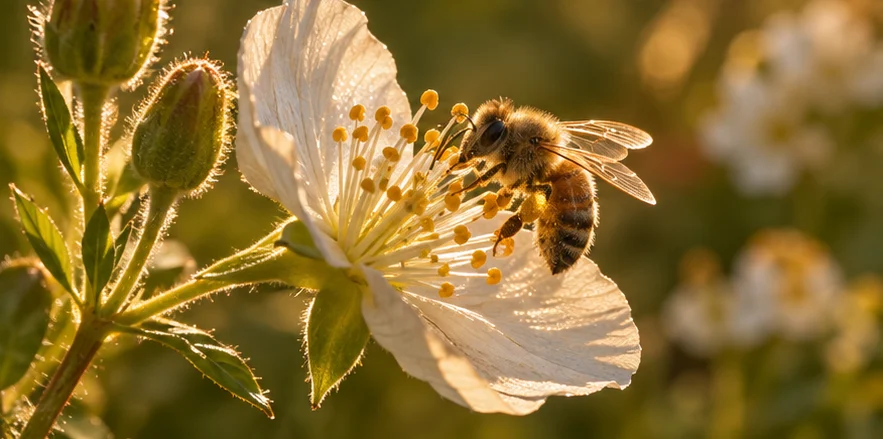
The strongest rule for writing up an observation is to make every important claim survive the loss of the photograph. A good caption notes the view, the observed structures, and the relevant moment; the broader method explains how observations were selected and what was not measured. If an image is an editorial illustration, mark it as illustrative and keep it out of the evidence train. The side-lit bee pictured for this article conveys the idea of a near encounter, but neither its lighting nor the apparent proximity of stamens tells us that a real visitor touched them.
Names in a title and captions can do misleading work long before the methods are read. “Flower visitors in the garden” is not the same as “the garden's pollinators,” and neither should replace a statement about a defined contact. If you use “potential placement,” explain that the phrase means a location suggested by physical contact, not confirmed attachment of grains. If a story genuinely includes independent pollen identification, say which stage that confirms. The new measurement can strengthen one link in the chain without automatically establishing every downstream event.
A handy review question is what would make the statement false. “The bee looked like a pollinator” may be impossible to dispute because it names no event. “On exit, the marked anther touched the dorsal thorax” could be disproved by a side view showing a gap or by a better identification of the organ. That vulnerability is a strength. It gives the next observer something to check and tells a photographer what to capture. The early stages of inquiry are often most productive when notes are designed to make observations easier to challenge, not harder.
This can also help with apparently contradictory anecdotes from the same flower patch. One observer reports that bees usually brush the upper parts of the flowers; another reports frequent lower contacts. Before deciding that one observer was wrong, check which species or broad visitor groups they saw, how they defined a visit, whether they watched the entry or exit, and which surfaces were visible. The two reports might both be accurate descriptions of different parts of the sample. Careful reports preserve enough context to find that out instead of creating a debate over an overly broad headline.
If the goal later shifts to deposition or plant reproduction, say so openly and design a separate study with the appropriate controls and local permissions. A researcher might compare a flower after a known visit to an unvisited control in order to distinguish visitor-associated deposition from background pollen. That would still require knowing which pollen is of interest and interpreting the significance of the observed grains. If the question is about offspring rather than grains, the evaluation changes again. A camera is helpful for associating a visit with an interval; it is not a substitute for tracking what follows.
Finally, keep your sample honest about zeros and missing observations. The researcher who finds no visible contacts from a usable angle has a limited negative result. The observer who loses the relevant surface behind a petal has a gap in observation. The log that ends before a stigma is inspected contains no measurement of deposition. These may sound like small bookkeeping distinctions, but they decide whether a claim can be tested by someone else. Write what touched, where on the body, and which way the visitor moved. If the next step of the biological chain was not measured, put that just as plainly. The contact is already worth describing.