
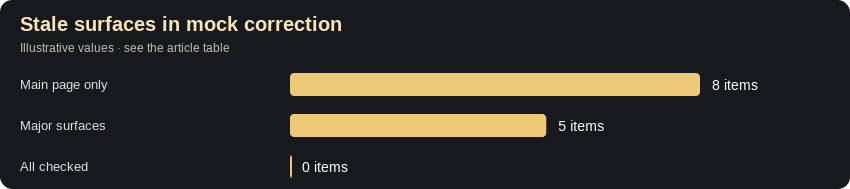
| Category | Value (items) |
|---|---|
| Main page only | 8 |
| Major surfaces | 5 |
| All checked | 0 |
Constructed checklist scenario for this brief, not measurements, ratings, or results from cited sources. Each displayed count represents checked items in the named example.
An archive publishes a feature about volunteers cataloguing photographs of a railway station. The article initially says the group reviewed 240 photographs from the station. A later check finds that 240 is the number of catalogue entries screened across several stations; the team identified 84 photographs of the station in question. The editor corrects the article, then someone opens a previously published quote card: “240 station photographs reviewed.” The article may now be accurate, but the public package still repeats the error wherever the card travels.
A correction has to reach the versions readers actually use. That may mean a chart, image description, caption track, transcript, spreadsheet, downloadable PDF, newsletter or social post, as well as the main page. Each copy has a different relationship to the source. Some are generated from shared data, others restate the number by hand, and still others record what a speaker actually said before the correction was known. Updating all of them does not mean putting identical words everywhere. It means giving every reader access to the same corrected meaning while respecting the function and history of each artifact.
This article uses the fictional archive to follow one correction through an editorial system. The 240 and 84 figures, the releases and the chart's audit counts are invented. The aim is to make a correction traceable, usable and honest about its reach. It is not to claim that an editor can erase all earlier copies or that everyone who read the original will automatically see the revision.
Specify what changed before searching for old numbers
A useful correction starts with the original claim, the revised claim and the evidence for the difference. In the example, 240 is not necessarily a wrong number in every context. It is wrong when attached to the photos of one station. It remains meaningful as the count of catalogue entries screened across several stations, provided that definition is supported by the underlying record. Replacing every appearance of “240” with “84” would corrupt any accurate account of the broader work. The central defect was attaching the wrong category and scope to the count.
Write the corrected statement in full before making abbreviated versions: “Volunteers screened 240 catalogue entries across several stations and identified 84 photographs of the featured station.” Add the relevant dates, exclusions and counting rules if they matter. The two counts should not be treated as complementary slices of one chart just because the second is smaller. Catalogue entries and photographs are not necessarily one-to-one. A record can refer to more than one image or be duplicated under different identifiers. Do not calculate a percentage by dividing 84 by 240 unless the denominator and the relationship between the counted units actually justify it.
Next, describe what the correction changes in the story. An estimate of the archive's workload may still be supported by 240 screened entries. A conclusion about the size of the station collection may have to be revised. A statement that the volunteers finished reviewing every available picture could be unsupported regardless of the revised figure, because the evidence concerns the material examined, not everything the archive holds. A number's surrounding sentence often contains the most consequential part of the mistake.
Identify whether an update is a change to the facts or an extension of their time window. A later count of 90 images might be valid in a new inventory without making the original count of 84 wrong as of the original date. Conversely, giving an old incorrect statement a new date does not fix it. Keep the original reporting period and the correction date separate. The reader should be able to answer both “What was wrong?” and “What period does the replacement describe?” without reconstructing the revision from screenshots.
Build an inventory of artifacts, not a list of file formats
Start with where the fact first appears and follow how it was copied. A chart made from a data file, a chart caption written separately and a table extracted for a PDF can all carry the same error in different ways. A downloadable spreadsheet may contain the correct data values but misleading column names. A narration may use the old wording while the caption file faithfully reflects it. Every place where a reader encounters the claim should appear in an inventory with its source, owner, location, version and whether the team can change it.
Distinguish an artifact's master from its rendered copies. The layout file for a quote card may be correct while a social platform still serves an old export. The current HTML may have updated chart data while an image URL still resolves to a graphic assembled from old values. A browser can serve previously cached files; a link preview can use a different representation from the article itself. Do not consider a changed source file sufficient evidence that the affected audience gets the new version. Verify the output where it is actually obtained.
The Library of Congress summary of digital format preferences is useful as preservation context for thinking about distinct forms of digital publication. It is not an editorial rule requiring an archive to publish a correction in one particular format. Its relevance here is practical: a structured text source, a page image, an audio recording and a published export may each have independent preservation and delivery needs. Store enough context to identify which version readers saw and what was corrected. Do not mistake retention of an earlier record for permission to keep serving it as current.
An artifact inventory should include things scheduled but not yet shipped. A social card queued for later that still carries the wrong claim is easier to fix before it publishes. A learning packet planned for the following week may already have inherited the error. Keep track of child artifacts embedded by partners or distributors, but distinguish what the publisher can edit from what requires a separate authorized request or public notice. Identifying a stale surface is different from being able to replace or retract it.
Count the fixed set, not the apparent number of copies on the internet
Imagine that the fictional archive knows about eight supporting surfaces in addition to its main article. They are a table download, a chart image, the chart's long description, a PDF handout, a video caption track, a standalone transcript, a social image card and a recorded newsletter web edition. The review defines one item as one named public surface checked against the corrected factual meaning. Files, tracks and text can share a route and still be counted separately if readers encounter them separately. This example does not try to count every saved copy or every device serving them.
In the Main page only version, the archive changes the article but none of the eight listed supporting surfaces. Eight remain stale. In the Major surfaces version, the team corrects the table download, chart image and PDF handout, bringing the stale count down to five. The graph looks updated to a sighted reader scanning the article, but its long description still has the wrong scope. The video captions, standalone transcript, social card and newsletter edition also need review. In All checked, each of those five has been addressed and the eight named public surfaces have been verified against the approved correction.
Illustrative chart data: Stale surfaces in mock correction.
| Editorial pass | Stale surfaces | Checked surfaces carrying the correction out of eight |
|---|---|---|
| Main page only | 8 | 0 |
| Major surfaces | 5 | 3 |
| All checked | 0 | 8 |
The bars show eight, five and zero stale items in the fixed supporting set. Eight minus three fixes leaves five; resolving those five leaves zero. The corrected column is eight minus the stale count in each row. The main page is not counted as a ninth supporting surface. These are repeated snapshots of the same eight items, not additive incident counts, measurements of public reach, accessibility ratings or results from the cited organizations. A sign-off of zero in this exercise means only that no stale copy remained in the checked set. Copies outside it could still circulate.
Before using these counts in a real team, decide what exactly qualifies as resolved. A caption track might be considered current only after viewing the relevant timing in the player, while a previously mailed newsletter might require a dated notice linked from the browser copy rather than a fictional recall. A transparent audit can include categories like “corrected,” “historical with prominent notice,” “externally controlled” and “not yet verified.” For the chart's narrow exercise, the eight maintained surfaces all reach some verified state that accurately communicates the correction. Do not automatically count an inaccessible or unknowable copy as fixed to reach a pleasing number.
Trace the copied meaning, not just the exact string
Searching for the old figure is worthwhile. Search the publication source, visible text, charts, asset libraries and distribution drafts for the numeral, alternate formatting and written-out versions. Then search for the old interpretation. A card might say “almost 250 pictures of the station” rather than using 240. A chart might retain the sentence “nearly three times the collection size” calculated using the old count. A transcript might leave the digit unchanged inside a quote but add the correction outside it, which can be appropriate. A number-only search cannot make these distinctions.
Look at everything that relies on the figure. An article might include a superlative about the biggest photo collection in the archive. If the original count supported that comparison, the editor needs to rerun it or remove it. A figure legend may use units that now differ from the old statement, while a brief alt description may name the wrong scope but not give any number. A source link might point to a table containing all screened entries rather than the audited station-specific list. Correcting the number without correcting the evidence trail can leave the reader unable to tell how it was derived.
Look beyond rendered pages to editorial machinery. Search a template that builds the newsletter, a metadata description used by link previews and localization files that may convert a number into a differently punctuated form. Search task drafts with enough care to avoid unnecessarily exposing private notes. Use machine-readable feeds and output exports as checks when available, not replacements for visual and accessible proofing. Some mistakes appear in responsive or serialized variants that are invisible in the designer's chosen screen. If the asset copies words into an image, searching only text may miss the principal version people see.
Ask who first carried the claim into each artifact. A designer might have paraphrased it rather than reading from a shared source. A video editor may have timed captions to an audio cut that predates the article. A manager may have copied an estimate into a title used independently by another department. Every transfer creates another interpretation. With a written corrected statement and clear provenance, those teams can adapt their formats without treating their memory of a late meeting as the new source of truth.
Update captions without rewriting what a person said
First identify which kind of caption is involved. A figure caption is editorial text explaining an image or result. It can ordinarily be rewritten to state the accepted figure and its scope. A synchronized caption track represents the playing audio, including relevant non-speech information. If the speaker says “240 photos of the station” and the underlying audio remains unchanged, silently showing “84 photos of the station” as if that were the speech produces a new mismatch. The correction should be unmistakably distinct, or the audio itself should be revised where that is editorially appropriate.
For a scripted explainer the publisher controls, one option is to record the corrected line, revise the edit and synchronize the caption track to the new media. The resulting track should be checked in the actual player; changing the duration of the sentence can affect subsequent cues. A second option, particularly for archival recordings, is to preserve the spoken line and provide a clear correction through an adjacent note, a visibly distinct editorial message in the video or another appropriate channel. Review how people who encounter the specific asset receive the correction. Putting the note only on the article can miss anyone watching an embedded copy elsewhere.
If the correction is accessible only through a visual title card, someone listening without the picture may not receive it. A caption or transcript reader may likewise miss it if the correction is available only as a spoken announcement not addressed in related text. WCAG 2.2 distinguishes several kinds of accessibility for time-based media and for text alternatives. The W3C WAI media guidance explains differences among captions, description and transcripts. Apply the relevant guidance to the actual release. These sources are not newsroom policies on modifying historical speech; they are useful for checking that the revised information reaches people using different forms of the work.
For a standalone transcript, decide whether it is a faithful record of an archived session or part of a revised teaching package. An archived record can retain the original words and add an identified editorial note at the relevant point, with a clear route to the correction. A transcript of a revised video can instead match the new audio and describe any meaningful revised visuals. An editor should not quietly replace a participant's words in a historical quotation. In either version, readers should not have to know there was an older upload to understand which statement is being corrected and what replaces it.
Rebuild cards that cannot be edited as text
A quote card often stores its most important words as pixels. Editing the social post caption may not change the card itself, and downloading the image can strip away the surrounding post. Open the rendered asset and inspect it at the size it appears in a feed as well as full size. If the card paraphrases a statistic rather than quoting a person, use a correct replacement line with its scope included. A tight line could say, “84 photos of this station identified.” If the broader workload is relevant, include the separate count in its own sentence. Do not squeeze two incompatible units into a comparison simply to preserve the original design.
When the card contains a direct quotation, verify who said what and whether the words can be used in the new context. A corrected factual card can paraphrase the reporting and credit the archive, without assigning a sentence to a person who never said it. If there is good reason to retain the quote, attach the correction in a readable way rather than editing the quote itself. In a small social image there may not be space for the required context. A single accurate paraphrase may be clearer than a large mistaken quote accompanied by a line too small to read in the feed.
Check the text used outside the asset. Alt text must not describe a corrected card the reader will not receive, and it should not be the only location of a substantive correction to an inaccurate graphic. Visible post text, image description and linked page should agree about what the published card says. If the original image is uneditable, the publisher may be able to attach a clear notice, issue a corrected post or withdraw the old item under its policy. Test what the platform actually lets the public see. A changed draft in an account dashboard is not evidence that the live attachment changed.
A separate problem is a link preview generated from the article metadata. It may still show the old title or number apart from any native social image. Update the appropriate preview title, summary and image if they depend on the correction. Then verify the generated representation where possible, distinguishing a currently observed stale preview from one that cannot be forced to refresh. A publisher can supply corrected metadata and replacement assets, but it should not claim that every cache reused those values immediately. Report the correction's actual reach rather than promising a universal update.
Make downloads internally consistent and easy to identify
A PDF can contain both a visible page and text that a reader searches, copies or hears through assistive technology. A visible correction pasted over a page does not necessarily repair the text the reader receives through another route. Regenerate the document from the approved source where possible, then inspect its visible content, search layer, chart descriptions, headings and any notes that carry the figure. If the old PDF remains available as an historical record, identify its status near the title or download link and provide a direct route to the revised copy.
Spreadsheets and structured downloads have different checks. A worksheet can show the new number in a summary tab while a chart points to an old range or a hidden sheet retains the wrong label. A file might contain separate valid counts for catalogue entries and identified images but use an exported column called “photos reviewed” for both. Inspect the instructions, units and field definitions as well as the final cell. The user may import the data without reading the article, so a README or clearly labeled columns may need the corrected scope. Do not silently replace source rows that accurately represent the older reporting period.
Make the current version distinguishable even away from the page that delivered it. A revision date, version identifier or short correction notice can make a downloaded copy traceable. Choose stable destinations for readers who want the latest copy and documented destinations for people who need a particular archived version. Whether those are separate links or a version page depends on the publisher's practice. The important distinction is between a link that always serves the latest copy and a version-specific link expected to remain stable. A file name that says “final-final” does not define either one.
Crossref's guidance on version control and corrections provides one primary example of a scholarly publication system that connects significant updates to correction notices and metadata. Not every archive or newsroom participates in that system or needs its identifiers. The transferable lesson is to keep the relationship between the original and the correction understandable. A reader who has already saved an earlier file should be able to discover its successor through a known source or notice, even though the publisher cannot usually change a file on that reader's device.
Give charts two independent reviews: the numbers and the story they tell
A visualization can remain wrong after the data is replaced. For example, a bar can shrink to 84 while a caption still calls it the count of screened catalogue entries across all stations. The axis might still say “archive total,” even though the revised bar concerns a scoped set. If the chart compares this count with other station investigations, the editor may also need to check whether those comparison bars refer to photographs or entries. A valid spreadsheet is not proof that a visual comparison is meaningful. Review the plotted values and units, then separately read the chart as a reader would if the adjacent paragraphs were absent.
A long description or accompanying table deserves equal attention. It should communicate the same essential data and relationships as the figure without relying on color or spatial cues alone. The W3C WAI guidance on complex images offers practical examples of bringing detailed information into a text alternative. Whether a project uses a visible table, a detailed description or another equivalent method, do not leave the pre-correction text on that path. A polished graph and a mismatched text version deliver two reports, one to each audience. An accessibility check must include the actual substantive correction, not just the presence of an alternative.
A chart correction can also invalidate a derived sentence. Suppose the article says the featured station accounted for a majority of the reviewed photographs. The new evidence only counts identified photos of one station alongside screened entries across several. It does not supply the total number of photographs from all stations. The earlier claim of a majority should not merely become “a smaller share” without the relevant denominator. Remove or narrow it. A review that finds every old mention of 240 may still miss this claim because it has no old number in it. Read the story each object tells, not only what strings it contains.
Test how the figure travels. An image downloaded alone may not carry the article's correction note. A spreadsheet pasted into a presentation may shed its comments. A built chart can appear with a different crop on a mobile screen. Place the scope and units where they are likely to stay with the artifact. In this example a compact caption could distinguish “screened entries across stations” from “identified photographs of the featured station.” When those categories cannot be compared cleanly in one small figure, two separate labels in a short paragraph may communicate more accurately than a visually attractive chart.
Keep a correction notice accurate about who saw what
An appropriate notice can give readers a reason to trust the update. State the previous wording, explain the problem and name the correct distinction. A model for the archive might be, “An earlier version described 240 as the number of photographs of the featured station. It was the count of catalogue entries screened across several stations. The team identified 84 photographs of the featured station.” Include an effective date and links to the affected assets or replacement when useful. Distinguish changes made now from analysis done at the original reporting date.
Do not promise that distributed materials have been recalled unless that really happened. A message already delivered to someone's inbox cannot generally be changed by replacing its web edition. A forwarded screenshot can remain in circulation after the original card is taken down. A print packet might already have been filed or handed out. The publisher can often correct maintained online copies and give a clear notice at the original destination. Additional distribution, when appropriate and authorized, is another action. A status statement should say where the correction is available and which copies have not been verified.
Proportionality matters. A tiny typographical edit that does not affect interpretation is different from replacing a figure materially changing the story. Follow the actual editorial policy for notices and archived versions, making sure the policy is applied consistently across destinations readers rely on. A technical fix that makes the latest values appear cannot substitute for an explicit correction when readers need to know the earlier statement was wrong. Conversely, posting a notice without correcting controlled current assets can leave conflicting versions visible without a good reason.
Historical records can be kept intentionally. A library may retain an earlier edition or preserve a recording that contains the original speech. A researcher tracing what was originally published may need access to that evidence. The editorial obligation in this example is not to erase the original; it is to clearly distinguish historical material from the latest interpretation and make the correction discoverable wherever the older work remains intentionally exposed. A dated note on a preserved file can serve a different purpose from a modified current handout. Put the distinction in the inventory and in public labels appropriate to each version.
Proof the delivered artifacts from three reader starting points
First, begin on the main article as a new reader. Look for the notice, the corrected story text and the chart. Open the current data or PDF link from the public page; make sure the path delivers the right file and that its own content identifies the revised scope. Verify the accessible text route independently. If the figure shows 84 photographs, the text alternative should not describe 240 photographs or silently omit the category that distinguishes the correct count. Record the observed version and date of the check, not just the editor's expectation.
Second, begin with a direct path to an artifact. Open the transcript without the article, then a downloadable handout and the referenced social card. Can someone reading only that version tell which findings it represents? Does a preserved original recording identify the corrected information in a way supported by the distribution design? Could a saved copy lead the reader to the current notice later? Some limits cannot be solved for offline copies. One can still design maintained file versions and stable source links to make verification less dependent on remembering the original page.
Third, start from a public discovery route. Find an index entry, a published preview or a previously shared link where practical. It may have independent title or image information. If an old preview still appears, note the destination, what the public sees, and any limits on changing it. Inspect whether a newly generated version has the corrected number and meaning. If a platform forbids replacing an asset in an existing post, do not record that particular image as corrected just because a new one exists elsewhere. Record the remedy and its boundaries.
Include an ordinary copy-and-paste check. Copy a line from the displayed PDF or transcript and see whether it matches what is visible. Read a portion of the document in logical order rather than relying only on a visual scan. A correction associated with the wrong caption can be just as misleading as no correction. Test video cues around the precise moment of a revised or annotated statement and check that the transcript's note mentions the same distinction. A good audit follows the reading task rather than stopping at whichever administrative control says the new file was uploaded.
Handle versions in other languages and formats without flattening the facts
A translation needs to keep the corrected units and relationships, not necessarily the same word order. The distinction between an entry in a catalogue and a photograph can be easy to lose if a translated headline refers to both with a general word meaning “item.” A short check by somebody able to read the target language can identify where the two groups need separate nouns or extra context. The correction date and the original reporting period still have separate roles. Neither should be silently rewritten as the other when design space is tight. Ask reviewers to state which two things were counted before they compare the numbers.
Number formatting alone can complicate a search for stale copy. A localized asset may group thousands or mark decimals differently from the source. An older audio version may round the count or say it in words. If the corrections list includes a normalized value and separately names the object counted, a person can search usefully without assuming one punctuation pattern will find every version. When a language release remains unverified, mark that fact in the inventory rather than assuming that regenerating the primary language propagated to every linked file. Use the correction policy and publishing tools that actually apply to each distribution route.
Readers also move among formats. A class may display the video with captions on a projector while handing out a transcript or data table. If one representation describes the count differently, learners can be left deciding which published artifact to believe. Proof the set as a group while treating each version as independently usable. A note on an internal master record cannot supply context on a handout that travels separately. Use a start-to-finish spot check in which somebody tries to answer the same factual question from each delivered copy, then investigate any disagreement rather than assuming that the latest-looking file is correct.
Decide how to stage a correction when every artifact cannot move together
When deciding what to correct first, prioritize the consequences of leaving a known mistake visible. A project may be able to correct the main text and chart quickly while a re-recorded audio version takes longer. A useful interim step can explicitly label the old recording, provide the corrected text where the recording is accessible, and say what is pending. Do not hold an easily corrected current page hostage to a difficult export if the editorial policy allows progress, and do not report all supporting items current when one important part is still being remade.
Keep pending work specific enough that another person can finish it. “Video not done” is less helpful than “At the count statement, the archived audio still uses the earlier wording; the visible web note is live, and the revised teaching version needs a synchronized caption and transcript review.” Assign the work to the people who can act on the actual asset, and verify public delivery rather than promising a date unless it is known. If an old source remains published for a reason, identify the relationship to the correction without using the same status for both the archived asset and the current teaching copy.
At the end of a staged release, review the interim notices as well as the final versions. Some notices may have become obsolete, while an explanation of the original error remains necessary. Remove duplicate instructions when they confuse which version is current, but preserve the correction record and the context needed by readers comparing editions. In the archive example, the enduring distinction is simple: 240 screened entries across stations and 84 identified photographs of one station. The checking and rollout are successful when every controlled delivery path supports that reading, even if the path describes the original wording differently.
Prepare the next correction before the next number is copied
A compact claim record can prevent unnecessary drift. For each major quantitative assertion, capture the wording, measurement or count, unit, scope, reporting window and source. Tie generated artifacts to a version of that record where feasible, and ask people preparing manual extracts to cite it. A common source makes coordinated updates easier, but it does not eliminate the need to proof individual expressions. The same values expressed as a table, a narrated line and a small graphic need different wording and checks to preserve meaning.
Set out which team owns each public surface. The owner of the recording may be different from the owner of the caption track; a designer who changes the editable card may not have access to the place where it was posted. Have a way to escalate corrections and identify artifacts waiting for a distribution decision. An inventory that says “social fixed” cannot distinguish a new image export from a replaced public post. Small, concrete status descriptions give the editor a reliable picture: text changed, regenerated export inspected, public destination verified, original still circulating.
Keep a test case for an intentionally preserved historical version as well as for the newest release. It helps teams distinguish a stale artifact from an old artifact that is correctly identified and annotated. A check that blindly rejects every occurrence of 240 would wrongly flag the broader screened-entry count; a check that accepts every occurrence alongside any correction notice could miss a graph still claiming 240 station photographs. Human-readable rules and a few known fixtures help automated checks call attention to risk without treating matching strings as an editorial verdict.
Before signing off, ask what can be said about the reach of the correction without qualification. It may be safe to say that the main article, current handout and current card were verified, while an older recording remains unchanged and carries a clear note at maintained distribution points. That is not weak reporting. It tells readers where reliable information is and what persists. The point of following a correction through captions and cards is to make the current claim legible on the surfaces people actually see, not to imply the publication never made a mistake.