
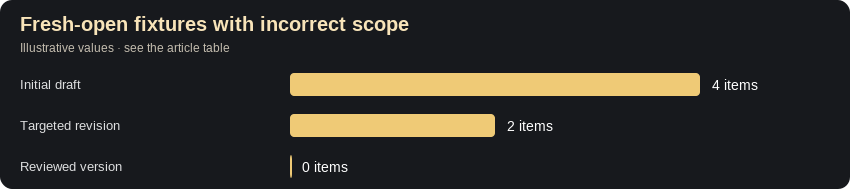
| Category | Value (items) |
|---|---|
| Initial draft | 4 |
| Targeted revision | 2 |
| Reviewed version | 0 |
Constructed audit of 4 fixed, distinct cases. First review resolves 2; second resolves the remaining 2. Not observed performance or a conformance score.
An editor opens an archive, selects printable guides in two topics and changes the sort to newest first. The address looks like something another person could open, so the editor sends it to a colleague. The colleague lands on the same catalog but sees every format, an older sorting order and an unexplained message asking them to sign in. The link succeeded as navigation. It failed as a handoff of the collection the editor meant to share.
A shareable filter URL is a promise about which choices travel. It needn't copy the entire interface or reproduce a private account. A filter can point to a public view of an evolving collection without preserving the exact items that appeared at an earlier instant. The important thing is to state those distinctions and make the result provable in a browser that did not participate in creating the link. If the only successful test is opening the address in the same session where the filters were chosen, the collection might be coming from that session instead.
This article explains how to decide what a catalog link carries, what it leaves out and how to test that promise. The catalog and proof cases are fictional. The goal is not to maximize the amount of state written into an address. It is to let another reader understand and reproduce the intended public selection without moving private values into a place that may be copied, stored or shared.
Begin with the meaning of “same collection”
An archive can promise the same selection rule without promising the same membership over time. A link can identify public guides filed under two topics, ordered by release date, wherever it is opened. A new guide published after the link was sent can legitimately enter that result. If the editor needs the collection as it existed on a specific date, a separately identified snapshot is a better fit. Don't offer the first promise in the interface and label it as the second in share copy.
The same apparent difference can have several explanations. A second reader might receive more results because the original excluded a restricted subset under their account permissions; another might see fewer because they lack access. A different language or region may use distinct catalogs. The collection itself may have changed. On the other hand, a fresh link might simply fail to reconstruct selected filters. Define what information is comparable and test against a controlled dataset before interpreting these cases.
Sort deserves its own decision. A link to a set can preserve membership but show the recipient items in a different order. If the sender shares the newest three items as the intended use, ordering is essential. Another product could intentionally leave ordering to the recipient's preference. Neither behavior should be accidental. Decide whether the order is part of the link's meaning, whether a secondary sort is needed for stable ties and how a changed collection affects which items are visible first.
Page position is another distinction. The link might intentionally point to the start of the reconstructed collection rather than to the exact place a reader last saw. That is different from failing to reconstruct the filters. An address that opens page four of a moving catalog may not show the same fourth page tomorrow. If a particular item matters, share its stable page separately. The focus here is selection and ordering, not preserving a scroll position or simulating a person's prior navigation.
Define a small public vocabulary for the address
Give every shareable choice a defined name and an authorized set of meanings. Categories, public topics, formats, languages and sorting choices can often be encoded using stable values rather than whichever current label the interface happens to display. A translated or renamed label can then change without invalidating the underlying interpretation. If the interface supports multi-selection, specify whether selecting two values in one group means either or both, and how selections across groups combine. Query parameters cannot express a clear intent if the product never defined one.
Document whether the absence of a parameter means a default choice, no restriction or an intentionally blank selection. If the product defaults to public items only, omitting that field may be enough within the stated contract. If the default could change later, older links may acquire a different meaning. A versioned interpretation or explicit public choice can be useful in contexts where old links need to remain dependable. Don't encode unnecessary information simply because it is easy to serialize. Encode the choices the product actually promises to reproduce.
The WHATWG HTML Living Standard provides primary definitions for links and browser navigation; the companion WHATWG URL Living Standard describes URL and query parsing, including search parameters. These specifications don't tell a catalog owner what a particular category value should mean or which values are appropriate to share. Application behavior has to supply those decisions. Follow standard encoding mechanisms and document product-specific interpretation instead of reconstructing it from ad hoc text operations or the current browser display.
Account separately for blank, repeated and unsupported values. Repeated topics might be a deliberate way to carry multiple selections. Repeated sorts may be invalid, or have a documented resolution. A missing sort can use a declared default. An unsupported category can produce a clear message or a smaller safe selection, depending on the contract. The unsafe editorial outcome is a broad silent fallback that opens every item when the reader thought the view was restricted. State what was applied and flag material omissions when needed.
Leave room for ordinary changes without silently changing intent
Catalog labels evolve. “Guide Sheets” may become “Field Guides,” tags can be consolidated, and a format that was once supported might disappear. If an old value has an unambiguous successor, an explicit mapping may preserve a meaningful link. A changed label alone need not require migration. But substituting a broad public topic for a narrowly named category can expand the selection and should not be treated as an automatic synonym. Document changes in the relation between visible labels and stable link values.
There are at least three honest outcomes for a retired value. The address can continue using an unchanged underlying classification, it can open a verified equivalent with a clear explanation, or it can report that the original choice can no longer be rebuilt. These are better than silently redirecting to a generic collection and calling the job complete. A publisher can choose how much backward compatibility to provide, but a recipient should be able to tell when a link's intended selection was not restored.
A display-only label and a stored identifier can drift apart. In a comparison view, for example, the control might show a new localized name while the data layer still filters by a deprecated definition. That is not automatically wrong if the identifiers were intentionally preserved, but it needs an evidence check. Compare the active control, the applied query and known included and excluded items. This will reveal whether a naming change preserved meaning or only covered up a changed selection.
The chart tracks scope failures in four invented links
Illustrative chart: Fresh-open fixtures with incorrect scope. The bars count failing cases among the same four hypothetical fresh-browser fixtures. An incorrect scope means that the applied public selection or treatment of excluded state does not meet the fixture's documented expectation. These are not observed defect counts, measurements of a real browser, or results from WHATWG or Digital.gov.
| Fictional proof stage | Fresh-open fixtures with incorrect scope (items) |
|---|---|
| Initial draft | 4 |
| Targeted revision | 2 |
| Reviewed version | 0 |
Choose four distinct examples. One needs two public topics; one needs a language and a particular public format; one has an unsupported old value; one is built while the sender has a private account option active. In the initial version all four fail fresh-open inspection or fail the sharing-scope expectation. In the targeted revision the two ordinary public links are fixed. The unsupported value still falls back silently, and the fourth link still doesn't meet the private-state rule. In the final mock proof those two issues are repaired and all four fixtures meet the declared rule.
These stages do not count ten independent tests or incidents. The same four cases are inspected repeatedly. Zero means that none remains failing under the invented checklist. It does not establish privacy, access control, usability or correct behavior for every valid and invalid address. A real defect log should record discovered issues outside the original four cases rather than ignoring them to keep the chart neat. A small audit is useful when its scope stays attached to the graphic.
Keep private and transient choices out of share links
A reader might use filters that refer to personal history, private collections, saved items, unpublished labels or another value not meant to travel. A product should explicitly define which fields the sharing operation includes. This is not the same as copying everything that appeared on screen and then removing a few known sensitive cases. Build the output from a narrow list of approved fields and values. Check that a public-looking field cannot contain an unapproved private identifier and that errors don't create alternative paths for leaking it.
Don't mistake a URL portion for a private container. A query can be copied, stored in tools or otherwise exposed according to how the service and its clients handle it. A fragment is also visible in the address, and someone can share it or read it in a page. Neither is a suitable place for a credential or a private account filter just because it sits out of sight during normal rendering. Assess the product's privacy and security needs separately and don't put material into the address that the audience isn't meant to receive.
Excluded state deserves a thoughtful notification. A reader who selected a private collection might think the shared copy contains the same items. Tell them if the share represents only public topics and formats, leaving account choices behind. If there is no honest public analogue for what they are seeing, it can be better not to offer the link as a reproduction. In either case keep the disclosure near the share action. A note in a help center is less useful when the person is deciding whether to paste the result into another conversation.
The recipient's authorization remains independent of the shared selection. A link can request a public topic without granting entry to restricted items, and an account may still affect the view under explicitly stated rules. For a public share experience, test with no account or with the intended low-permission context. Do not interpret visibility of some metadata as permission to expose a record. A test that uses an editor account cannot establish the public behavior even if the filters were correctly reconstructed.
Make visible controls and displayed results tell the same story
Loading the right results while leaving the filter controls at their defaults is not a complete handoff. It can lead the reader to change an unrelated setting and unexpectedly lose the shared selection. Loading the right controls but fetching a different query is equally misleading. Test the applied selection, visible labels and actual content jointly. Pick a result that must be included and one that must not, so the test can reveal a too-broad result that still superficially looks plausible.
Some catalogs fill a list while more choices are still being restored. A brief interim state can be acceptable if it does not present an unrelated collection as definitive or let the wrong result be shared. Keep loading, true empty results and failed retrieval distinguishable. A link whose valid selection currently yields no items should not remove its filters to avoid an empty page. A link whose results could not be retrieved should not display an empty-state verdict as though the query succeeded. These states call for different language and sometimes a different control.
The Digital.gov plain language guide is a primary resource for organizing explanations around readers' needs. In this case people want to know which choices were restored, which were not and whether the displayed collection is ready. A message such as “Showing printable guides in History or Weather; newest first” is more useful than “State hydrated.” If an older filter was not supported, name the consequence in plain language rather than surfacing an internal parser label. Don't imply that a notice about a narrower scope is a proof that all technical behavior is correct.
The controls should also allow an intentional change. If the recipient removes one topic, the result and any next share action should represent the new selection. If they choose reset, the visible controls and the address should agree about the default. Test navigation behavior according to the product's declared contract. Back and forward actions may restore earlier filter states or operate at a different granularity. Whatever behavior is chosen, distinguish it from the central promise that a copied deep link can build the selection from a fresh start.
A fresh browser is the simplest useful independence check
Start by establishing a fixture with a small known dataset and a defined collection rule. Make a list of both expected inclusions and exclusions. Set the filters using the ordinary interface, then copy the exact address produced by the share action. Open it in an appropriately clean profile with no prior catalog state and with the intended permission context. A private window can be useful for some checks, but know what environment it actually isolates. The point is to avoid inheriting saved filters, cached preferences or account behavior that accidentally supplies missing address values.
Check a recipient's first completed view without adjusting the controls. Is the target catalog correct? Are the intended filters visible and applied? Does the sort select the expected order under the controlled data? Does the result contain both known positives and no known negatives? Then test whether a fresh reload preserves that same behavior. Don't fix the settings and then record a passing screenshot. A successful proof begins before the editor supplies any knowledge the recipient wouldn't have.
Compare what happens when the same address is opened in a context that already has different preferences. Define whether a shared link takes priority over public personal defaults, and verify the behavior. A product can choose to show a prompt or to apply the received selection directly. The noteworthy mistake is silently merging compatible-looking state and reporting it as the sender's exact filter. Show a readable difference when an existing preference legitimately modifies what the user will see.
Record the actual environment and any limits. A local preview can show that parsing and reconstruction work for an approved test dataset. It cannot prove that a deployed redirect or cache delivers the same behavior. Check the produced link through the intended public route when an approved test environment is available. If you can verify only the preview, say so. An application under test should not make a real private record public in order to demonstrate that the share system excludes it; use controlled synthetic fixtures.
Preserve boundaries through normalization and canonicalization
The interface might produce more than one literal address for the same selection, especially when filters can be selected in different orders. A consistent output convention can make links easier to compare and document. Choose it based on whether order changes semantics. Sorting the values in a group used as an unordered set can make sense; doing the same to an ordered priority list could change the result. Document which fields are considered equivalent rather than canonicalizing every string without checking its meaning.
A filter label needn't be the exact encoded token. Spacing, punctuation and non-ASCII characters need to survive any supported path from the UI to the address and back. Use known inputs with those features to catch cases where the filter was reconstructed from the wrong string or encoded more than once. An easy visible label and a safe stable identifier can coexist. Show enough information in the interface for readers to understand what was applied without asking them to manually decode their address.
Think through redirection. A link may lead through a short address, an older route or a language selector before arriving at the catalog. If the intended query changes or disappears along the way, direct fresh-open tests of the final destination won't catch the failure in the copied link. Test the actual sharing path. If a destination no longer supports a previous filter rule, use the documented unsupported-state behavior rather than silently sending the reader to a broader page. A convenient redirect should preserve a truthful promise about scope.
Use deliberate defaults when the collection is public but still personalizable
If a new reader commonly sees one language and a signed-in reader sees another, determine which of those choices a link is allowed to override. There is no requirement to expose a reader's personal default in the shared address merely because it influenced the original view. The link can carry a public language filter selected for the example without describing the sender's full profile. When the choice was implicit rather than intentionally selected, make the share behavior clear instead of declaring that every visible preference is an explicit filter.
Think about the difference between showing the same collection under a translated interface and showing a collection selected by language of content. An address might control one, the other or both. A recipient can reasonably expect a link to French-language guides to retain that content restriction even if the menu language stays English. If the product conflates those settings, separate them in labels and tests. A fresh browser using a different locale can reveal a hidden dependency that two editors using the same defaults would never notice.
The same distinction applies to public region settings. Choosing material about a region is not necessarily choosing an edition distributed only in that region. Respect restrictions in the actual delivery system. If scope changes as a result, show what the recipient is seeing without exposing the sender's private information. An archive can provide a clear public version without claiming equal access across circumstances it does not control.
Rehearse the four checks as a small editorial handoff
First choose two public topics whose overlap and separate membership are known in the test dataset. Select them through the interface. If the documented combination means either topic, the result should include an item filed under the first only and a second item filed under the other only, while excluding an unrelated item. Check the controls and results in a fresh browser using the copied link, not a link assembled by the tester. A one-topic reconstruction could otherwise appear to pass if the test item happened to belong to both groups.
For the second fixture, select both a public format and a content language. Choose a negative control that has the right format but the wrong language, and another with the right language but the wrong format. If a later revision replaces the restriction with a preference or a soft ranking, that should fail the original fixture unless the product contract intentionally changed. The positive examples should justify why the result is not simply empty. A controlled set of known items makes interpretation independent of what happened to be in the live catalog that morning.
The third fixture uses an unsupported old filter. In a fictional product the documented behavior is to show a notice and avoid silently pretending the original selection was restored. The proof can verify the actual message and which selection remains, rather than requiring an invented universal error design. If the team chooses to migrate a value instead, choose a known example where the migrated scope is equivalent or explicitly narrower, then revise and retest against the new policy. A passing outcome should measure a rule readers can understand.
The fourth fixture starts from an account-specific choice in a fictional private view. The copied address should contain only the approved public filter, and a nonprivileged fresh browser should see only the intended public result. The sender's visible message should explain what did not travel. Inspect the produced address and received view, using synthetic entries rather than real sensitive labels. A correct recipient view doesn't prove sensitive state was omitted from the address, and a clean address doesn't prove the displayed results obey the relevant access rules. Both checks matter.
These examples make good regressions after changing how filters, routes or category labels work. They are small enough to repeat and varied enough to catch different failure modes. Keep the fixture descriptions with the expected outcomes. When data are updated, confirm that fixture items still satisfy their intended inclusion and exclusion conditions. A test that passes only because its negative controls were inadvertently removed is less helpful than a clear note saying the data must be reset.
Know when to offer a snapshot instead of a filter
Someone may want to cite exactly the fifteen resources shown on a specific day, including their ordering. A filter tied to a changing catalog is a bad fit for that task, even if every correctly encoded choice survives. A dated public snapshot or controlled list of stable record references can do better. It should have its own identity, content version and limitations. Do not represent an ordinary live-query address as the preserved contents of a specific report.
Conversely, a public list for returning readers may benefit precisely because it stays up to date. A snapshot would stop answering the question of what's newly available within the same topic. The interface can help by naming the difference between sharing filters and sharing a fixed list. Those actions can coexist without creating a technical puzzle for most users. Many sharing defects begin with a product asking one button to serve both goals without distinguishing them.
Print and offline copies add related but distinct goals. A link may be included on a printed inventory so people can check future results; a printed count may reflect the date of distribution. Label each accordingly and include enough context for the printed claims to remain meaningful when the live list changes. The physical artifact doesn't need the same interface behavior as a browser. It does need the relevant period and selection rule if readers are supposed to compare it with a later opening of the link.
Separate an unsupported address from a genuine empty result
Imagine an old topic and format combination is still recognized, but all matching public items have been withdrawn. The current result can be empty while the link was correctly reconstructed. Show the applied filters and a neutral description, such as that no current items match. It might be appropriate to give readers an option to revise the selection, but don't do it automatically and erase the very evidence that the link worked. A fresh-open test can use a deliberately empty fixture to catch this behavior.
A data service that cannot retrieve results presents a different situation. In that case the view does not know whether matching items exist. Preserve the recognized filters, state the retrieval problem and offer a safe means to retry where appropriate. Logging and internal diagnostics can help distinguish it from a parser failure or a valid empty query, but the public text should explain what it affects rather than present raw technical details. The recipient wants to know whether they saw nothing or were unable to see.
A malformed or unsupported state is different again. The application may be able to use some choices while refusing or ignoring others. Tell the reader what was retained and what couldn't be applied if that changes the collection. A broader fallback may be available as a separate explicit choice. Do not silently fall back to it while suggesting that every incoming choice took effect. Errors in scope are particularly hard for an unfamiliar recipient to detect because they do not know what was supposed to be missing from the result.
Record a strong enough proof without making a universal claim
Save the exact copied test address only in a suitable context, using no sensitive values. Record the fixture data version, relevant environment, permissions, expected selection, actual controls and membership checks. If a problem appears only after several redirects or on a particular route, explain the starting point and observed end state. A screenshot of selected chips can be supporting material, but it does not prove which data were fetched. Include a check of actual results and an independently reproducible route.
Distinguish scope, sort and timing when you report failures. A result may include the right items but fail their requested ordering. Another could show briefly different results until initialization finishes. A third could be stable but incorrectly broad. Give each failure an expected outcome and record what changed. A vague ticket about broken sharing can lead to repairing the wrong part of the workflow. Clear logs also let a reader tell exactly what “fixed” will mean in a subsequent review.
If the test examines only a preview or uses a controlled synthetic response, disclose that limit. Opening a copied link on a fresh preview is a meaningful test of the tested artifact; it does not show that a live public path has been deployed or verified. If the full environment is available, test the actual path before declaring the handoff finished. The goal is to make a claim that a later person can repeat without trusting your browser's memory.
Check that accessibility does not depend on knowing the address
A public selection can be technically reconstructed and still be hard to understand. Make it possible to discover the applied state through controls and text, rather than expecting readers to inspect an address bar. If a filter group supports several values, its displayed label should explain the grouping where the difference matters. A person should be able to tell which restrictions apply before acting on the list. Brief status about a new set of results can complement that information, but a quick announcement should not be the only record of the current filter.
Think about the share action's name and feedback. A control that copies a link should say what it copies and what was left out when that matters. A confirmation saying “Link copied” does not establish the recipient can rebuild the selection; it states the outcome of the copy operation. If clipboard use is unavailable, a selectable address with an explanation can offer a path that doesn't falsely imply copying already occurred. Verify the output separately from the success message. Both can be correct or wrong independently.
Filters can appear in chips, an expandable region or a mobile drawer. A recipient landing on a narrow display may have no reason to open the drawer if the result looks like an ordinary default view. A brief text summary can give orientation and reveal a material omitted choice. Test that the summary doesn't replace fully usable controls. A reader receiving a link still needs a way to inspect an applied filter, revise it and understand when the modified result is ready.
A local translation can change which filter labels fit. It can also make two distinct groups sound equivalent if the summary is compressed carelessly. Preserve the meaning of public scope across labels and test at least one layout with different language preferences when the product supports them. For exceptionally long lists of selected values, a short count plus a route to inspect the complete selection can be sensible. The route itself should be reachable, and the summary should not imply that an undisplayed restriction was unimportant.
Compare confirmed navigation and confirmed membership
Someone who copies an address, opens a different profile and gets a page that looks approximately right may still miss a serious scope bug. The catalog title might be correct, and several intended items could appear because the default happens to include them too. This is why a negative control matters. Verify at least one item that should disappear under the selected rule and one whose position depends on the requested kind of sorting. An exact comparison can be more useful in a tiny fixture dataset; a targeted comparison might be sufficient to diagnose a known defect in a much larger system.
Use the same edition or time of the fixture when comparing expected and observed membership. If a colleague adds a new public item between runs, the recipient could receive one more result despite correct reconstruction. That isn't a reason to treat all discrepancies as ordinary churn. Stabilize the test when it is practical, or record the changes that can account for the observed difference. Scope and freshness are useful properties, but they must not serve as excuses for failing to check each other.
After a catalog redesign, inspect which URLs the public may already have. A redirect that drops filters might not show up in tests of links generated only by the new interface. Use synthetic representatives of the documented older forms and test through the actual redirection path. If the owner has chosen to retire an old mode, verify that the message doesn't say the full prior selection was restored. Preserving a previous promise and communicating its expiration are both legitimate, provided the outcome is deliberate and visible.
One useful test covers intentionally different view modes. If the reader has selected an accessible list view or another local presentation preference, the shared filters need not override it. A compact grid and a long text list can represent the same selection. Make sure the proof does not fail simply because the interface looks different when the contract concerns only membership and sort. Equally, don't excuse genuinely wrong membership because the recipient's presentation mode was expected to differ.
Decide what a handoff does when the result is changed
Suppose a recipient opens a shared link and then changes the format filter. A new share operation can return the changed public scope. The interface should distinguish that from the originally received selection, particularly if it offers a return link or a button to copy the original. Check whether the generated address reflects the current choice rather than a stale version of the initial view. This is a different test from expecting the browser to restore a scroll position.
When the user resets the view, decide whether the address should return to a baseline catalog URL or explicitly contain default filters. The answer depends on the published interpretation of missing values and backward compatibility. Check that a reset on a signed-in profile doesn't produce an address whose meaning depends on the private preference being restored. A result that is clear in the current session may be wholly different when copied out of it. The same fresh-profile check gives that decision a useful independent test.
Put the collection promise in the share copy
A short description can identify both the restored state and the limits. “Anyone with this public link sees printable guides in either selected topic, newest first; the list can change as new guides are published.” If private options are visible in the sender's interface, name the omission in similarly plain language. Don't tell people the link rebuilds an exact collection unless the product supplies a verified snapshot that supports that statement.
Then try the practical test one more time. Copy the link, leave behind the session that produced it and open it from a fresh context. Read the displayed selection, verify known inclusions and exclusions, and confirm that private values stayed out. If a result is missing because access or collection definitions have changed, say which part of the promise couldn't be kept. The best filter link doesn't share everything the sender knew. It shares the intended public choice and enough context for the recipient to know what was reconstructed.
References
- WHATWG HTML Living Standard, primary definitions of links and browser navigation.
- WHATWG URL Living Standard, primary specification for URL parsing and query representation.
- Digital.gov plain language guide, government guidance for clear, audience-centered explanations. The references do not supply the illustrative fixture counts.