
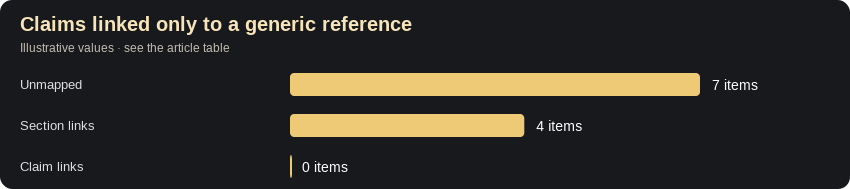
| Category | Value (items) |
|---|---|
| Unmapped | 7 |
| Section links | 4 |
| Claim links | 0 |
Constructed checklist scenario for this brief, not measurements, ratings, or results from cited sources. Each displayed count represents checked items in the named example.
The editor opens the first link in a paragraph describing three results. It loads a professional looking report from the organization that ran the study. There is a table of contents, a lengthy introduction and a carefully worded executive summary. Nothing on the screen obviously matches the number in the paragraph. After seven minutes, the editor finds a figure that almost matches. The denominator is different. A second passage gives the result for an earlier year. The citation was never broken in the ordinary sense. It simply did not tell anyone which statement the link was supposed to support.
This is a failure of mapping. A reference tells a reader where information comes from only when there is a traceable relationship between the claim in the article and something in the referenced material that actually supplies evidence for it. That relationship is not established by a live link, the reputation of its host or a familiar title. It takes attention to both ends: the words in the article and the evidence at the destination. In a review article, where paragraphs routinely contain results from different studies, keeping those relationships apparent is one of the most useful services the editor can provide.
The word “evidence” here is intentionally narrower than “something worth reading.” A collection page can help readers discover related material. A glossary can give useful background. An organization's annual report can help establish context about what the organization does. None of those uses is a defect. The defect comes when a link intended as orientation is asked to carry an empirical or interpretive claim it wasn't built to carry. A careful review distinguishes links that substantiate statements, links that explain terms and links that merely lead to further reading. The audience need not learn the editing team's internal labels to tell those roles apart.
The two ends of a mapping problem
At the writing end, find the smallest claim whose support matters. This is usually not “all of paragraph six,” but it is not necessarily every noun and verb, either. An individual assertion about an outcome, comparison, date, definition or scope is often a workable unit. The editor's question is whether a reasonable reader would understand that assertion to have independent support. Sometimes one sentence contains several such assertions. Sometimes two short sentences state the same result from different angles and can be covered by one explicitly scoped source.
At the source end, identify the smallest passage, result, figure, table row or dataset selection that supplies the support without losing needed context. A table cell by itself can omit a denominator, group name or reporting period printed in a heading or note. A single sentence can be misleading without the preceding sentence that defines what “participants” means. A precise citation should narrow the reader's search, not detach the number from the qualifications that make it true. Point at a usable unit of evidence rather than shrinking the target for its own sake.
The language between those ends also matters. “The evaluation recorded an improvement” can accurately summarize a difference reported by a study that was not designed to establish causation. “The program caused the improvement” is a different claim. Changing an anchor or improving its label cannot fix that difference. The article must either show more evidence or narrow the wording. Similarly, a paper may report a result for people who completed a follow-up, not for everybody initially enrolled. A link directly to the corresponding row can help a reader catch the difference, but the article still needs to name the population correctly.
Treat mapping as a relation between claims and evidence, not between footnote numbers and filenames. A note can point at more than one source. One source can substantiate several claims. A claim can depend on evidence from several passages in a single document. The right question is not whether every sentence has a blue word; it is whether a reader can find the supporting material, tell what it supports and distinguish the writer's reasoning from the source's results.
A real hyperlink is necessary but not sufficient
The WHATWG HTML specification on links describes the mechanisms that let a reader navigate to another resource. In an ordinary article, a text link to a cited report is a hyperlink whose destination is supplied in its address. That is a technical relationship between documents. The browser can follow it; it cannot determine whether the article's claim is borne out by the destination. A link checker can tell the editor something about navigation. It can't by itself validate the underlying sentence.
A second, independent concern is usability. The W3C explanatory document for WCAG 2.2 Link Purpose in Context explains that a reader should be able to determine why a link is there from its text or its programmatically determined context, within the criterion's stated scope and exception. The explanatory page is informative guidance, not the normative standard itself. Its examples make clear why a link with meaningful text often helps a person who tabs through the page or asks assistive technology to list the available links. That usability check does not establish the truth of the statement near the link. A readable, well named link can lead to excellent evidence about something else.
For editorial purposes, run those two judgments independently. First inspect the promise the label makes: if it says “Table 3: results by age group,” expect that result at the destination or a clear way to locate it. Then check the evidence itself: does that table report the number and conditions stated in the article? A link labeled “full report” may be honest navigation but too broad as the only citation for a specific median. A superscript may be usable when it leads to a well scoped note, but an unlabelled cluster of numbers past several findings can obscure which finding each note supports.
The separation helps when a fix appears obvious. Renaming “read more” to the report's title makes the destination clearer. It does not identify a page or row. Changing the address to a more exact fragment can reduce searching. It does not grant permission to stretch what a source says. Rewriting the article sentence to match the table may solve a substantive problem while leaving the link confusing for nonvisual readers. Each intervention solves its own defect. A robust review records which defect was found, then checks the other dimensions rather than assuming they improved as well.
The example behind the chart
Illustrative chart: Claims linked only to a generic reference. The bars compare three fictional editing states of the same seven-claim draft. The counts are constructed for this article; neither W3C nor WHATWG measured, scored or recommended them. A claim counts if the best link available for it leads only to a general destination rather than to a source and a locator that identify specific supporting evidence. In this scenario each claim always has at least a generic link, so there is no separate missing-link category in the chart.
| Editing state | Claims linked only to a generic reference |
|---|---|
| Unmapped | 7 |
| Section links | 4 |
| Claim links | 0 |
At the beginning, all seven claims share an index entry or an undifferentiated set of references. In the intermediate version, clear section links allow the reader to find unambiguous support for three claims, leaving four generic-only claims. That stage demonstrates that a section link is not intrinsically too broad: if a short, labeled section supplies one clear result and its context, the supported claim can be traceable without a separate cell link. In the final version, all seven have sufficiently precise source and locator combinations, so zero claims are left with only a generic reference.
These are snapshots of the same denominator, not three different samples of claims. The bars should not be summed to eleven errors in one draft. The first change resolves three generic-only cases, and the second resolves four. The final zero does not imply that the studies are unbiased, that their conclusions agree, or even that no other kinds of citation errors are possible. A target can be precise and wrong. The walkthrough presumes that the last version checked both the relevance of the destination and the accuracy of the scoped claim; the chart alone does not independently show that check.
The count is best viewed as an inventory of a particular problem. In a real review, a companion internal tally should distinguish remaining claims with no evidence, claims whose sources disagree, inaccessible evidence and locators where the reference is precise but doesn't support the sentence. If an editor simply removes all links to broad references, some claims may move out of the charted category without getting any real support. The difference would be visible in a proper ledger. It would disappear in a celebratory headline about reducing the count.
Give each finding a portable address inside the draft
A dependable ledger has a key for each claim and a separate key for each source. The claim key can be as plain as “R4” in a manuscript with seven reviewed results, provided it stays put when the discussion is reordered. The source key identifies a particular document, release or dataset. In a row connecting them, include the manuscript wording, the destination, the locator and a note about what kind of support it supplies. Keep the location in the draft as a convenience, not as the only identity: a paragraph number will change when an introduction is shortened.
The checker's notes should be descriptive enough that another editor can continue without starting over. “Supports claim” is less useful than “reports post-intervention response for people with both visits; excludes missing follow-up.” The difference is consequential if another draft replaces people with both visits with all enrolled people. The short explanatory note makes it easier to see that the older verdict does not automatically carry over. A small excerpt of a table heading or a short paraphrase can help without creating an unofficial duplicate of the entire source.
Useful status labels answer three separate questions: has someone located the relevant evidence, does it support the exact wording, and is the public destination suitable for the intended readers? Don't establish a long mandatory taxonomy if a short note will do. Do preserve especially important distinctions. A row marked “source needed” calls for research. “Evidence located but narrower than claim” calls for revision or stronger support. “Evidence verified in publisher PDF; public anchor missing” calls for a good fallback locator, not a panic search for new evidence. “Cannot resolve” should mean that the editor knows what is missing and has not found a defensible fix.
Ask for one owner and one next step for unresolved rows. The owner needn't be the person who introduced the mistake. A specialist may be able to identify the correct evaluation protocol and an editor may be able to rewrite the comparison. For a private draft the unresolved state can remain visible; for publication a consequential unsupported claim should be fixed, narrowed or withheld. A mistargeted link with a stable page fallback can be a much smaller problem. The ledger should allow those decisions to differ without hiding either type of issue.
What exactly belongs in a locator?
A good locator is both specific and resilient. A publisher-maintained section anchor coupled with the section name is often enough for a brief result. A table number and row label can be clearer than a manually copied URL that scrolls to some text in one browser but not another. For a long report, record the printed page and table heading. If the printed pages differ from the viewer's count, label which number you give. “Page twelve” is a frustrating clue when page twelve of the file opens a preface whose printed page number is in Roman numerals.
When the primary result appears in a supplement, don't send the reader to the abstract and assume the abstract includes it. Link to the stable supplementary material where practical, state which appendix contains the result and preserve the relationship to the main paper. A supplement can be one of several similarly titled downloadable files. A note specifying the file name, table label and row or column can save readers from opening each of them. If the supplement itself does not carry the definition of the analysis population, include the relevant methods location in the support record.
For data, a report is not always the most helpful target. A release note can establish the origin and version of a dataset. It cannot by itself show how a writer calculated a particular proportion from selected records. In that case give the release, table or variable names, relevant exclusions, treatment of missing data and calculation in a separate methods note. Readers should be able to distinguish a directly quoted cell from the result of a calculation performed for the article. If the data can be queried through a public interface, test that the saved link preserves the relevant selection or describe how to reconstruct it without relying on hidden interface state.
For a versioned standard, name the edition whose scope you are discussing. A live standard link can be useful if the sentence is explicitly about the living text. It is poor support for a claim about what the text required five years ago unless an edition or snapshot supplies the historical wording. An organization can revise instructions without changing the name on the page. Recording a revision label protects the reader from believing the earlier article and today's source necessarily describe the same requirement.
A page in a third party repository may make access easier but change the provenance question. Is the copy actually the same revision, complete with table notes and any published corrections? If not, treat the publisher record as the canonical identity and the copy as an alternate access route, only if you have verified its relationship. A citation to a related headline, press summary or conference slide is not a replacement for a locator in a primary document when the claim depends on definitions only visible in that document.
Sometimes the strongest locator is textual, not clickable. Image-only scans may not provide meaningful section anchors; certain PDF viewers handle page fragments differently. Give the reader enough information to continue when the click doesn't scroll correctly. A short section name, figure number and printed page usually beat a browser trick with no visible fallback. Testing that the link opens on one machine is not the same as showing that the rest of the article remains usable when the navigation mechanism behaves differently elsewhere.
When one sentence needs more than one thing
Consider a fictional sentence in a transportation review: “The trial cut median wait time by three minutes, and riders with reduced mobility saw the largest gains.” It sounds like one finding, but it asks the sources to do three jobs. One is to establish a median difference. Another is to justify calling it a consequence of the trial rather than merely a change during the trial. The third is to substantiate a comparison across groups, including what “gains” means. The median might come from one table and the group claim from a descriptive interview study that doesn't quantify gains at all. No single short citation style can rescue that sentence without editorial judgment.
A defensible revision could say that the measured median was three minutes lower during the trial, link the evaluation table and name the comparison period. A separate sentence could say that some interviewed riders described particular improvements and link the relevant findings from the interview study, if those findings were actually reported. That's not cosmetic hedging. It preserves the strength and type of each observation instead of letting one claim borrow confidence from the other. If a formal assessment did estimate group differences on a common scale, the article could make the narrower supported comparison and identify the appropriate measure.
Check for causality hidden in connectives. “After,” “because,” “resulting in” and “therefore” create different relations between two otherwise identical statements. An article can correctly quote two numbers and still imply a transition the source never examined. Keep conclusions drawn by the article visibly separate from conclusions explicitly stated by the primary source. Sometimes the right locator belongs next to the supplied evidence, with a separate clause labeled as the reviewer's interpretation and an explanation of the logic that leads to it.
A similar problem occurs with a list of findings. If a paragraph claims shorter waits, fewer cancellations and lower expenses and ends with a single note, readers reasonably expect that the note substantiate all three. If the last item instead comes from an independent budget document, its proximity to the note may make that conflict hard to spot. Put the budget item in its own sentence or item with its own support. More links are not automatically better, but scoped references are worth the additional line when readers might otherwise misattribute the evidence.
A focused worked audit of the seven claims
The chart's invented checklist can be rehearsed with a fake editorial review of a neighborhood service pilot. Start with seven claims: change in average visit time, change in median wait, total people served, catchment boundaries, operator training requirements, operating expenses and reported ease of use among interviewees. The example uses no real trials and supplies no factual values for those metrics. Its purpose is to illustrate how similar sounding statements demand different locators. Initially, all seven appear beside a link to the pilot's central document directory.
At the section-link stage, suppose the introductory section defines the study catchment unambiguously, the budget section explicitly states operating expenses for the period the article names, and a short interview findings section reports the described ease of use. Give those sections precise and visible names in the draft. The editor follows each link and checks the article's phrasing against the named passage. Those three claims are no longer generic-only. The other four still link only to broad sections with multiple candidate values or different kinds of information. Their status is not failures of subject relevance; they are failures of evidence identification.
The final pass examines those four in detail. For visit duration, the editor identifies the table containing the average rather than quoting an adjacent median. For waits, the editor checks when the clock starts and ensures the sentence uses the same convention. For the total served, a table distinguishes visits from unique visitors, so the author changes the sentence to name what was actually counted. For training, a program manual distinguishes required orientation from optional refresher sessions, so the editor links the named requirement and removes an unsupported reference to refreshers. Each correction leaves claim, locator and meaning aligned. The three resolved at the earlier stage remain resolved without unnecessary duplication.
If “reported ease of use” sounds too general in anyone's reading, look at what the interview material can actually support. A narrative summary can illustrate recurring descriptions without providing a representative percentage. A recruitment note might show that interviews reached only people who used the service recently. A reader should not infer that nonusers found it easy. The ledger can mark this as “qualified direct support” and specify interviewees in the wording. Even in the friendly example, the count of traceable links does not lighten the burden of honest scope.
The editor then does a cold read in the order of publication, without the ledger. Is it clear that the budget numbers come from a different document than the two timing measures? Can a reader find the source of the catchment definition before going to the data? Do any links promise access to a dashboard while actually opening a report archive? This pass catches misdirection created by adjacent text even when every ledger row is individually well documented. It also tests whether the prose reads like a review rather than a dense index of supporting documents.
Compare the populations before the values
A sentence comparing numbers across sources can make two matches inside one mismatch. Suppose a review says use rose from one reported proportion in an early year to a higher proportion in a later year. The two sources might print both numbers, which is enough to satisfy two simple find operations. Yet the early estimate could represent only registered users and the later one the entire eligible population. Finding the source for each value is necessary but doesn't establish that they belong on a trend line. The relation between the values is itself a claim and needs to be reviewed.
Build a quick comparison sheet with the numerator, denominator, time window and operational definition for both figures. Then ask which changes might plausibly account for the difference even if underlying behavior stayed the same. If eligibility or counting changed, a sentence reporting the numbers separately without implying a measured trend may be appropriate. If the necessary facts are unavailable, identify the uncertainty instead of inventing an adjustment. A note can be useful when it explains why a neat comparison was not made.
Units deserve equal attention. A displayed percent can be mistaken for a percentage point difference, a whole-period count for a rate, or total dollars for inflation-adjusted dollars. A single number may be correct in the cited table and wrong in the sentence around it. Audit the noun after the number, the time period and any comparator. Also look for sign changes caused by writing about increases when the source reports decreases in remaining deficit or another quantity whose interpretation moves in the opposite direction.
The same logic applies when synthesizing statements that are not numerical. Two studies may both report that an outcome improved, while measuring different constructs under that outcome label. One might measure self-reported confidence and another actual completion on a task. Don't call them independent confirmations of the same effect without making the distinction explicit. Conversely, similar words in two different papers do not make the papers duplicates. Find out what each measured and show readers how the review grouped its evidence.
Decide what to do when a claim does not fit
The best outcome of mapping is sometimes deletion. If a sentence makes the strongest claim in the article and the underlying sources only gesture toward it, the loss of that sentence may make the piece more valuable. A careful article can show the strongest defensible conclusion without exhausting its reader with speculation. If the idea matters enough to keep, convert it into a clearly marked question or hypothesis. Do not simply move the unsupported assertion to the heading, image caption or introductory summary, where it may escape review.
One common alternative is narrowing. An article that says a change occurred “across the city” might be revised to say it was observed at the three participating facilities. In the ledger, retain the older wording and note the scope correction. Otherwise an author revisiting the draft may restore the sweeping phrasing, believing it to be an innocent stylistic variation. Giving the check an audit trail pays off when a summary is rewritten to be livelier and a caveat disappears by accident.
Another option is replacement with stronger evidence. When the original citation is a homepage announcing that a pilot succeeded, replace it with a report or dataset that defines the outcome and supports the revised wording. If the announcement itself is the subject of the claim, keep it as the primary source for what the organization announced. “The agency announced a decline” and “the outcome declined” make different commitments. In the first statement the announcement is the event being documented; in the second it may only be a report about the event that needs to be checked.
When a result remains unresolved because the evidence is inaccessible or contradictory, log the reason literally. “Only an abstract is available to us, and it doesn't state the subgroup result” is actionable. “Conflicting rows report calendar year and fiscal year totals; need the intended frame” is actionable too. An empty cell or a red dot only tells the next person there is a problem. Include what has already been examined and what would settle it, so two people don't repeat the same unsuccessful search.
If the publication needs to keep a genuinely unresolved substantive issue visible, say exactly what remains uncertain in the article. This is different from publishing an unsupported assertion plus a disclaimer. The supported claim might be that the published evidence does not establish a result for the requested subgroup, or that two sources used incompatible measures. That statement itself needs careful sourcing and should not imply that absence of evidence disproves an effect. The wording should show why the reader is being told about a gap rather than being invited to assume a conclusion.
Make the public link work for readers without exposing the editing ledger
Open the article as a reader, not as an editor who knows why every link is there. A sequence of five links named “source” can be frustrating when all five destinations differ. A phrase such as “budget appendix, operating costs” gives a useful hint about the evidence and the section the reader should expect. For a conventional scholarly note, an accessible label and clear placement can preserve compact typography while keeping the relationship readable. Whatever mechanism the team uses, do not assume that a faint color or visual alignment conveys the context through other ways of navigating.
Put enough context near the link that a person looking at a narrow screen doesn't have to infer its purpose from a subtitle above the fold. A full sentence ending in a named evidence link is often easier than a naked label at the start of a paragraph, especially if the description appears only after the link. A phrase can do double duty when it names what the article relies on and what it opens. The chosen phrase should still be accurate when quoted or copied on its own, especially if a reader is likely to share it.
In sections with data tables, the location of a note matters. A citation appended near the table title might be enough when every cell comes from the same identified table. When different columns come from distinct releases, label that explicitly. If a particular row is calculated by the author, document that row's derivation instead of styling it as a directly imported value. An endnote keyed to the row can carry details while the table remains legible. This prevents the strongest-looking object on the page from escaping the same mapping rules that apply to prose.
Make it possible to recover context after visiting a source. A visible note number, nearby label or clear heading can help a person return to the original sentence. Avoid surprising download behavior where a label can explain that a link is a data file or PDF. Consider whether a public route can open the document without relying on the editorial team's cookies or institutional login. If access is restricted, note the restriction and give a locator where possible; do not imply permission or publicly share a private file merely because you can open it.
Link tests that return different kinds of answers
On a routine proof, check that the address resolves to the intended document in a normal reader session. The returned page might be a login, an announcement superseding the old report or a landing page for a whole document series. An automated checker that looks only at a success status can miss these changes. Compare the destination's title, organizational identity, edition and relevant content against the record. Then test whether any fragment actually moves the reader to the relevant region, and whether a human readable locator remains useful if it doesn't.
Next test the claim itself using the article sentence, not just a keyword. Open the source and find the passage. Read outward to the nearest heading and notes. Try to reconstruct any transformation the article applies. Check that qualification words survive the trip: “eligible,” “during the pilot,” “reported,” “in a subset,” and “when adjusted” can carry more meaning than the number itself. It is easy to skim for an identical number and miss the condition whose omission changes the factual claim.
Now test whether another person can repeat the mapping without the original author. Supply the draft and ask the reviewer to locate evidence for one or two especially important sentences, note the relevant context and point out anything the sentence added. If the second reviewer has to ask which of two plausible sections to use, the map is too weak even if the author knows the answer. This exercise is particularly useful after a big structural edit, when an old citation can remain technically attached to a paragraph but conceptually drift to another statement.
Some publishing systems handle links differently in a browser, newsletter and exported file. Check the actual artifact that readers will open when you have one to inspect. A link can be valid in the draft format but have its destination truncated by an exporting step. A Markdown note can end up detached from its reference on conversion. A meaningful label plus a visible textual locator protects the article against some rendering failures, but the right response to an observed defect is still to fix the path and retest it.
Handle revisions without pretending evidence has not moved
Review articles age even when no one revises the prose. Publishers reorganize sites; data releases replace earlier ones; an erratum can change a value without making the primary article disappear. Record enough identity information to distinguish these cases. A document that moved can keep the same interpretation when the replacement destination is verified. A newer edition needs a decision about whether the article is describing a historical result or should be updated to the current one. An erratum may demand more than a new link if the article repeated the original number.
When an older URL redirects to a general search page, repair it by matching the original document identity, not by linking to the first result for the broad topic. Compare author or issuing institution, title, date and version when available. If you cannot find the original, don't silently switch to a secondary page whose evidence differs. Mark the situation in the ledger and flag any claim that can't still be substantiated. The access problem and the support problem are related, but not identical.
The date you checked the link can be useful in the internal ledger. It tells later reviewers when a previously validated connection last worked and whether a change may have occurred since. It is not a statement that the fact will remain true after that date. Conversely, a stable archival link can continue to prove what an institution reported at a particular time even when its web infrastructure changes. Scope the wording so readers can distinguish current facts, historical records and preserved evidence.
Editorial changes can be just as disruptive as source changes. A copyeditor merging two sentences can unintentionally expand a citation's apparent scope. A heading rephrasing an observation as a conclusion can introduce a new uncited assertion. A rewritten summary, callout or social excerpt may be the only thing some readers see, so do not confine factual review to the body. Add a final pass for changed statements and for reproduced claims that lost their context. It takes less work than rechecking the entire article if the ledger clearly identifies what the previous pass covered.
When support is distributed across a review
A literature review has a problem the original study seldom has: its conclusions may depend on the collection of sources rather than the most visible result. Imagine that a review says most evaluations used a particular outcome measure. An individual evaluation cited next to the sentence can show that one did. It cannot show that most did. The stronger destination is the review's own included-study table or screening record, where readers can inspect the definition, denominator and handling of unclear cases. Point the individual study link at the row where it belongs. Point the summary sentence toward the work that actually substantiates the summary.
Likewise, a statement that multiple studies agreed depends on what the review was prepared to call agreement. Suppose one evaluation reported a small increase and another reported a larger increase with substantial uncertainty. They could agree about the direction of their point estimates without establishing a reliably positive result in both settings. If the article says “both showed an increase,” make clear what showed it: the reported estimates, the underlying observations or the authors' interpretation. Mention disagreement or uncertainty where leaving it out would materially change the reader's understanding.
A good review also maps the reasons for not combining results. If reports measured waiting time using incompatible start points, let the cited methods carry that explanation. This is not merely a long list of reasons to be cautious. It is evidence for an editorial decision with consequences: the proposed comparison was not made. Readers who think the definitions are equivalent can inspect the same passages and disagree on a basis they can describe. The map opens a decision to inspection rather than presenting the editor's judgment as an unchallengeable verdict.
When a review takes a practical position despite uneven evidence, mark the transition from reporting to recommending. It is reasonable to recommend further independent evaluation based on gaps the article documents. But the recommendation is the writer's; it should not be attributed to a study whose authors did not make it. If there is a recommendation directly in a source, distinguish it from the empirical results underpinning it. Something can be a recommendation by a reputable institution and still require a different kind of appraisal than a reported measurement.
Decide what “done” means before the final pass
A citation review should end with a short record of what was covered. Count the claim units in scope, note the remaining exceptions and state how the public destinations were tested. A full review of one chapter is not a full review of the whole site. If you used a sample, explain how it was selected and what the sample can reveal. A deliberate sample of the strongest numerical claims is sensible for triage, but it will not reliably discover problems scattered among captions, background descriptions and incidental historical claims.
The public review should be navigable without a private spreadsheet. The spreadsheet makes the work assignable; the article makes its outcome usable. If the public article still forces a reader to look at every link and decide which one might match a sentence, the private ledger merely documents a relationship the editor chose not to provide. A simple footnote can do the job when its scope and locator are clear. Linking each phrase of a readable paragraph can do worse if readers cannot tell which links are evidence and which are optional context.
Keep perspective when building acceptance criteria. Every checked destination need not give a close-up fragment that always opens perfectly on every device. A stable document with a clearly labeled heading and a page can be better than a short-lived deep link. Conversely, even a perfectly stable home page is almost never ideal evidence for a narrow result buried in one of its reports. The target is repeatable discovery with the relevant context intact, not an impressive number of clicks or fragments.
Finally, run a small handoff exercise. Ask another person to pick one result, find its evidence, read the applicable notes and describe the finding back in their own words. The exercise often catches the most consequential issue: the article's plainest interpretation may differ from the one the author privately intended. When that happens, correct the sentence before polishing the anchor. A good source map leaves a reader with the right evidence for the claim actually on the page.
References
- W3C Web Accessibility Initiative: Understanding Success Criterion 2.4.4, Link Purpose in Context. Informative guidance about identifying the purpose of links from text or context. It does not evaluate the illustrative citation inventory.
- WHATWG HTML Living Standard, Links. Technical specification for links and navigation. It does not establish an editorial standard for how to substantiate a factual claim.