
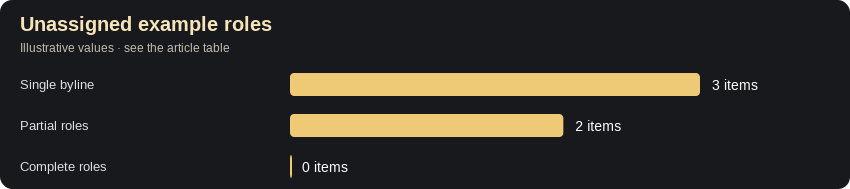
| Category | Value (items) |
|---|---|
| Single byline | 3 |
| Partial roles | 2 |
| Complete roles | 0 |
Constructed checklist scenario for this brief, not measurements, ratings, or results from cited sources. Each displayed count represents checked items in the named example.
A report appears with one byline. The person named there wrote the story and chose which claims to make. A second person made the photographs. A third organized months of field observations and supplied the file from which the chart was made. A fourth checked the chart against that file. Readers can find the writer, but the work of the others is invisible. An editor adds the fourth person's name under the byline, hoping to be fair. The new layout leads some readers to believe that the reviewer coauthored the story. The credit problem did not need another undifferentiated name. It needed a sentence about what each person actually did.
Life is harder when the four people overlap. One writer may have conducted the fieldwork; the photographer may have corrected terminology in a long caption; the technical reviewer may be employed by an organization mentioned in the article. None of those facts alone says which label is accurate. A contribution panel can describe work without making all work the same kind, and can be specific about where review stopped. This guide builds a simple panel, a checklist for keeping it accurate and a fictional chart showing what an incomplete panel leaves out.
The point is not to create a complex authorship tribunal for a small article. It is to avoid the most avoidable mistakes: erasing indispensable work, crediting duties that did not happen, and using someone's participation to imply endorsement they did not give. Different publication settings have different rules. A public magazine story, a commissioned report and a medical journal paper should not have identical authorship tests just because they all display a list of names.
Give the byline and the contribution panel different jobs
A byline answers a reader's first question about responsibility for the work. Depending on the publisher's policy it identifies the author or authors of the article. It need not enumerate every kind of work in the release. A contribution panel answers a more detailed question: who contributed which work, to which part or edition, under what relationship? A photo credit on an image might answer a narrower question still. Putting these systems side by side lets an editor be generous and accurate instead of choosing between a long undifferentiated roster and no acknowledgment at all.
The NISO CRediT role descriptors provide a useful research-publishing vocabulary for activities such as data curation, writing an initial draft, visualization and validation. NISO explicitly distinguishes this vocabulary from the decision about who counts as an author. Use that distinction even when your publication uses ordinary terms rather than the full taxonomy. Calling someone a data curator describes work. It does not by itself settle whether the person is or is not an author under an applicable policy. Calling someone an author does not tell a reader which dataset that person prepared.
The ICMJE recommendations on authors and contributors give a different reference point in medical journal publishing. They tie authorship not simply to one visible task but to a combination of substantial contribution, intellectual drafting or review, final approval, and agreement to accountability. This helps illustrate why naming work and determining authorship are related but separate decisions. It does not make those recommendations the automatically governing policy for an independent newsletter, museum label or local archive. State which policy actually applies before invoking it to resolve a dispute.
A website can explain this distinction in plain language. Keep the main byline clear, then give immediate appropriate credit for supporting work. Prefer labels like “Photography,” “Data preparation” and “Checked the chart values” to a procession of names preceded only by “With.” If a contributor truly shares authorship under the policy, credit that as well. A specific separate role should not become an excuse for relegating a coauthor to the fine print. Likewise a long acknowledgment need not turn a focused independent reviewer into a coauthor by visual proximity.
Put publication responsibility somewhere a reader can locate it. A person who prepared a dataset may be well placed to address an issue with that dataset but not responsible for headlines chosen by the publisher. A named writer may take responsibility for the story's argument without personally operating the monitoring equipment. Let the reader find an appropriate route for corrections through the publication rather than expecting every contributor to act as its customer service contact. The public credit can state what work was done while other editorial information explains how errors should be reported.
Describe the work before selecting the label
Start with concrete verbs. One person drafted the text and incorporated edits. Another made a specific field image. A third reconciled field labels and documented which rows were excluded. A fourth recomputed three quoted values from the release file. Those actions can later be summarized consistently. Begin with “What happened?” rather than “What title sounds most impressive?” A role that describes an act supplies evidence for readers and gives the person a chance to confirm whether the credit says more or less than they did.
For a photographer, identify the asset or set and what credit is expected. An editorial image might be original, licensed, an archive reproduction, or an illustration. A credit cannot substitute for establishing permission or recording the applicable reuse conditions. Conversely, holding a license to publish an image does not make the publisher its maker. Where an image is transformed or a composite is assembled, keep the source roles and the transformation distinct when it matters. “Photos by Mina” should not quietly include a generated or archival image Mina did not create.
For the curator, distinguish acquisition, organization and analytical decisions. The person who collected the original observations may be different from the person who cleaned a file, documented its column meanings and prepared an edition for public release. The producer of a chart might then calculate a different summary from those same values. A credit like “Prepared and documented the observation dataset” identifies work more clearly than suggesting its curator personally made every observation or endorses every derived result. Respect the distinctions made in the underlying dataset's citation and release notes.
For a review, describe the scope and level of scrutiny. Checking the arithmetic against a named table is not the same as validating the original measurements. Advising on an early draft is not identical to approving a final version. Proofreading line breaks is not a subject-matter review. Avoid grand labels where a narrower sentence accurately names a valuable contribution. An independent review may provide useful criticism precisely because the reviewer does not sign on to everything. Their work should not have to become an endorsement in order to be visible.
A person can hold multiple roles naturally. If the writer also took the field portraits, list both where appropriate. If the curator reviews only someone else's chart based on the curated dataset, you may want to disclose that relationship rather than implying the review was independent. An independent technical reviewer might also offer copyedits; distinguish the materially important scopes without inventorying every small suggestion. Reviewability comes from a useful level of detail, not from attaching every available term to every participant.
Keep review separate from the promise it sounds like
“My comments were limited to the figure” is a common response when someone sees “Reviewed by” next to a whole article. The shorthand may be true in a broad office sense and still misleading to a reader. If the person checked one figure, say which one or describe the defined set of evidence they looked at. If the review did not cover the headline, visual assets or neighboring claims, make the limit clear where an ordinary reader could overinfer. Precision is especially valuable when the reviewer has a recognizable public role or institution.
An endorsement is different from a contribution and should not be inferred from agreement to give feedback. A reviewer may spot errors, assess methods, or suggest cautious wording without choosing to advocate for the project or agree with its conclusions. Do not add “approved,” “certified” or “recommended by” unless that status is actually supported and appropriately authorized. Even obtaining approval for the wording of a contributor credit does not automatically establish approval of the article's claims. Use separate fields or decision records for those questions if the publication needs both.
Affiliation can raise a similar problem. A staff scientist may assist in a personal capacity. A museum logo, lab badge, or institutional name prominent beside the credit might imply a formal collaboration that never happened. When affiliations are included, confirm the appropriate form and state the capacity if omitting it would be misleading. Do not try to create legitimacy by treating the best-known name associated with the project as a sign-off. A small focused credit like factual check of dates often communicates more useful information than a large emblem and a vague reviewer label.
Dates or editions can matter. Suppose an article adds three new paragraphs after a review and changes the source of a figure. Whether the earlier reviewer examined those additions is a factual question. Preserve the version or scope that was checked and decide which changes need new review. A clear note can say that a prior draft's methods section was reviewed, with subsequent changes not part of that review. It is preferable to retiring a useful credit altogether or stretching it to cover writing the person never saw.
Some review processes are intentionally anonymous or confidential. Do not disclose an identity because a contribution panel normally has a name field. State the process or scope at an appropriate level when allowed, or omit personal details the publication should not reveal. A disclosure policy can protect both credit and privacy without presenting invented names. Store sensitive evidence only in authorized internal records, and do not unintentionally expose it in exported metadata, image labels, or an earlier draft embedded on a public server.
Reproduce the chart with four defined roles
The example chart is a constructed checklist, not evidence about a real publication and not a measurement, endorsement or rule supplied by NISO or ICMJE. Imagine one article with four documented activities and one designated role for each: author, photographer, data curator and reviewer. Suppose the actual people have authorized appropriate credit and each working description is accurate. The exercise counts roles with no explicit assignment in the published presentation, not how many people appear in a room or the number of characters in the credit.
| Illustrative rendition | Roles without an explicit assignment | Roles in the example |
|---|---|---|
| Single byline | 3 | 4 |
| Partial roles | 2 | 4 |
| Complete roles | 0 | 4 |
In the first rendition only the author is assigned visibly, leaving photography, curation and review unassigned in the presentation. Three of four is the first count. In the second rendition the editor labels the photographer alongside the author, leaving curation and review without an explicit assignment. Two are missing. In the final rendition all four roles are stated, leaving zero unassigned. The sequence is three, two, zero. The work and denominator did not change in this toy case; only how the contribution information was presented changed.
The design chooses missing role assignments as a narrow measure so the arithmetic remains transparent. It does not test whether an assignment is factually right, whether the person consented to being named, whether pronunciation of a name is appropriate, or whether permission for an image was obtained. In a real review, false assignments and unconfirmed assignments can be separate statuses. A made-up reviewer would not be a success just because the field is no longer blank. A carefully described review by an unnamed person may give useful context under a supplied policy, and the counting rule should state how such cases are treated.
Work through a second version mentally without changing the chart. Suppose the author also took the photos. The panel explicitly names that person for both jobs and the other two roles remain unlabeled. The count of missing roles is two, regardless of how many distinct names appear. This is why the checklist is about assignments, not headcount. In a larger publication one role might have several contributors or apply to different assets. The review would need a more specific unit, such as defined role per image or per dataset edition, before a count would mean anything to a reader.
A clear caption should preserve the term unassigned in its context. The chart describes unassigned visible statements in an example where the work was done and participants can appropriately be credited. It does not mean unfilled jobs at an organization. Nor does the complete panel mean every contribution that could be named in a complex project has been named. It describes these four declared roles under an explicit publishing exercise. Good quantitative captions help people avoid extending a simple indicator beyond its purpose.
Draft the panel while it is easy to ask questions
A reliable workflow starts early enough that people can correct misunderstandings. Put a provisional role note beside the draft when you commission a photograph or request a limited check. Confirm the relevant publication context and name preferences through the appropriate process before the panel is released. If someone requests that their name not appear, deal with that within your policy rather than inserting an unapproved public label and planning to remove it later. A note in an internal task board is not automatically permission for a public attribution, and permission to give credit is not permission to claim endorsement.
A small editorial record can carry four pieces of information for each relationship: who, what, which part or edition, and what may be publicly stated. Add a pointer to the evidence or owner when a matter might be disputed. That record can distinguish someone who made a figure from someone who supplied the values and someone who verified the arithmetic. It can preserve the useful agreement without copying private correspondence into a public footnote. Wherever the project has an external policy about disclosures, conflicts, rights or approval, identify who owns the decision rather than expecting an informal list to replace the policy.
Before release, compare the panel with the finished artifact. If an image was dropped, a separate description of its photographer's contribution to the final edition may no longer be needed or may need rephrasing. If an appendix was revised, the original curator may still deserve credit for the data edition they prepared while another person deserves credit for corrective work. Verify the correct version of the source and avoid treating updates as a zero-sum replacement of names. A contribution can remain historically accurate with a bounded scope even when the current output has changed.
Ask the credited people to look at the actual wording when appropriate. Someone can approve the spelling of a name while objecting to the implication of independent review. Someone can be comfortable with attribution on a technical record and not with placement in a marketing endorsement panel. The request should make the purpose evident. Approval should be interpretable against the exact statement under consideration, not a guess based on silence or a general willingness to collaborate. When permission or credit terms are unclear, pause that attribution rather than filling a gap with an invented assumption.
A lead editor then checks for omissions that can be hard to see from the last files in the pipeline. An archived metadata specialist may have done essential work months before today. A translator may have created substantive text behind a final English draft. An image researcher may have obtained the context for an archival reproduction but not made the original image. Identify actual roles, obtain the needed approvals, and avoid either erasing essential work or granting labels simply to satisfy office hierarchy. Timing and visibility should not determine whose work is legible.
Resolve difficult cases by separating certain facts from labels in dispute
Consider an article that reports trends from a community survey. The writer chooses the framing and drafts the copy. A community expert helps interpret local place names and corrects how two neighborhoods are described. They also supply revisions to one paragraph. The publisher's policy determines whether this participation merits authorship. Regardless of that determination, the actual contribution can be stated accurately with suitable permission. Do not reduce a substantial contribution to “gave feedback” merely because the institution has no vocabulary for what happened. Conversely, do not promise coauthorship before applying the relevant policy and confirming accountability.
Another difficult case involves an institution that funded a dataset but had no role in writing the article. Funding may deserve disclosure or acknowledgment; it does not automatically establish writing credit, review or approval of the resulting claims. A person doing paid photography still made the photographs. A reviewer paid for professional time might still provide independent criticism under a defined process, but the relationship may need accurate disclosure according to policy. Role labels should coexist with support and conflict information rather than being asked to communicate distinctions they cannot carry alone.
Suppose an expert reviewed the figure before a change to the underlying dataset. Now the writer wants the original “fact-checked” credit to remain on the article announcing the new chart. Read the version history. Earlier work can often be credited in a bounded historical note, but the revised figure should not be presented as checked by that person absent new evidence. An editor might arrange a new check or leave the revised component plainly unreviewed. Version integrity matters more than preserving a tidy panel with exactly four filled slots.
A difficult conversation may focus on what name order implies. Do not turn the contribution panel into a hidden ranking system by changing order without a reason. Use ordinary grouping by role where that serves readers, and explain whichever authorship ordering convention actually applies separately. Listing every contributor alphabetically might seem neutral but can erase useful operational distinctions if descriptions are absent. Listing by seniority might reinforce misunderstandings about who did the visible work. A stable structure with appropriate labels makes disagreement about order less likely to become disagreement about facts.
When you cannot resolve a role before publication, avoid overprecision. A note that a dataset was prepared by the originating team with named records linked may be more truthful than assigning its entire lineage to the person who emailed the file. Unknown is not the same as permission to omit everybody. Preserve what is verified and identify the open issue for correction. A responsive credit process does not silently make uncertainty permanent, but it makes sure the first public version does not make an unsupported claim.
Place the right credit where the reader needs it
A public article might give its writer a byline immediately after the title. A photo can carry its maker or source in a short credit close to the image, preserving the link even if the photo is reused in an approved context. A methods or data section can name the dataset curator and link the relevant release. A clearly titled contribution panel can tie these roles together, including a review scope that people can find without reading all the footnotes. Placement is part of meaning. An isolated row of names beneath the title can be mistaken for multiple authors even when someone intended it as generous acknowledgment.
Use textual role descriptions rather than depending on colors, initials or finely styled separators. A reader navigating an article through a small screen or assistive technology should not need to infer that one name belongs to a camera icon and another to a clipboard. Write every indispensable relationship in ordinary text. Keep the same role descriptions in alternate formats where possible, and verify how they read when the layout is simplified or the page is printed. A credit system that works only in the full visual design is fragile and excludes readers who need exactly the information it provides.
Scope should remain intelligible when a quote or figure travels. If a standalone chart says “Reviewed by” but does not identify the checked edition or input, the review claim may survive long after the actual checked evidence has changed. Keep an edition identifier or a traceable relationship to the article where useful. A photo credit might follow a separate convention required by its source. Respect those terms while preserving the publication-wide account of contribution. A credit panel and an asset caption are complements, not replacements.
Consider what happens when your summary becomes a feed card or a plain text email. A feed might display only an author field, which is fine if that field still means author. Do not add the reviewer's name there purely to force it into a system that does not carry contribution metadata. A source page can hold the complete panel, and the feed can link back to it without mislabeling people. Similarly, avoid copying stale controlled vocabulary into a public export if the local role description would make the work clearer.
A useful plain-language panel for the fictional example might read: “Written by Ruth, with photographs by Mina. Ari prepared and documented the field dataset. Sam checked the plotted values against the released table; that check did not cover the article's interpretation.” Its specificity keeps the sentence short even while assigning all four roles. The actual project may need other names or more detail. The point is to demonstrate that completeness of the four named assignments does not require a vague umbrella byline.
Connect the panel to the evidence without exposing private records
A release manager can maintain a compact relationship table behind the scenes. Start with an edition identifier and distinguish the article from its dependent assets and datasets. For each stated contribution, retain the role label, the work to which it refers, and an appropriate confirmation record. The public data should contain only the attribution the publication is authorized to share. The internal system can track outstanding questions without publishing emails, draft commentary or permission records. Maintaining the distinction helps the project support corrections without converting a private workflow into public documentation.
The chain of responsibility is especially important for complex figures. A chart may be designed by one person from a table another person curated, using measurements taken by several contributors, and checked by someone else. Good labeling clarifies the roles without requiring every image caption to retell the entire research story. Put immediate credits where required or useful, and link to the fuller published record. If the chart contains fictional data, make its illustrative status visible so a data credit or reviewer name does not make invented values look like collected observations. Clear credit and a clear evidentiary status reinforce each other.
Distinguish credit from an assertion of access to independent verification. A statement that a reviewer reproduced a chart means something specific about their check. It does not automatically imply they inspected original specimens, interviewed every data provider, or approved the publication. If a report wants to use a stronger phrase, require stronger evidence appropriate to that claim. An ordinary technique is to name what the reviewer actually compared: plotted numbers against released table, interpreted terminology against a named reference, or citations against the documents supplied for the edition. The concrete comparison is easier to understand than the impressive but undefined scope of “independently certified.”
A fact about work can change without anybody making a mistake. A person might complete a review that was pending at first release, or a publisher might start carrying a role that an earlier interface had nowhere to display. Keep historical versions accurately identified and date material corrections. If the earlier panel miscredited a figure, do not rely on a quietly edited field that leaves archived or printed copies inexplicable. A short note should distinguish spelling repair, changed publication policy, and actual correction of who performed a role. That helps people who cited the earlier edition understand the effect.
Test the panel with people who know different parts of the release
Start by asking someone who did not work on the publication to read the title, byline and contribution panel. Ask who they believe wrote the text, who made a selected photo, and what exactly was checked. If they say “the institution endorsed the article,” ask what visible evidence led them to that conclusion. A broad logo treatment or a heading such as “approved by” might create that impression even when the role note is precise. Correct both language and layout when either invites an unsupported reading.
Then ask a contributor to identify what the panel says they did. It should be specific enough for them to agree or suggest a correction without being expected to sign off on every claim in the work. Ask separately about public naming permissions or any obligation tied to role language where applicable. Avoid treating this review itself as a waiver or endorsement; its job is to improve attribution. A contributor's correction can reveal a process gap, for example if a name came from an archived asset record for a different image with a similar filename.
A third review follows the output formats. Check that the byline remains a byline on the mobile page, in plain text fields and in print output where those forms are offered. Check that accessible reading order makes the relationship between name and role understandable. In a list or feed that represents only authors, keep review and preparation names out of author slots. If those formats do not support full contribution details, point people toward a complete approved record where practical and do not claim those formats preserve what they omit.
Run a private negative test: add a convincing but unverified reviewer name to a working mock-up and see whether the normal review catches it. Then change a reviewed figure and see whether the workflow recognizes that the documented scope may need revisiting. This sort of test catches more than a count of missing names. It tests whether the process relies on evidence and versioning or merely on completing a neat template. Test material changes as part of deployment because many mistakes enter after initial copy approval.
Keep an open question from turning into an accidental promise
A useful panel can sometimes say what the release did not have, when the absence is important to a reader's decision. For instance, a methodology note can state that the editorial team checked transcription but did not obtain an external review of the analysis. This is more informative than saying the publication had no review at all if some checks did occur. On the other hand, avoid long disclaimer lists that distract from genuine contributions. Scope the statement to a distinction a reader might reasonably need.
Don't make completeness compete with confidentiality. If anonymous review is part of an authorized workflow, an explanation of the process may be appropriate where details can be shared, but it may not be appropriate to publish any exact role holder. The four-role checklist is a teaching example in which the assignments can all be disclosed. Real reporting can track withheld by policy separately from missing evidence. An anonymous role can still be clearly distinguished from authorship, and a count should not penalize valid privacy choices merely because they cannot fill a public name slot.
The hardest problems are often boundary problems between owned work and outside assistance. A publication may incorporate licensed images, quotes from an interview, or a dataset released by another group. Sources deserve accurate citation and applicable credit, but their appearance does not establish that they participated in preparing or endorsing the article. A good panel does not imply partnership merely because a project was quoted, imaged, or discussed. Keep citation, credit, responsibility and endorsement as separate labels where relevant. They can all be answered in public without making any one answer carry the meaning of the others.
For a final handoff, keep the illustrative chart and its table tied to the same four assignments. Say explicitly that the visible gaps are three, two and zero for the three fictional presentations. Then ask the broader acceptance questions independently. Are the roles accurate, authorized and scoped? Does the byline identify the proper author or authors for this policy? Can a reader tell whom to contact about an error without confusing a reviewer with the publisher? A publication can make the numbers look good while failing any of those questions, which is why the chart belongs beside them and not above them as the final verdict.
Preserve a correction route after publication
Provide a publishing contact or ordinary correction mechanism so contributors and readers can report a gap without guessing which name in the panel is responsible for the site. An actionable note records what was published, which contribution was missed or overstated, and what evidence supports the proposed correction. If the person has separate concerns about privacy or permissions, route those under the appropriate policy rather than asking them to post personal details publicly. The objective is a more accurate record, not a demand that every disagreement play out on the article page.
Sometimes the right correction is a small wording change: from “reviewed this report” to “checked the figures in the original edition.” Sometimes the right correction is to add a previously absent role or remove a claim of institutional approval. Check the formats and templates that propagate the credit, not only the first page where it was noticed. If an inherited panel still surfaces the mistake in a download, the correction has not reached every affected place. A short revision record makes it possible to explain why different saved copies contain different language.
A good contribution panel is easy to read because it answers ordinary questions directly. Who wrote this? Who created the image? Who prepared the evidence? What did the reviewer check? It does not replace a publication's actual authorship, rights or disclosure process. It makes the results of that process legible and helps everyone see the difference between doing the work and approving a claim about it.
Compare permissions to name, publish and promote separately
Think of a fictional contributor who reviewed a statistical appendix and approved a specific credit inside the report. Later a marketing mock-up lists the person under a statement that leading experts recommend the entire project. The original editorial permission does not show that the new claim is authorized. It changes both the context and what the words imply. Bring it back through the applicable review process or remove the unsupported claim, rather than assuming placement is merely a design choice. It is possible to keep the factual technical credit and decline the implied endorsement at the same time.
A similar distinction applies if a photograph appears in a supporting note as a licensed image but someone wants to move it to an unrelated promotion. Confirm applicable terms and approvals separately from authorship. A location or role holder may already have signed off on the exact original credit, yet a broader reuse can require another decision. Avoid sweeping these questions into a single spreadsheet cell called approved. That cell can mean too many things to support any one of them when the release changes.
Keep the separate decisions visible to the people preparing the final assets. A one-line notation can identify the agreed publication context, statement or use, and where outstanding decisions remain. It should not reveal personal correspondence to a wider audience. If an approval is withdrawn or revised, resolve the particular issue with the responsible team and check downstream forms for copies that still imply more. This is the same principle that governs the original panel: describe only the work and commitments you can establish, and do not make a person's name stand in for the rest.
References
- NISO CRediT role descriptors, for the contribution taxonomy and its distinction from authorship.
- ICMJE: Defining the Role of Authors and Contributors, for a medical publishing example distinguishing authorship, accountability and other contributions. Neither source supplies the fictional chart counts.