| Category | Value (episodes) |
|---|---|
| Grasp visible | 6 |
| Flight visible | 9 |
| View blocked | 4 |
Illustrative values, not sourced observations. Invented example for the stated comparison; not a biological threshold, ecological estimate or observed dataset.
A bee settles on a flower, braces its body against the center and makes a short, distinct sound. To a person standing on the path, the sound seems to tell the entire story. There was a buzz, so the flower must have released pollen right then. But turn to the recording and three separate things are apparent: there was an audible episode, the bee appears to hold part of a flower during some of it, and the smallest parts of the scene are too close together to see clearly. Nothing in those first two observations furnishes a timestamp for the third.
That does not make listening useless. A sound can draw attention to the most informative few moments of a passively recorded visit. A clear view can help establish what a bee was doing while a sound occurred. A rare view of particles leaving an identifiable floral structure can support a narrower statement about release, though the material may still be uncertain. The improvement is to keep those records separate until evidence connects them. Once a note calls a sound a release, another reader can mistake a natural-history observation for a measurement that was never made.
The garden, timings and tally in this article are invented. The methods concern passive observation and review of existing recordings. They do not require manipulating flowers, attaching devices to animals, provoking responses or trying to extract pollen. The aim is an evidence clock that can be honest at several scales: what was heard, what was visible, which timelines could be aligned and which outcomes were beyond the view.
Name the physical process without treating the microphone as its measure
Some bees use vibration while collecting pollen from flowers. In many familiar accounts of buzz pollination, a bee in contact with a flower transmits mechanical vibration to floral structures, and pollen can be released. Anthers are the flower structures that contain and release pollen. In some flowers their openings are small pores, an arrangement often discussed in this context. These statements describe a biological mechanism. They do not establish that every bee on every flower was vibrating it, or that every sound accompanying contact shook a visible quantity of pollen loose.
A microphone registers changes in air pressure at its location. It does not directly register the motion that reaches an anther during contact. The sound an observer hears and the flower's movement can be related without being interchangeable measurements. Vallejo-Marín's account of the biomechanics of buzz pollination distinguishes the acoustic component from vibrations transmitted through contact. That is the relevant distinction for interpreting an ordinary video. A strong sound does not tell you precisely how much motion reached a specific part of the flower.
The same outward pair of facts can have several explanations. A bee can make a sound during takeoff just after handling a flower. Another insect can pass behind the one in view. Wind against the microphone can overwhelm a short recording. If the bee's body covers the relevant parts of the flower, the contact can be well documented while release remains unobservable. Treat each layer of evidence at its own level. A sound with uncertain origin is still an acoustic observation, just not evidence that can be assigned to a particular action with confidence.
This distinction also matters for scientific language. Pollination involves pollen transfer to a receptive structure, not just pollen leaving where it was produced. Release can be useful evidence about one part of the process. Collection by the bee, transport and deposition are further steps that need their own evidence. A good educational clip might illustrate how a flower and a bee interact while leaving transfer unmeasured. That is enough to tell an interesting story without using the phrase “pollination succeeded” as shorthand for everything that happened on camera.
Compare the studies at the level of their endpoints
The original De Luca, Cox and Vallejo-Marín study comparing floral and defensive buzzes examined vibration in more than one behavioral context. The authors' full-text copy provides context for the species and comparisons. Their work illustrates why the category “a buzz” does not identify a unique action. It does not turn distinctive sound in a casual field record into an all-purpose classification rule. Observational categories should follow the behaviors and evidence you actually recorded, not just a familiar acoustic impression.
A separate De Luca and colleagues study of variable pollination buzzes and pollen release examined the release endpoint under controlled conditions; an author-hosted copy documents the actual comparison. The difference between these studies matters. One compares properties of vibrations in different contexts. The other explicitly relates variation to released pollen. A video whose author measured neither mechanically nor by counting pollen is not a replication of either study. The primary research is valuable here because it shows why its measurements cannot be replaced by an ordinary microphone.
Do not transfer a numerical relationship across settings without checking what it represented. A paper might describe the magnitude of a vibration under a particular measurement arrangement and certain flowers. The volume of a clip can vary with microphone distance, device settings, wind and processing. The flower type, contact geometry and previous handling may also matter. Even knowing that two episodes sound louder and quieter in the same video does not rank pollen release across them. If a study compared conditions, cite its conclusions at their stated scope rather than pretending the garden audio reproduces the measurement.
There is a second way to overread the scientific background. If one species of bee and one species of flower feature in the paper, calling the animal in your clip that species requires independent identification. Do not derive the name from the fact that it made a similar sound or stood on a similar shape. Use a description at the level you can support, perhaps a bee or a bumble bee-like visitor, and keep plant identification separate as well. A study can supply an explanatory example without certifying the organisms in an unrelated recording.
Give each observation its own clock
Start with an ordinary usable view. Note the recording's origin, its time scale and whether the sound and image are parts of one recording or came from separate devices. If the clip already preserves them together, the file still has a limit on how precisely you can compare transitions. Frames are samples of motion. An audible onset may occur between two video frames, and the image before and after it may not show exactly when contact changed. A useful field note can state an interval of uncertainty without needing to calculate the instant to many decimals.
When reviewing separate tracks, do not assume that they began together because they cover the same visit. Devices can start at different times; editing or file export can change an audio offset. Use evidence already present in the record to evaluate alignment, such as a plainly visible, naturally occurring event with a matching sound where that connection is genuinely plausible. If no reliable shared reference is available, report the relative timing as unverified. Do not create a disturbance near the animal just to produce a synchronization signal. An unaligned sound track can still document sound and an unaligned image can still document visible handling.
Timing uncertainty may change across a clip. A cut removes a gap; variable video timing can make a frame count less straightforward than dividing by a nominal frame rate. When the result depends on a narrow difference, check the actual displayed or source timing and preserve a copy of the relevant unedited segment. If you cannot establish which event came first at that resolution, describe them as occurring in overlapping available intervals. The phrase “within about the same interval” can be stronger evidence than a precise order inferred from an edited replay.
Use measured language about where a timestamp belongs. The first audible instant is a timestamp for the sound onset under a particular listening or recording rule. The first frame showing definite contact is a lower-resolution observation of the bee's posture. The first frame showing a visible plume is not necessarily the moment it started; the plume may have begun between frames or been hidden in earlier ones. Write the observation and its limits in one line. This will keep later charts from changing the status of a duration by attaching a better-sounding label.
Toy audible episodes by visual support
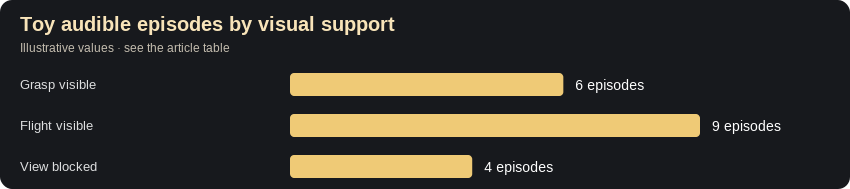
The following chart and table contain invented episode counts, not observations or values from the primary sources. Each row describes what the image showed during the assigned audible episode under the toy scoring rule. These are counts of episodes, not individual bees, measured vibrations or pollen releases. Episodes are grouped into one primary visual-support category in this example.
| Visual-support category | Episodes |
|---|---|
| Grasp visible | 6 |
| Flight visible | 9 |
| View blocked | 4 |
The bars sum to nineteen audible episodes. In six there is a usable view of a grasp. In nine there is usable flight evidence during the relevant window. In four the view is blocked under the toy criterion. None of these categories requires a visible pollen release, and the table does not contain one. The six grasp observations are not six measured releases or six successful pollinations. Similarly the nine flight observations do not prove the sound originated in the particular bee in frame. Visual context and source attribution are separate judgments.
An actual scoring scheme might allow several labels within the same episode. If a sound extends across a departure and you can see both contact and flight, report both and state that categories may overlap. If a graph requires exclusive categories, use a predefined mixed or uncertain class or a documented primary rule. Do not place ambiguous items in whichever bar best supports a narrative. The toy arrangement is intentionally simple so readers can see its counting structure; the original record should preserve whatever detail is lost to the simplification.
The distinction also prevents a misleading percentage. Six out of nineteen describes the fraction of the toy episodes assigned the grasp-visible category. It is not the fraction of all visits involving a grasp, because visits with no eligible audio are not in the denominator. It is not a rate of release, since that outcome was never measured. If a garden team reports episode counts, say which recordings were analyzed and whether silent, interrupted or unusable material was eligible. A correctly drawn bar cannot repair a denominator mislabeled as all the bee activity in the garden.
Give a release its own evidence standard
For an informal review, use “visible possible particles” when the image shows small material but origin or composition cannot be distinguished. To describe a visible release from the flower, the trajectory and its starting region need to be clear enough to make that narrower statement. To call the material pollen with confidence may require corroboration your passive field record does not supply. The favorable score is not necessarily “confirmed”; it may be “unresolved despite a useful view,” which accurately records why more could not be said. Do not move or remove anything in order to satisfy the form.
An earlier dusting on the bee is not evidence of new release during the part you watched. It could have been carried from elsewhere or acquired at a moment outside the current view. An insect changing direction can make existing particles look like new motion. Light passing across the scene may reveal material that was present but invisible. Another source of nearby moving particles may also fill a shallow field of view. When no plausible view connects material to the flower in the relevant interval, record the impression without promoting it to observed release.
If you see no plume, be equally precise. The particles could have been too small, poorly lit or hidden behind the visitor. A clear view adequate to describe the grasp may be inadequate to assess the outcome at the anthers. “No release observed in this clip” is not equivalent to “pollen did not leave the flower.” A good scoring sheet needs an unknown category even when the audio and visible posture are both recorded cleanly. Those positive entries do not make an obscured endpoint negative.
Review before, during and after the candidate episode
Start with a short stretch of ordinary playback rather than jumping directly to the most striking sound. The earlier interval can show whether the subject was already holding the anthers, in flight, obscured or absent. The later interval can show whether there is a continuous view of departure. Retain a little context on both sides when bookmarking the episode. A clip cropped to the apparent peak may be dramatic and omit the evidence that distinguishes contact from takeoff. Cite the longer source segment in the observation log even if a shorter illustration is used on a slide.
Now review the image without sound if practical. Write which actions can be identified from the pictures before listening for an onset. Then review the sound without relying on the outline of a waveform to decide that the bee in view was responsible. This is not a perfect blind assessment, especially when the same observer remembers earlier playback, but it is a useful discipline for preventing each channel from being used to assume what the other should show. Keep uncertain optical events separately from uncertain acoustic markers. The combined note should say what changed after comparing them.
For one hypothetical clip, a bee is clearly holding a flower before the audio mark starts, remains in contact in the first few frames of the marked interval, and leaves after a blur obscures the transition. A sensible record states that grasp was visible during part of an audible episode, that the departure time was not resolved and that no release could be verified. It does not say all of the sound occurred during contact. This distinction is important if another observer later tries to count sounds before takeoff versus sounds accompanying flight. The evidence brackets part of the sequence without deciding every temporal relationship.
Use slow playback only to clarify what frames really show. A player can repeat, interpolate or smooth frames as a convenience. Those views can hide the fact that the original sampled separate instants and may not reveal intermediate events. The original record remains the authority for a timing claim. If a viewer generated new intermediate frames, do not use those frames as evidence of a release that the camera never recorded. Save the relevant source timestamps and disclose any transformation used for an illustrative replay, especially if an editor shortened the silence or moved sound to improve presentation.
Decide how to assign a sound when more than one source is plausible
A garden recording is not a private channel between recorder and insect. Other animals, pedestrian movement and wind can contribute. A sound present at the same moment as a visible action is a candidate association. Stronger source attribution can come from a view that follows the same insect and the repeated relationship of the sound to an observable action, with no obvious competing source. Even then the appropriate field term may be “associated with” rather than a quantified measurement of anther vibration. Record any competing source you could see. Various kinds of agreement support various strengths of claim.
Say one visitor is holding a flower and a second crosses the top of the frame. The nearest sound aligns with the overlap of those events. It may not be possible to choose a source. The log can record a visible grasp, a visible flight and an audible episode with unresolved source attribution. This is more information than choosing one of the two and erasing the other. When summarizing examples for a classification study, include ambiguity rather than letting busy scenes disappear. Excluding them without a note makes the chosen clips appear more diagnostic than they typically are.
Now consider a cleanly recorded departure with wing motion visible and a clear audible mark after the animal leaves the flower. This provides a useful comparison for training observers about flight context. It does not prove a universal signature by which all flight sounds can be recognized. Device processing, distance and other conditions can differ from clip to clip. A safe criterion is the documented action and whatever overlap the evidence supports. The purpose of the record is not to assign every audible mark to a behavioral label with perfect certainty. It is to identify what can be assigned and how much remains unknown.
Some ordinary misalignments produce a persuasive narrative. A phone may play a slowed version with altered audio, or a separate clip may have been extracted from a longer source whose times were reset. If the beginning of the visible grasp appears two seconds before a sound in one version and exactly aligned in another, check whether they are the same record before analyzing either. Preserve filenames or stable identifiers, the viewing range and the clock basis. Timing is an evidence relationship, not a cosmetic feature of whichever saved version is easiest to open.
Keep silent, blocked and off-screen outcomes visible
A recording collection made by saving only striking sounds provides no ordinary comparison with quiet visits. If the project wants to compare different contexts, define a fixed recording or review interval before extracting audio marks. A silent recording could contain eligible visual behavior, or sound could be lost due to the device or conditions. Keep those cases distinguishable. Counts of usable audio need not be counts of successful video and neither is a complete count of animals. A submission form with one field for general quality may obscure exactly which channel failed.
There are at least three forms of unobserved evidence in these examples. One is continuous observation with no detectable sound under the stated rule. Another is sound absent because recording was paused or unusable. A third is sound present while the view cannot locate its source or outcome. None should automatically be used as a negative for pollen release. A table can keep the three pieces of information separate, including whether the observer was watching directly. That makes the case usable for the right analysis without encouraging false comparisons among very different records.
Natural interruptions deserve a timestamp too. A visitor crosses between the camera and the plant, the bee goes behind overlapping petals, or the frame shifts when the person holding the phone changes posture. Stop scoring what you can no longer see. If the view returns, document whether it supports continuity of the same subject or merely restores a view of the flower. An uninterrupted sound cannot resolve identity through a blocked image unless separate evidence does so. In a timed field series, mark the period of lost observation rather than trying to bridge it with a guess prompted by the previous action.
Consider also episodes whose beginnings are cut off when a recording starts after the visitor arrives. It can still provide evidence that the bee was in contact by the first frame. It cannot establish that the audible onset preceded or followed initial contact if the relevant onset was not in the recording. “In contact at first usable frame” is an appropriate status. For a later comparison of transitions, exclude it from that specific timing denominator or retain it separately as incomplete. That way the project preserves useful evidence without inflating the set of fully documented sequences.
Describe what happened to pollen without skipping the other endpoints
A hypothetical clear frame shows visible particles moving away from a known floral structure at a recorded moment. If the particles are sufficiently identifiable as pollen, the note can document visible release and the window supported by the record. A separate view might show some material on the visitor afterward, but that is another observation. It could be consistent with pickup without providing a complete count or proving the later material came from that flower. As the claims move from release to pickup to transfer, the need for an independent link grows. Do not allow narrative continuity to replace evidentiary continuity.
The distinction is particularly useful when presenting educational explanations. One diagram can show the general mechanism of mechanical vibration reaching the flower. Another image can be labeled “passive garden clip: an audible episode during visible handling.” An accompanying note can say that pollen was not resolved in the clip. The diagram explains a plausible mechanism and the video documents a particular event under known limitations. Neither has to serve as proof of the other. That division can make the presentation clearer than a single caption that purports to show an invisible endpoint.
Avoid interpreting volume as a measure of quantity when choosing excerpts. The most audible episode may be the one closest to the microphone. The quietest may be the one recorded just as a neighboring noise ended. It is possible that the loud event also released more material, but without appropriate measurements that is a hypothesis, not a result. If an example is selected to make a behavior easier to notice, state that it is a selected illustration. Do not present it as representative of the relative prevalence of other behaviors that were never as easy to hear.
If a research article records pollen deposition on a flower after an identified visit, that endpoint is different from any audible release. A comparison that establishes how pollen left one flower does not tell you where any grain later landed. A crop outcome such as fruit set brings in yet more processes and observations. Use the word pollination with an understanding of which part of the chain you are discussing. Nothing forbids calling the general mechanism buzz pollination while being careful to label the particular clip as evidence of sound and handling, not verified transfer or fertilization.
Build notes somebody else could score
Give each reviewed episode an identifier connected to its source clip, the intended watch and the relevant visible subject where known. Record whether the audio and video timing can be aligned, the window that contains the mark and the rule you used to choose its bounds. Add distinct fields for visible posture, flight, possible material movement and whether an outcome could be evaluated. One person might use a compact table and another a written form; the important part is that the evidence does not require reconstructing their intent from a single column titled “positive buzz.” Keep any raw media private or compliant with the relevant sharing policy.
A practical review exercise uses several fictional or properly available source clips. Ask two observers to choose a visual support category independently and then state whether they could attribute the sound. The disagreements are informative. If one person calls a blur evidence of flight and another marks it obscured, refine the visible flight standard without assuming either habit was based on bias. If both agree on visible contact but disagree about the onset of sound, the audio threshold or sync might be the relevant problem. Working through the categories improves the audit more than averaging the two proposed times without explanation.
Add a timing illustration that can be checked on paper. Suppose a hypothetical clip shows definite contact at the fourth second and definite flight at the sixth, while a brief audible event lies somewhere in the intervening span and the middle frames cannot resolve posture. You have bounds on two visual states but cannot place departure precisely. Even if you can measure the audio instant to a fraction of a second, that does not improve the image evidence. Describe which intervals overlap and which relative orders are established. The weakest relevant channel sets the limits of the joint interpretation.
If the form goes to another group, include examples that end in unknown. A note meeting the protocol should not be penalized for refusing to infer a release. Emphasize what a strong observation would have to show, and why the project's purpose can be met with an acoustic and behavioral description. Many field exercises fail because the form demands a biological conclusion every time the counter increments. A good sheet allows a more interesting distribution: multiple clear sights of handling, some clearly contextualized sounds and very few directly assessable outcomes.
Choose a comparison that the available timing can actually answer
Suppose a group asks whether sound begins before or after contact. For that comparison, a clip must show the first defensible contact interval and contain the first usable audio onset. A clip starting with a bee already on the flower can be excellent evidence of an audible episode during handling, but it cannot answer which came first. A clip with a near-simultaneous appearance can fall into an unresolved order class instead of either order. Put the eligibility rule beside the result. Otherwise the cleanest timing comparison often turns into a mixture of genuinely observed transitions and entire visits whose beginnings were never in view.
The same approach is useful for contact and departure. Suppose the last definite grip is in a usable frame, followed by two obstructed frames and later clearly visible flight. Onset of flight can be bounded but may not be pinned to a single frame. If the audible mark falls anywhere inside that gap, the current record cannot settle its relationship to the precise transition. Rather than rounding both to one instant and calling it simultaneous, keep the uncertainty interval. A precise sound boundary does not make the less precise visual boundary any narrower. This is the exact reason the title talks about a timestamp rather than denying any relationship between sound and handling.
Choose a suitable temporal resolution when summarizing results. If enough clips only support statements about intervals lasting several seconds, report those as intervals. Do not publish a chart of differences in milliseconds simply because a sound editor can display that unit. Conversely, a clear close comparison may support finer timing than a general field note, provided its equipment and processing history are documented. State exactly what resolution the evidence supports. A high-resolution label on a file is a statement about format, not necessarily about what can be identified at that scale.
Sometimes a person wants to compare which kind of visible action was most often accompanied by sound. This is not the same question as which action was most common among selected audible episodes. The former starts with a defined set of visual actions, including ones with no detectable audio; the latter starts with sound. Either can be a defensible design if the sampling rule is explicit. When recording only a few memorable clips, frame the conclusion as descriptive. A reversed conditional fraction can turn a modest accurate observation into an unsupported claim about most visits.
Account for how the viewing channel influences apparent outcomes
A camera looking down into a flower may resolve the posture of the visitor but show no clean background against which small moving particles can be seen. A different passive view might provide good contrast but leave the contact point hidden behind the insect. Two clips can therefore have different evidence strengths within the same watch. Treat camera placement and field of view as part of the evidence, not something to explain only when results seem inconsistent. No choice of view is worth disturbing a flower or its visitor. A site where the usable public view cannot answer the question deserves a narrow question instead.
Lighting can create its own apparent chronology. A particle might only pass through an illuminated zone after it leaves an obscured area. The first seen instant would then mark when it became conspicuous, not necessarily when it departed the flower. If you can see the starting structure but only in alternating dark and bright moments, use a lower confidence category. Similarly a short flower movement at the relevant moment can be evidence of movement while leaving its force, origin and effect unresolved. Record what the sensor and observer could see instead of making the most visible frame the beginning of the mechanism.
Remember that the sound track has a viewing equivalent of its own. Background conditions may change, and automatic gain can make a quiet part of the recording look comparatively loud. A microphone can be obscured or moved while the animal remains in the same place. Try comparing the ordinary recording context before treating amplitude as a carefully controlled measure. For the passive workflow here, a documented audible event does not rely on an assumed calibration. A quantitative comparison of mechanical vibration on flowers is the subject of study instrumentation, not a hidden feature of a garden audio clip.
Keep a short review trail after deciding what the clip supports
A review trail can include the original window checked, which channels were considered and the best-supported action and outcome labels. If a colleague later sees a clearer version, they should be able to revise the outcome without changing the previous file or inventing an earlier departure time. Add a dated reason and distinguish improved evidence from a new behavior. If the disagreement is about the rule rather than a frame, consider reviewing the comparable set with the new rule rather than selectively updating an interesting case. The purpose of a reproducible note is to accommodate better understanding without turning that understanding into a new field encounter.
Finally, make one correction test in a fictional sheet. Change an entry from view blocked to grasp visible after a usable image is supplied. The number of audible episodes should remain unchanged; only the visual-support category moves. A report of verified release should remain unchanged unless independent evidence of that endpoint is actually added. This check protects a simple counting relationship that is easy to lose in an attractive graph. Improving the view can make a recorded event more informative without making an unmeasured biological quantity suddenly known.
Make a report that keeps its evidence when a clip is shared
A caption might read: “A short sound overlaps visible contact in this selected segment; pollen release cannot be assessed.” If the scene only shows flight, say so. If the sound was recorded separately and alignment was not verified, avoid a caption asserting simultaneity at all. The timeline can show colored blocks or small labels for each observation channel, but the legend should not depend on color alone. Plain words for audible mark, grasp visible and view blocked can help readers recover the record in a static copy or text alternative. The more polished the edit becomes, the more important that its labels preserve the limits of the original.
When presenting aggregates, include a small note about the selection frame. A tally of episodes chosen from one clear viewing position describes that set. It should not be treated as a census of all visitors or compared to an earlier watch with a different mix of device settings without qualification. If the primary purpose is explaining the anatomy or timing, avoid making a biological frequency claim at all. The toy chart in this article illustrates categories and a denominator; its invented values are not estimates for any region, plant or kind of bee. Preserve that distinction in the chart file as well as the prose.
Finally, choose the smallest justified verb. A sound was heard. A grasp was visible. A visitor left the flower. Material appeared to move. Pollen release was observed only when the available evidence meets that particular endpoint. A reader can then see exactly when the account moves from some shared principles of pollination to a claim about a single moment in a recording. It may seem inconvenient not to label every good sound as a release, but the record becomes much more useful. Another observer can compare the sound and posture without inheriting a conclusion about parts of the flower nobody could actually see.
Sources and illustration note
- De Luca, Cox and Vallejo-Marín: Comparison of pollination and defensive buzzes in bumblebees, original study; author-hosted full text.
- De Luca et al.: Variability in bumblebee pollination buzzes affects the quantity of pollen released from flowers, original study; author-hosted full text.
- Vallejo-Marín: Buzz pollination, studying bee vibrations on flowers, author overview of acoustic and substrate-borne components.
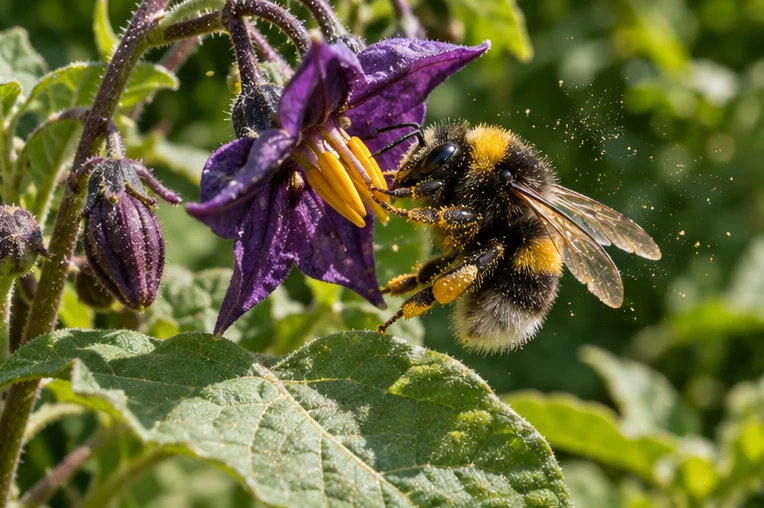
The examples and figures are invented. Any generated bee and flower image is editorial art, not recorded evidence of an animal, an anther release or a timestamp.