| Category | Value (observations) |
|---|---|
| Visible feeding | 7 |
| Perched uncertain | 11 |
| Flight only | 6 |
Illustrative values, not sourced observations. Examples distinguish behavior rather than individual IDs.
A butterfly settles on a flower head at the sunny end of a garden bed. Its wings open. A person watching from the path writes “feeding.” A second person, standing off to the side, sees that the head is angled away from the flower and that the mouthparts are not visible. Neither person needs to settle what the butterfly was doing by guessing. They can agree it landed on the flower and held its wings open, and leave feeding unresolved. The distinction may feel minor for one butterfly. It matters when a dozen such sightings turn into a chart or a recommendation about which plants fed the most adults.
A butterfly can use a garden in ways that a flower list does not capture. There may be places to rest, surfaces that receive direct sunlight, sheltered positions, plants providing liquids, and locations an insect simply passes while flying through. Observing one use does not prove that other uses are absent. Nor does finding an adult on a flower establish how much nectar it obtained or whether it transferred pollen. A behavior ledger gives the observer a way to preserve an encounter without making it answer a broader ecological question.
The approach here is for noninvasive observation of free butterflies from a permitted vantage. It uses a few grounded distinctions: posture is descriptive, an observable mouthpart and its target can support a feeding interpretation, and an obscured view should remain obscured in the record. The example chart uses invented values. The aim is to produce notes someone else can review, not to make a butterfly perform for the notebook.
Start by describing the scene, not by naming the motive
Write down the object the butterfly contacted and what part of the body was visible. The animal could be standing on petals, on the upper surface of a leaf, on a fence rail, or on a warm-looking stone beside flowers. Record whether the wings were open, folded, partly spread or changing position. A foot visibly resting on a flower and a head pointing toward it are distinct descriptions. Neither establishes that the proboscis, the adult mouthpart used in liquid feeding, reached anything the butterfly could take up.
Then describe what changed. Did the butterfly remain motionless for a time, walk across part of a flower head, repeatedly lower its head, or take off before a clear view was possible? If it moved, tell readers whether you maintained a continuous view. A move observed from one flower to the next might be a single encounter within a garden patch, depending on the protocol. A reappearance after the butterfly passed behind a hedge is harder to link. A handful of carefully chosen words can keep continuous observations distinct from plausible sequences that were not actually seen.
The USDA Forest Service guide to attracting pollinators with native plants provides context for garden plant relationships and the variety of visitors a planting can support. The U.S. Fish and Wildlife Service monarch account distinguishes adult use of nectar sources from the milkweed food requirement of monarch larvae. That context helps explain what kinds of interactions observers might look for. It does not settle what happened during a particular landing. Keep resource background in the report, but avoid using it like a label pasted onto every animal at a familiar plant.
A well-supported entry might say that a butterfly perched on the outer portion of the flower head, opened its wings and left; the head and mouthparts were hidden. That is substantially more informative than “butterfly on flowers” if a future reader wants to distinguish resting or landing from feeding. The entry is also more reproducible than a motive claim. It says what the scene allows. If the view later improves and mouthpart contact is documented, the reviewer can add a better supported classification without changing the description of the earlier interval.
Take basking seriously without seeing it everywhere
Basking is not simply the word to use when feeding has not been demonstrated. Butterfly posture can relate to thermal behavior, but the relation is specific to the animal and situation. A primary study of the Australian common brown, Behavioural thermoregulation and the relative roles of convection and radiation in a basking butterfly, analyzed posture and heating in that species. A separate primary study, Physical and behavioral adaptations to prevent overheating of the living wings of butterflies, describes several aspects of thermal biology and how some of the studied butterflies behaved in light. These studies explain why it is reasonable to consider warming or heat avoidance. They do not make a single pose a universal decoder for the intention of any individual.
An open-winged butterfly on a sunlit stone can be recorded as perched in direct light, with a posture consistent with basking. If a team wants a specific basking category, define the repeated observations or comparison features it would need, and make clear that body temperature was not measured. Which way the butterfly faces, whether it moves with a sun patch, and what happens when the light changes might help formulate a hypothesis. A garden viewer should not alter light or risk disturbing the insect to force an answer. The animal's own movements are enough to support a descriptive record.
Resting, sheltering and thermal behavior can overlap in ways a short view cannot resolve. An animal under a leaf could be protected from wind, out of direct sun or simply out of the observer's sight. Another might pause in sunlight and then begin feeding while remaining at the same flower. A protocol that gives every perch one fixed motivation will miss this type of change. Instead separate visible movement and posture from confirmed or reasonably supported resource contact. The local notes can then acknowledge more than one pattern within a single encounter.
Even a good photograph can make a thermal story seem clearer than it is. Visible sun can be recorded for the time and place of the image, but a bright background can result from exposure rather than a reliably warmer surface. Positioning a person on a different side of the animal changes which surfaces appear bright. If the project discusses warming from a particular location, it should distinguish weather context from body temperature. Basing a behavior hypothesis on visible wing position is not the same as measuring temperature change in the butterfly.
Use the proboscis as evidence, not a quantity meter
A useful feeding criterion for a short garden exercise is a clear view of the extended proboscis reaching a plausible liquid source, with contact that fits the project's observation rule. A sustained contact or repeated clear probing can be more informative than a fleeting curved line in a photograph. Keep the target in view if conditions permit, and name the target only to the level the evidence supports. Contact at the base of a visible flower is different from confirmation of the exact flower structure reached. At this scale, feeding may be an operational behavioral label, not a direct measurement of liquid uptake.
If the observer sees the mouthpart extend but loses the tip behind a petal, record visible extension and uncertain contact. If a probable antenna or a fine petal edge might be confused with the proboscis, leave it unresolved. A clear photograph could help identify the structure later. It cannot show an earlier or later movement that was not captured. Similarly, the absence of a visible proboscis in a distant view does not establish that the butterfly was not feeding. Recording “not visible” rather than “retracted” keeps lack of evidence separate from a positively observed state.
Choose the relation between flower feeding and other kinds of apparent liquid contact. A project may wish to record a butterfly using a damp surface separately from probable floral feeding. If the example ledger is limited to floral feeding, that nonfloral observation should not be quietly added to the same category. A broader project can give each plausible resource a named field and calculate separate totals. In either case do not infer how much material was taken up, a nutrient preference, or the source of moisture simply because a winged visitor approached a surface that looked wet.
Pollen transfer is a further claim. Visible contact with a flower may be useful evidence for a study of interactions, but it does not say a butterfly carried pollen from another plant or that a compatible grain reached a receptive surface. Even a direct feeding observation is not a count of fertilization. A garden can keep a list of plants with documented adult contacts without describing that list as a measure of plant reproduction. If the research question concerns pollination outcomes, design it separately instead of enlarging the meaning of the feeding label.
Decide how much one observation includes
An encounter can be defined as continuous observation of one visible animal within a specified patch, ending when it leaves that patch or is lost under the protocol. That definition is useful for a small behavior ledger because it prevents a burst of photos from becoming a burst of independent butterflies. It also allows field notes about transitions. The animal might enter in flight, perch with no contact visible, then extend its proboscis in a clear view. The three moments can be recorded as a sequence linked to one encounter.
This article's toy chart assigns one category to each observation. An implementation might use the most strongly supported behavior for an encounter: visible feeding if that was recorded, perched uncertain if the butterfly perched without enough evidence for feeding, and flight only if no landing was seen during the observed encounter. This is a hierarchy for a particular ledger, not a description of the full time budget. A more detailed study might count individual feeding bouts or code timed behavioral segments rather than select one label per continuous encounter. If you change the unit, tell readers which results use each definition.
The hierarchy does not imply that all occupied flowers without visible feeding are examples of nonfeeding. Perched uncertain includes potentially different actions that cannot be resolved from the observed window. Also separate a confirmed nonfeeding behavior if the question and method support such a category; there may be good evidence for a particular posture or activity even when it belongs in another display. Keep the words visible feeding restricted to an affirmative cue rather than moving cases into it based on substrate, color or expectation.
Do not claim repeated encounters are individual identities. A butterfly may leave and return, and separate file timestamps alone do not distinguish whether that happened. If knowing identity matters, the project needs appropriate evidence for it. An educational note can state that one butterfly was observed continuously for a minute without claiming a second one came back an hour later. The same conservative rule helps when two visually similar animals cross paths. The time to put an observation boundary into the methods is before people start treating every landing as a formal record.
Read the illustrative chart and its companion table
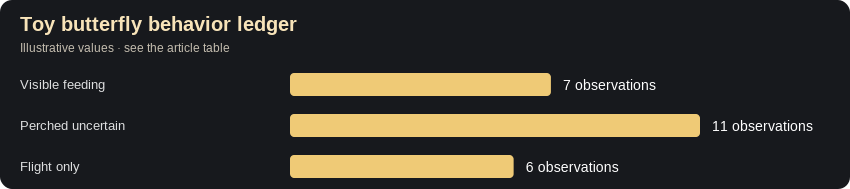
The chart “Toy butterfly behavior ledger” gives twenty-four fictional observations. Seven are Visible feeding, eleven are Perched uncertain, and six are Flight only. The classes partition the toy ledger because each observation has one heading for display. They are not counts of twenty-four unique butterflies, and they were not reported by a source agency or a field study. The bars demonstrate how a set of ambiguous perches can remain visible in a report without being counted as feeding.
| Illustrative behavior class | Observations |
|---|---|
| Visible feeding | 7 |
| Perched uncertain | 11 |
| Flight only | 6 |
| Total | 24 |
Seven divided by twenty-four is about 29.2 percent, the share of all toy observations classed as visible feeding. If the operational procedure treats observed feeding as having involved a landing, then seven and eleven together give eighteen observations that included a documented perch or landing under this toy setup. Among those eighteen the verified-feeding share is seven divided by eighteen, about 38.9 percent. The second percentage answers a question about that subset. Neither tells how many butterflies in a real garden feed. The values lack information about detection, site coverage, sampling in time and repeated appearances.
A fact that surprises new reviewers is that the apparent count of feeding would jump from seven to eighteen if all the uncertain perches were recoded as feeding. That increase would come from a change of label, not from any new observation. It would be equally unsound to treat those perches as conclusive examples of no feeding. The useful result is the one that names what is supported and preserves the ambiguity. A category for unresolved behavior is a measurable feature of the ledger even when it does not decide what the animal did.
Flight only means no landing was observed in the defined interval. It does not mean the animal never landed beyond the patch or at a time outside the watch. A short clip that ends on a butterfly still in flight obviously leaves later events unobserved. The same is true of a human view, even when it lasts longer than the clip. The scope of all three categories is the actual observation window. Put that in the method and make the caption clear enough that a reader does not infer a life history from a temporary classification.
Keep the view and time budgets visible
Field observers can spend the same number of minutes at two benches and obtain different opportunities to see a proboscis. One side view might show flower contact clearly while another faces the backs of the petals. Perspective, glare, plant height and moving foliage affect what can be observed without increasing or decreasing actual feeding. Record the intended point, whether the head of the butterfly was visible, and whether there was an obstruction relevant to the decision. A record with a clear landing but no usable head view is useful for landing counts, even if it supplies little evidence about feeding.
Use actual observation effort rather than the time volunteers spent at the garden. A class might stop to write descriptions after a butterfly goes into view, or an observer might answer a question and miss the moment it changes position. Define how an interrupted watch is handled. Record canceled and partial sessions instead of converting them to complete zero-feeding sessions. If a watch was completed and no qualifying encounter occurred, keep that zero under its stated conditions. A data table needs both eligibility and outcome fields; not every absence of a positive label means the same thing.
If a team uses still images as additional evidence, keep photographs linked to the watch and do not change its effort duration to include reviewing them at home. Review can improve classification of events already seen, but it does not add minutes of animal activity. A camera recording that runs during a pause may provide useful evidence under a video method, which is distinct from a live observer's watch. Say which source a reported event came from before mixing records into an analysis. That distinction becomes important when one garden has recordings for all sessions and another has paper descriptions only.
When possible, record context without changing the animal's opportunities. Standing closer to get the head in focus may alter the encounter or end it. A suitable zoom view from a path can be helpful, but stop if the angle is not possible. Do not move flowers toward the camera, catch the butterfly, prompt it to reopen its wings or bait it for a better-looking record under an observational protocol. A missing view is a valid limitation. The field notes exist to document a scene observed responsibly rather than to demand that the scene cooperate.
Compare plants without pretending an observed visit shows preference
Imagine two flower beds in one garden. The first has low open flowers where the observer can clearly see an extended proboscis. The second has tall clustered flowers where contact is often hidden. A higher count of visible feeding in the first bed can reflect visibility, actual feeding behavior, observation time, differences in the amount of available bloom, or any combination. It is fair to say what more often became visible under the method. A claim that butterflies prefer one flower over the other needs more support, including a sensible comparison of the alternatives available and exposure under matched conditions.
One improvement is to define where the watcher stands and make a note of open flowers visible from that position. When two plants are available during the same watch, record whether the butterfly could plausibly encounter both under the observation boundaries rather than merely assuming a choice from plants that grow somewhere in the garden. A short introductory exercise can focus on classification and let preference remain a question for later. The most important decision is not to use a stronger verb than the design supports.
Time and setting can affect comparisons beyond obvious view differences. A shaded bed may be watched early while a sunny bed is watched late because the class follows a convenient route. A flowering species may be much more prominent during one week than the next. Keep the date, watch order and context with each record. Alternating order or using planned comparable watch windows may help a later project, but a sparse garden ledger should not present a corrected preference estimate where the relevant exposures were not measured. Concrete limits are more useful than a general warning that all field data are imperfect.
Keep habitat features that do not involve feeding in the story. A sunny stone with regular perches can be worth documenting even if no clear feeding occurred there. A planting area with many flower contacts can have a different role from a sheltered edge with frequent rests. The point is not to rank every feature using one column. Different behaviors can be legitimate observations of site use, and they can guide different questions about the garden. An honest account of two contributions is better than claiming one was observed simply to turn it into a score.
Practice on a few cases before counting a season
First consider an animal that makes several loops above flowering plants and never lands within the watcher's qualifying view. The observer notes approximate position and the fact that no landing was documented. In this toy scheme the outcome is flight only. If the animal disappears behind a bloom and reappears flying, the middle action may be unknown. Do not substitute the assumption that a hidden part of the route was uninterrupted flight. A short note about the gap can accompany the category or make the case unresolved under a more stringent method.
Second, a butterfly opens its wings on a dark rock and remains there. A side view does not show any clearly extended proboscis. Record substrate, posture and direct light if it was observed. Perched uncertain is appropriate under the three-class example. Basking is a plausible interpretation of some such scenes but not a necessary label, and thermal effects were not measured. This same entry could be useful for a separate observation about which surfaces were used as perches. Lack of feeding evidence does not remove its value to a broader garden inventory.
Third, the observer has a continuous view of a butterfly walking into an open flower head and sees the proboscis extend and make sustained contact at a plausible floral source. This meets the visible-feeding threshold for the toy scheme when the required view is present and the observer can identify the structure. It does not settle how much was consumed, whether pollen moved, or whether the butterfly chose this site over others it could have visited. The narrow label is strong enough to support the intended comparison without making it more specific than the observation.
Finally, consider an adult that rests on a leaf, later flies to a flower and visibly feeds. If the same individual was continuously seen, the behavior sequence can be saved under one encounter. In the one-label summary it goes to visible feeding, while the rest and flight remain in the underlying notes. In a timed study of how long animals rest, those intervals would be important in their own right. Conversely, two short clips separated by loss of view should not be forced into such a sequence without adequate evidence. The ability to match records should be tested before using it to simplify the totals.
Resolve disagreements without guessing at the missing action
A pilot can give two reviewers the same set of permitted observations or clips. Ask them first to mark the visible part of the view, then to classify the event. Someone might see a curled dark structure near the head and think a proboscis is extended. Another reviewer might see only a loop that never reaches a plausible source. The disagreement is useful because it reveals a rule that needs an example. It does not require two people to split the difference and create a new unknown probability of feeding from two strong impressions.
Check the role of clip duration. A still frame shows posture; a sequence can show repeated contact or a transition. When only stills are available, the rules may need stricter cues than a protocol using confirmed continuous views. An earlier report by a trained observer can supply evidence beyond a photograph if the method incorporates the observer's note. But the later photograph still cannot confirm every phrase in that note by itself. Write which part of the judgment rests on imagery and which depends on a documented witness or sequence.
Version revised instructions and use them consistently. If the definition of visible feeding changes midway through a season, establish which records were reevaluated. A new figure can have a dated method note, while the older result can remain an honest description of its earlier rule. Avoid updating only the files whose behavior seems dramatic or straightforward. A useful quality check can ask someone unfamiliar with the garden to find the supporting record for one chart entry and explain why it did not belong in a neighboring category. If the labels verge on interpretation, revise what the form asks people to describe.
Preserve the field note before the story takes shape
An effective record begins with a few facts shown to anyone who was there: a watch ID, the viewing position, start and stop times, the target region, and who recorded the event. Use separate columns for the substrate, wing posture, whether the head was visible, the observed contact and the classification. This sounds formal for a garden sketch, but the distinctions become important when several people contribute. One observer's “uncertain” may say that the animal was too distant, while another's means the head was clear but the tip disappeared inside a flower. Neither note should disappear into a shared count without retaining what made the outcome uncertain.
For an example record, imagine a butterfly was continuously in view for forty seconds, first in flight and then on the edge of a pink flower. Its wings remained spread over the last part of the encounter. The observer wrote “mouthparts obscured by petal” and attached a supporting image showing posture but no visible contact. This is a complete account of that encounter from the stated viewpoint, even though the behavior category remains perched uncertain. A different record might give the same final classification when no trustworthy image exists but a clear perch was witnessed. The classification puts the cases together; the evidence fields let an editor see how strongly the details were supported.
Separately, keep a row for a completed watch in which nothing met the observation criteria. It is possible to carry out a planned watch without generating any encounter rows, or to create a detailed encounter note during an unplanned walk. If the record contains only encounters, a future reader cannot distinguish a truly quiet watch from one that never happened. If the worksheet contains only watches, it may not be possible to reconstruct how a mixed sequence fit into one class. An event ledger keyed to a separately described watch gives both levels their proper place.
A row that matches a photo should carry enough information to avoid linking the wrong image. File names alone can be misleading when several devices generate the same generic names. A stable watch and encounter identifier plus a clear time note is one way to make the association. Include whether the image shows the beginning, end, or just a moment during the observation. It is not necessary to preserve precise public location information if doing so would invite crowding or violate a site protocol. An internal map can support authorized review while the educational figure reports only coarse habitat descriptions and aggregate counts.
Ask whether the sample favored photogenic behaviors
A gallery exhibits butterfly behavior through choices people make about what to photograph and retain. Open wings on a dark stone can be easier to frame than a head partly buried in a bloom. A camera operator might hold a continuous clip through a conspicuous feeding stop but turn away when the butterfly crosses the path. Another volunteer may preferentially take close photographs at a particular flower because they hope to document the proboscis. These choices are not flaws in a personal nature collection. They become relevant when someone treats that collection as if it were a comprehensive sample of all behaviors at the site.
The resulting problem can arise even when the record has a sensible posture rubric. Suppose every clearly visible flight is noted in a live watch while the photo archive retains only stationary butterflies. Running exactly the same classification rule on both collections would give different opportunities to record flight. A lower number of flight-only records in the archive would not show that the animals changed activity. It would show that the archive and live notebook were assembled with different inclusion rules. Preserve the source and ascertainment method, and avoid pooling collections whose entry conditions cannot support the same summary.
Try an exercise with a fictional comparison. One garden supplies seven verified feeding observations from a planned watch set and eleven ambiguous perches. Another supplies seven feeding photos from a curated gallery and none tagged as uncertain. The matching seven counts do not put the two places on an equal footing. The first gives an exposure setting in which missed views and ambiguous encounters were retained. The second gives only a set of selected images. An editor can publish both as illustrations but needs to report the difference before plotting them as if each were an estimate of feeding at a different site.
Season and time can change who appears in the collection. A school group following a morning route may repeatedly reach the sunlit ledge at the time it is easiest to see open-winged perches. An afternoon group who starts at a nectar bed sees something different. If that contrast is the research question, plan observations that address both sites over relevant windows. If the project is not designed to disentangle them, describe the pairing of place and time instead of writing a confident mechanism. A modest result that acknowledges the selection conditions is more useful than a broad behavioral claim that becomes impossible to reproduce.
Match your next observation to what is missing
A weak view can suggest a better next question without turning into a promise. If perched butterflies often have their heads obscured from the regular path, look for an existing, equally safe viewing position where the relevant flower structures are visible. Plan whether the first and second viewpoints can be used at comparable times and whether people can observe without changing the encounter. Do not ask volunteers to follow butterflies into plants or move flowers for the sake of filling the confirmed column. The intervention would alter the conditions that the observation wanted to represent.
If observers repeatedly disagree about what they see near the mouth, the next action could instead be a calibration exercise. Show a small set of records with known views, let each reviewer describe the visible structure and its contact point, and compare those descriptions before assigning the category. Include cases where the best answer is uncertain. A training set consisting entirely of textbook examples may make the rubric feel easier than it is in the garden. Ask the reviewers what evidence they would need to become confident rather than requiring a yes or no on every file.
Sometimes a decline in apparent feeding simply reflects more careful reporting. A new method that keeps uncertain perching separate will almost certainly produce fewer verified observations than a method that counts all flower landings as feeding in the same dataset with uncertain perches present. The label change does not prove feeding declined. Save the previous summary and, if the original notes are detailed enough, rebuild both summaries under the new and old rules with labels. Readers can then see how the measurable claim changed before inferring a change in butterfly behavior. If old records never described the mouthparts, say that a comparable reconstruction is not available.
The practical advice for the garden depends on the quality of the evidence. If the project repeatedly saw adults in clearly documented perches on sunlit rocks, that observation supports discussing those surfaces as part of a varied garden environment. It does not mean the garden should fill every bed with rocks or that the perches had the same function every time. If a flower repeatedly shows probable feeding under a comparable method, that is evidence of local observed use rather than a guarantee about every year. A follow-up with explicit questions can turn these modest observations into better field decisions.
Write the caption that survives being shared alone
A public graphic may travel without the article or the methods. Put the key constraints where they will travel with it: the numbers are invented, the unit is observation, the three labels are mutually exclusive for the demonstration, and a perch with uncertain feeding was not counted as feeding. A longer accessibility description can add the numerical sequence of seven, eleven and six and its total of twenty-four. The chart is about classification. A stylized photo beside it does not need to prove the pictured animal was basking or that it contributed any data. Label generated illustration, contextual documentary image and evidence image as distinct kinds of artifact.
The best short description gives a reader something they can act on next time they see a butterfly land. Write what the legs are standing on, what the wings do, what the head reveals and where the line of sight stops. If feeding contact is clear under the observation rule, record it. If it is not, keep the perch and the uncertainty. Either way the scene remains worth observing. A careful ledger does not make a butterfly less interesting by refusing to name a hidden action. It gives the next viewer an honest place to begin.
Sources and illustration note
- USDA Forest Service: Attracting Pollinators to Your Garden Using Native Plants.
- U.S. Fish and Wildlife Service: Monarch species account.
- Behavioural thermoregulation and the relative roles of convection and radiation in a basking butterfly.
- Physical and behavioral adaptations to prevent overheating of the living wings of butterflies.
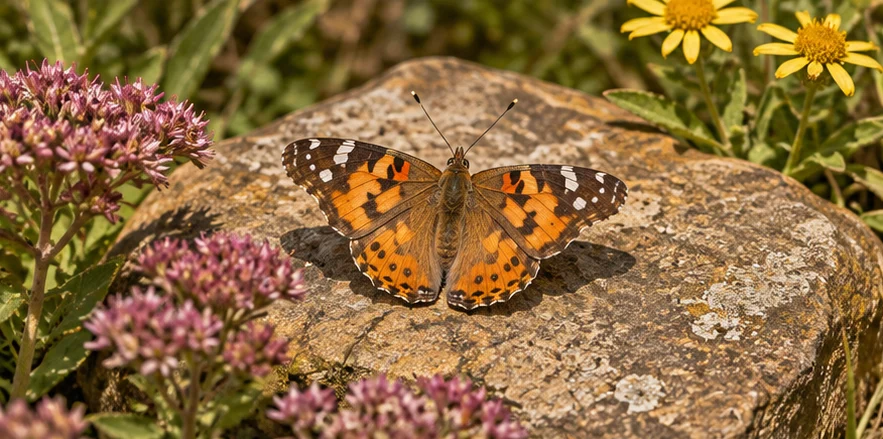
- The chart and table are invented behavior counts. The header depicts a perched butterfly as generated editorial artwork, not evidence about what a particular animal did.