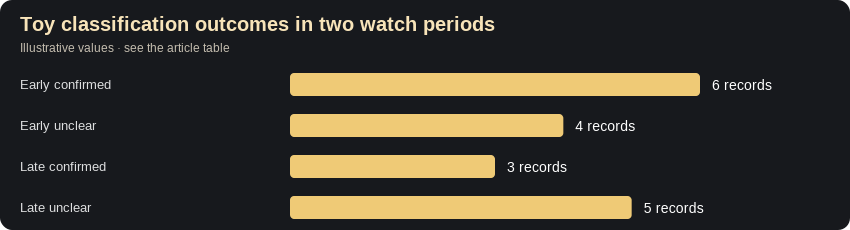
| Category | Value (records) |
|---|---|
| Early confirmed | 6 |
| Early unclear | 4 |
| Late confirmed | 3 |
| Late unclear | 5 |
Illustrative values, not sourced observations. No survival or successful-reproduction conclusion.
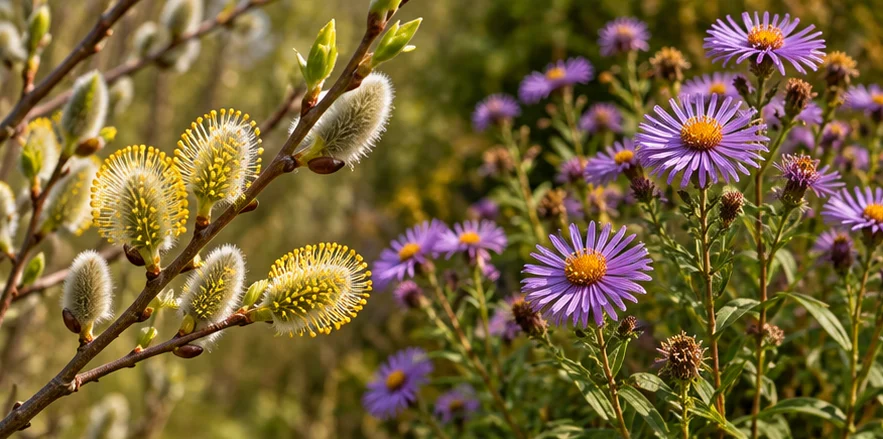
A large bumble bee passes low over a bank beside an early-flowering willow. Later that year another large bumble bee feeds on asters at the same site. An observer familiar with the annual colony cycle may think of the first as a queen searching for a place to found a nest, and the second as a new queen from the current year's brood. Both are plausible hypotheses. Neither comes with a date stamp that proves the animal's role. Size, behavior, season and identification can each help, but none should silently replace the others.
Gold at willow catkins and gold at autumn flowers can be parts of two quite different stories. In one, a reproductive female has survived an overwintering interval and is feeding or beginning the work of a new colony. In another, a reproductive female has recently developed in a colony whose worker phase is already established. A photograph of an adult can make either scene vivid without showing mating, natal nest, the animal's winter history or its future survival. The challenge is to describe the stage hypothesis while being very clear about what has actually been witnessed.
The title names two possibilities within a working annual model, not a date-based identification rule. Species, climate and habitat shift the timing. Some members of the genus have different life histories, and local seasons do not come with uniform boundaries. The chart here uses fictional classification records from two invented watches. It counts the clarity of records under a defined rule; it is not evidence of the survival of queens or the reproductive success of colonies.
Start with the annual model, then put the date back in its place
The Xerces Society account of bumble bee nesting and overwintering explains a common annual pattern in many bumble bees. A reproductive female overwinters, becomes active and may establish a colony. Workers subsequently contribute to the growing colony, and many colonies produce new reproductive females and males later in their cycle. Those new females can continue the cycle if subsequent stages are successful. The pattern is a useful organizing idea; it describes processes, not a universal set of dates.
The timing can differ across individual colonies as well as species and regions. Even within one site a sheltered patch can look and feel like a different season from a more exposed one. A warm spell may make an individual active at a time when a volunteer's usual survey calendar has not started. A late flower may bloom after a survey has ended elsewhere. Written periods such as early and late need local boundaries and dates, not the implication that all bumble bees follow the same schedule.
The model does not put every stage in a single continuous, observed line of succession. A foundress is an individual in a founding role, not proof of a colony that will successfully produce workers. An established colony is not necessarily one that will produce reproductive individuals. Seeing a newly produced reproductive female, where that status can be established, does not show that she will mate, overwinter or found another colony. Each transition has its own outcome and needs evidence at the scale where someone wants to make a claim.
Do not mistake conceptual expectation for observed age. A spring queen active near the ground might be searching, feeding, resting or moving among locations. In a late watch a large bumble bee could be a reproductive female, a relatively large worker or something whose identification is unresolved. If the observer believes a particular interpretation fits the date, put that in a hypothesis field. Keep the direct description independent enough that the hypothesis might turn out to be wrong.
Spring activity does not automatically show colony founding
Consider an adult bee moving low and stopping at several small depressions. That pattern can be consistent with searching for a nest site. It is useful to record the flight, how often the bee stopped and whether any particular opening was entered. A person who saw only the flight is not in a position to attribute an unseen egg-laying event. Even someone who witnessed an entry has not established that the animal committed to that site or began a colony there.
A queen that has become active can have several needs within a short period. Access to flowers may be relevant even when a watcher is primarily interested in nest searching. Entry into a cavity could represent inspection or another use. An observed return with material or repeated activity under comparable observations can strengthen the evidence of use. Such evidence should be recorded in its own right rather than folded into the adjective spring. The appearance of the flower patch does not tell whether a nearby cavity was selected.
Some early activity might be followed by a long gap with no further sightings. It is tempting to label the site unsuccessful or abandoned. That interpretation requires an appropriate method to distinguish failure, movement and non-detection. A watch of one accessible entrance cannot see all possible activity around a bank. If the original status was only a suspected founding site, a subsequent lack of observations cannot be turned into a count of failed colonies. Retain both the suspicion and the limits.
One primary study, Wild Foundress Queen Bumble Bees Make Numerous, Short Foraging Trips and Exhibit Frequent Nest Failure, used trap-nesting and RFID tracking to follow wild foundresses in a defined research setting. Its value here is that it illustrates how much more specific a study of founding and subsequent outcomes is than a single encounter at an early blossom. Findings in those setups should not be assigned to an unmonitored garden or to any of the fictional records in this article. The study's design, not just its topic, determines what it can say.
A late queen is not an observed winter survivor
The other end of the annual cycle introduces the word gyne. In this context it commonly refers to a newly produced reproductive female, in contrast with the established mother queen of her natal colony. Observers sometimes call both queens. When the role matters, say which sense you mean and how it was determined. A large adult at late flowers is a useful clue. It does not on its own establish that the adult is a gyne or identify the colony that produced it.
Even with a defensible gyne identification, subsequent events remain separate. Mating cannot be inferred merely from seeing a reproductive female feeding. A visit to a sheltered area cannot establish that the bee settled there for winter. Reappearance of a similar individual the following spring does not establish continuity of identity. A useful record of a reproductive female is valuable without calling her a successful founder in advance. A word about the possible next stage should stay explicitly conditional.
A late-season observation can also coincide with other activity. Workers and males may visit flowers, and their presence or absence in a short watch does not resolve which stage a particular colony has reached. Different individuals in the same patch may come from different colonies. If the goal is to describe the site rather than tie every animal to a colony, a dated foraging record can be appropriate. If the goal concerns which colonies produced reproductives, a site-level watch needs independent evidence that links those individuals to colonies.
This distinction helps avoid an appealing but misleading conservation claim. A planting can be documented as flowering when reproductive individuals may be active locally. If identified reproductive individuals actually feed there, report that stronger observation with its conditions. Neither fact alone proves the planting increased population survival. Both are meaningful, and clear scope is better than forcing the story to reach the next spring on evidence that stops in August.
What exactly counts as confirmed?
The toy chart is titled “Toy classification outcomes in two watch periods.” It shows eighteen invented records across an early and a late period. Confirmed means that a fictional record satisfies a stated evidence rubric for its identification or recorded stage claim. It is not a term for a successful new colony. For this exercise imagine a review that checked enough features to support the chosen observation label in the confirmed entries, and did not have sufficient evidence to resolve the unclear entries. Calendar alone is not a qualifying feature.
| Classification in toy chart | Illustrative records |
|---|---|
| Early confirmed | 6 |
| Early unclear | 4 |
| Late confirmed | 3 |
| Late unclear | 5 |
There are ten early records and eight late records. Nine of the eighteen are labeled confirmed under the toy rubric and nine remain unclear. That arithmetic says nothing about the proportion of bees with a particular role. Records are not necessarily distinct animals, source nests or completed life cycles. No source supplied these values, and no location or season was observed for this chart. It is an exercise in recording outcome categories, not evidence of survival or successful reproduction.
Six out of ten and three out of eight are corresponding descriptive proportions within the made-up periods. Changing the denominator to the sum of confirmed records answers a different question about where confirmed entries fall. In a real comparison, unequal duration, visibility or classification practice can make either ratio unsuitable for biological inference. Do not present a higher confirmed count as though more reproductive individuals necessarily existed. It might instead reflect better views or more occasions on which documentation was possible.
A useful detail in any real figure is how records got into the denominator. Were all encounters included, or only ones where an observer attempted an identification? Were repeated entries by the same individual linked where possible? Did the earlier watch produce more images than the later watch? Exposing those choices helps an editor avoid attributing a contrast in documentation to a contrast in colony performance. The toy chart deliberately leaves those larger questions unanswered.
Calendar evidence can be useful without being decisive
Suppose a watcher is familiar with the local season and has access to several years of observations. They know when the first sustained flowering often occurs and when they have previously documented reproductive individuals. That experience can help select watch dates and recognize unusual timing. Use it to frame a prior expectation, not an exclusion rule that rejects any observation outside the expected period. Moving a date on a schedule cannot determine the role of the animal that appears.
A more useful calendar has several tracks. Record date, approximate local stage of bloom, what other convincing behavioral evidence was available and, where there is a verified nest record, what was known of the colony's activity. These are separate data. A day may have abundant flowers but limited observation. A well-documented flight may occur outside the most expected weather. A calendar that keeps those tracks apart is flexible enough to register genuine surprises.
In field reporting, broad date labels can conceal differences in hours and conditions. A spring watch made in full sun can reveal details that a late-summer watch under dense shade cannot. One may take place in late morning and the other at dusk. A lower classification rate could reflect light and angle rather than an increase in uncertain individuals as a biological category. Explain the observation conditions that directly affect the ability to see relevant features.
Do not force a timing inference across places. An early record in one latitude or elevation is not directly comparable to the same calendar day at a different site. A regional model can become useful once its scope and evidence are named. For an educational garden, faithfully reporting the local observations is often a better contribution than assuming another location's pattern repeats on schedule. How timing varies can itself become an interesting question.
Appearance and behavior are separate kinds of evidence
A photograph can help establish visible features such as body pattern, proportions or other characters used in an appropriate identification. The useful characters and the level of confidence depend on the taxa and quality of the record. Size by itself is particularly easy to overread when the image lacks scale or the bee is foreshortened. Even a real size difference would not necessarily distinguish castes across species and colonies. Use suitable external guidance and informed review where needed.
Behavior can add another independent line of evidence. Low searching flight and entering potential shelter can be documented without assigning a fixed role. Pollen transport could be relevant to the observation while still leaving the stage unresolved. A big female feeding on a flower is not visibly performing all the tasks of a queen at that moment. Name the action rather than treating a broad behavioral impression as proof of an entire role.
When both appearance and behavior support an identification, record the reasoning. That does not require writing a long case for every image. A concise note saying which diagnostic views were available, what the individual was doing and whether a reviewer agreed is enough to help someone check the record. If a category was assigned by local convention rather than a biological determination, say so. The same label can mean different thresholds in different projects.
A watch that records a male, a worker and an unresolved large adult in sequence should not be summarized as an assured colony-stage diagnosis. Those individuals may be responding to flowers, moving independently or coming from more than one colony. Attributing them to one social unit requires appropriate evidence. The observations can instead describe the composition of the watch under the stated method, with boundaries that a reader can see.
Nesting and overwintering present different observation problems
A nest site can be challenging to locate and verify, even if adult activity is visible nearby. A sleeping or overwintering site can be harder still to observe directly, and disturbance to confirm it is not appropriate for a casual watch. The record can preserve evidence of approach or possible habitat features without concluding that a queen used them. Unknown is an honest statement about the method, not a finding that the habitat failed.
Do not equate a visit to leaf litter or a bank with successful entry into an overwintering state. An observer may see the bee vanish from view without seeing what it did next. Note the exact limit of continuous observation. Conversely, seeing an adult active in the following season is evidence of its activity then, without tracing where it spent the previous months. No pair of date categories on a bar chart can create identity across a gap.
The Xerces Society western bumble bee nesting report offers field context focused on the western bumble bee, Bombus occidentalis, and discusses considerations for nesting and overwintering habitat. Its species and management focus matter. A habitat feature worth attention in one conservation setting is not a rule that assigns caste, life stage or nest identity at every site. Use the report to help formulate plausible questions within a known scope.
Practical management can respect these uncertainties. Protecting existing resources through an appropriate local plan does not require proving that a particular queen used them. Conversely, a record of apparent activity does not authorize probing, moving or handling animals or structures to obtain confirmation. Observe from lawful, safe positions and comply with site guidance. A useful program can track habitat conditions and independently noted animal behavior without disturbing a potentially occupied area.
Separate three kinds of absence in the field sheet
The first is no observed encounter under a defined watch. It describes a period, a view and the interpretation of the chosen method. The second is a visible encounter whose caste or role could not be established. It supplies more information about presence but not necessarily about colony status. The third is a period not monitored at all. Treating all three as zero confirmed queens hides substantial differences for future analysis.
Consider an afternoon when a watcher cannot see a bee's relevant features because the animal moves back under the flowers. Record the visit and obstruction. If another observer photographs the same episode from a permitted angle, they may provide a better identification opportunity. If the link between the two observations is not certain, do not assume they were one bee. Better documentation of one category does not automatically solve the unit of count. Preserve details that matter to both questions.
The chart's confirmed and unclear categories concern records with potential classification information under a fictional rule. They do not include an explicit absence or a missed-watch group. An actual study could need both. Use distinct fields for whether a watch happened, whether an encounter occurred and how well the encounter could be classified. An empty cell or a false value used for all those cases will lead to hard-to-diagnose errors in a later summary.
These distinctions can matter to informal observers too. Someone can send a credible note that a certain site had activity at a given time with no view supporting a role. That record might help schedule a follow-up. It is not less valuable because it should not enter a tally of identified gynes. Designing a system to accept qualified observations improves evidence without rewarding overconfidence. An unknown kept in scope is more useful than a made-up positive result.
Use repeat observations without making repeat individuals
If the observation unit is a visit or watch record, say so. One animal may forage repeatedly while moving among flowers. Several images of the same visit can improve the evidence for identity without adding several animals to the site. Record which images can be linked to one encounter and where continuity is uncertain. Counting certainty records is a different operation from counting unique bees, even when both involve the same photographs.
A useful plan might define timed watches over several dates at comparable places, with dates chosen to cover the local seasonal question. Equal time does not make everything else equal. Flowers, visibility, weather and the animals available to encounter can differ. Record conditions that affect detection and effort, and use a method suitable for any conclusion comparing periods. A simple local watch need not try to estimate population size to be informative.
Consider measuring effort in something the observer can reproduce. A short record could state start and end, flowers or area actually observed, and major interruptions. Adding effort does not solve identification, but it makes comparisons less misleading. A watch cut short by wind is different from a full watch with no records, and should not silently be represented as equivalent. If hours differ between early and late periods, report that difference before interpreting totals.
Repeated watches can help document seasonality, but heritable or demographic claims require different units. Knowing that activity was seen on twelve visits does not show twelve nests survived. A colony's development across stages would need methods that genuinely follow the relevant units or otherwise connect evidence at that level. In the absence of those methods, report which period contained which supported observation. The season is a framework for organizing records, not an animal identifier.
Describe the type of success before looking for a count
The word success can refer to finding a site, initiating a colony, producing workers, producing reproductive individuals or having new queens survive to the next active season. These are not interchangeable outcomes. A person asking whether a garden helped bumble bees might be interested in one, several or something outside that list, such as availability of flowers. Name the observable target before deciding which kind of evidence the project needs. Otherwise the study may answer one question while its caption announces another.
Take a disputed note that says “successful queens in spring.” Was that meant to mean confirmed queens, queens observed feeding, or queens with an identified nest outcome? The figures could differ even in a small record. A revision can replace the phrase with an explicit observed behavior and its conditions. If no outcome data exist, that limitation can be stated in one sentence. Vague praise can be more misleading than an apparently cautious number because readers supply their own meaning to it.
In the late season, an identified gyne can be evidence that reproductive individuals are present in the study setting. It does not independently confirm where one came from or establish the rate of gyne production by any named nest. To use it as a measure of colony production, a study would need a defensible link and coverage of the relevant outcomes. To use it as a simple occurrence record, those stronger requirements may be unnecessary. Again, the same observation can be adequate at one scope and inadequate at another.
A statement about next-year survival is harder still. It requires comparable knowledge of individuals or populations across periods and a method that distinguishes survival from other explanations for encounter patterns. Observing adults in both years can be useful evidence of repeated seasonal activity at a site. It does not prove which individuals persisted or that the late count is the denominator for the spring count. Do not divide two convenient numbers to manufacture a survival estimate.
Protect the distinction when maps and photos travel
A field map may show where a large adult was photographed in spring, another symbol where reproductive activity is suspected in summer and a shaded patch associated with a verified local habitat feature. Those symbols answer different questions. Readers lose that clarity when every mark is renamed nest. Put provenance and classification meaning in the legend. Note which locations were visited and which marks simply illustrate possible habitat under a separate description.
Private or sensitive sites do not have to be published in detail to make an account useful. State the kind of place and observation window at the appropriate scope. Keep permission and disclosure requirements in mind. There is a difference between withholding exact locations and replacing them with an apparently precise but invented spot. A map can make the precision of public evidence clear without encouraging people to visit or disturb a sensitive area.
A caption for the illustration can say that willow and aster represent two seasonal settings. The image is not a pair of field observations proving a caste or linking colonies across dates. The same discipline belongs in the chart caption: “Eighteen invented records scored for classification evidence during two fictional watch periods. Counts are not survival or reproduction estimates.” If the chart is copied without the article, it can still carry its basic limitation.
For actual field photographs, specify which view and behavior was observed. “Large bumble bee at an early blossom; role not independently established” is useful even in a public nature note. Add a more specific determination only when the documentation supports it. Preserve the original photograph or relevant details as appropriate so a later expert can review the case. Telling readers where certainty stops can invite stronger contributions rather than discouraging participation.
Audit the example in both directions
A quick chart review can begin with the obvious arithmetic. Confirmed plus unclear yields ten fictional early records and eight late records, not ten and eight unique individuals. Notice that confirmed is reused in both periods and needs the same scope. If one observer applied a different threshold in each period, a contrast in proportions would not necessarily tell a common story. Record the rubric or acknowledge the difference rather than attributing it to biology.
Then look from the other direction: if a report claims early activity was easier to classify, what underlying watch data would support that? Time observations, view quality, observer training and clarity of the comparison could all matter. Our example contains none of them. Some readers may find the early percentages suggestive simply because the numbers are easy to calculate. The caption should not reward that leap. A well-formed toy table can be valuable even when it supplies no real comparative estimate.
Try rewriting the table as a log of evidence categories with no calendar words. Each line could still indicate a confirmed or uncertain classification. Restore the seasonal labels and ask what the date adds. It gives the context of the observation, not its verification. This is a practical test for a rubric: if removing the date makes every identification unsupported, then putting the date back may simply restore an assumption.
Finally, ask what the example omits. It does not include all watches that might have been planned, conditions at the time or observers' efforts. It does not link records to an adult identity, colony or overwintering spot. It makes a narrow point about how classification outcomes can be displayed. Being clear about omissions is not a sign the example failed; it is why it cannot be mistaken for a study of a population.
Connect management decisions with what is known locally
A gardener may want to supply flowers through the active season or maintain appropriate shelter features. Timing information can help identify gaps in records and guide compatible actions. It does not automatically indicate that a particular planting will improve survival of queens or that moving an object will have a particular outcome. Follow appropriate local habitat and stewardship guidance and distinguish the intended benefit from the measured result.
One practical planning note might say that early blooms were recorded and later coverage was uncertain. Another could state that sheltered areas were retained under the site's usual plan, with no animal use confirmed. Both statements give a manager something to review next season. If people then conduct carefully timed observations, those can be connected to the management records without pretending that flowers and bees come from the same data field. Document interventions and wildlife outcomes separately.
Conservation records can be useful even when they never identify caste. A trail worker can report that repeated activity occurred near a feature and consult the responsible manager without calling it a verified nest. A gardener can note a bloom period and preserve a lawful photo from a respectful position. Decisions about disturbing possible habitat should not depend on a confident label supplied after a brief watch. Qualified observations support discussion without incorporating unwarranted certainty.
Across multiple seasons, identities of sites and definitions of observation often matter more than one additional total. If a permanent watch location becomes inaccessible, note it and explain how any replacement was chosen. A change in opportunity to see activity can resemble a change in the animals. Good records make it possible to ask why rather than assuming a larger summer tally validates the new management choice.
Rehearse a useful handoff for the next watch
Imagine giving another observer the spring notes. Tell them which patch was watched, how long, what the action looked like and whether relevant identifying features were visible. The observer can plan a comparable session or acknowledge that conditions are different. Do not start the handoff with “queen nest here” if the notes show only searching flight. That would turn the next watch into a search for confirmation rather than new evidence.
Give the late watch the same treatment. A field note may document repeated visits to asters and a reviewer's reasoning for a classification. Keep any uncertainty attached to the right observation. If identity is strong but colony origin unknown, the two statuses can be recorded together. If image quality is weak, do not strengthen it because other records from the same date were good. New reviewers can make different determinations without changing when or where the event was observed.
Record how any new evidence would alter the report. A better view might help classify an individual. A well-supported link to a nest could clarify which colony had which stage. Longer-term evidence could address later outcomes under an appropriate design. These are independent improvements. A fresh view that helps identity will not also create survival data. The practical value of stating this upfront is that collaborators can collect the kind of evidence they actually need.
A template can leave space for evidence against the initial interpretation. If a supposed reproductive female turns out to have features consistent with another role under expert review, preserve the corrected identification and source. If a supposed return to a nest was only entry into another opening, preserve the documented behavior and remove the stronger wording. Revisions are evidence of careful work, not failures to keep the field story exciting.
Ask whether a change in counts could be a change in detection
Imagine the early watch took place beside a small willow, where all open flowers could be seen from a path. The late watch took place beside a broad aster patch, with many blooms low behind other stems. Equal minutes now represent unequal opportunities to see the relevant body features. If the question concerns classification rates, that difference belongs in the interpretation. If the question is simply what was recorded at each place, the two notes can remain useful without any comparative claim.
A survey organizer might respond by documenting the observed flower area and the kinds of views that were impossible. An independent review of anonymous photographs could help determine whether people use the classification rubric consistently without knowing the date. That exercise would not turn uncertain photographs into known castes, and reviewers could still need context when available. It would show whether a particular workflow tends to turn a seasonal expectation into a positive classification.
Finally consider whether the missing observations would change a proposed conclusion. The toy early and late figures do not show whether any unclassified record was a worker, a reproductive female or something else. Treating all the unclear ones as negatives silently assumes away the important question. Treating them all as positives is no better. Show unresolved records explicitly, and decide whether the comparison can support anything stronger than a description of the documents already in hand.
Two closing comparisons worth making
First consider the older queen of an established colony and a newly produced reproductive female. Both can be described with the word queen, but the role in a colony record differs. An image of an adult at a flower does not necessarily allow that distinction. If a report depends on it, name both possibilities and justify the chosen one, or leave it unresolved. Better stage terms help only when the study can support them.
Now compare a verified stage record and an inference about population change. One might help establish that reproductive activity occurred during some observation window. A claim about increasing success across years needs more coverage, comparable methods and an appropriate biological outcome. Do not confuse the existence of a stage with a rate, or the rate at one site with one across a region. A clear field account can be modest in scale and still contribute valuable context.
The two scenes by willow and aster can remain memorable without supplying a story of individual continuity. They mark chances to observe different phases of an often annual cycle. The calendar helps an observer decide when to return. Evidence about who was present, what they did and what happened afterward supplies the answer. Keep those pieces separate and both spring and late summer will yield a more useful record than a year of confident guesses.