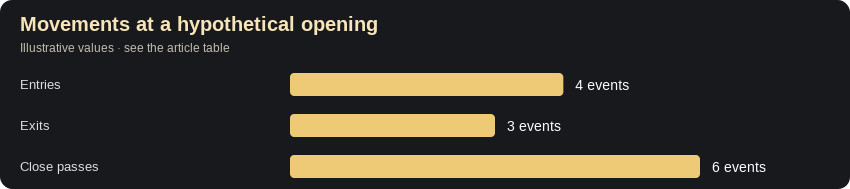
| Category | Value (events) |
|---|---|
| Entries | 4 |
| Exits | 3 |
| Close passes | 6 |
Illustrative values, not sourced observations. Passes are not nest entries or independent individuals.
On a warm afternoon a gardener stops at a bank and looks at a small opening below a root. Earlier, a large furry insect had flown near it. For several minutes nothing happens. Then one bee disappears into the opening, and later another emerges. By the end of the watch the evidence is better than when the observer arrived. It is still evidence about a few visible movements during a particular period, not a view of the chamber or a count of the insects inside. The value of the watch comes from describing each movement clearly enough that another person can tell how the interpretation changed.
A bank can have holes made by several kinds of animals or by weather and soil movement. An opening can have a visitor without being a nest. Conversely, a quiet entrance can be part of an occupied nest, especially when activity is low or the observer has caught a lull. Rather than trying to resolve the ambiguity by disturbing the opening, classify what happened from a safe and permitted vantage. Record entry and exit separately from movements close to the opening. Give the observation an actual time window, note what was hidden, and leave when visibility or safety does not support continued watching.
This is an exercise in observing behavior without needing a verdict. It can help a conservation volunteer distinguish a passing lead from a more substantial report, or help a gardener explain why a patch should be left undisturbed while the land manager decides what to do. An observation that remains unresolved can still be useful. A reliable description of where inference runs out is more valuable than a confident label inferred from the shape of a hole.
What to expect before making any field rules
The Xerces Society's account of bumble bee nesting and overwintering describes a typical annual colony cycle for many bumble bees and notes differences across species and environments. A founding queen first establishes a nest and carries out tasks that later involve workers. As a colony grows, an entrance may show more activity, though it can still be much quieter than a person expecting honey bee hive traffic might imagine. Later in the cycle a nest's activity and composition can change again. That broad pattern is a useful reason to be cautious with a snapshot. It is not a way to tell colony age from the number of crossings in one watch.
Colonies can use sheltered spaces, including some existing underground cavities, and not every species or site presents the same kind of entrance. The Xerces Society's western bumble bee nesting habitat report explicitly focuses on one species and treats the shortage of documented nest and overwintering habitat information as a conservation issue. That raises a methodological point: one good field identification in a particular setting can improve our understanding, but cannot stand in for documented habitat across a species' range. A bank, a gap by a board, and a tussock may all call for consideration. None is a universal nest sign.
A field study of bumble bee nesting in prairie and edge habitats in the midwestern United States used visible bees moving into and out of openings as cues during a systematic search; the researchers note that a founding queen's movements may be less frequent than worker traffic. The scientists worked under their own study design and access conditions. The useful takeaway for a passerby is narrower: movement at an opening can carry more information than the opening's appearance alone, and sparse traffic does not rule out an early nest. Do not extrapolate a published research team's detectability, observation effort, or permissions to a garden watch.
Watchers also benefit from remembering that the rest of the site is not obvious from a single view. A bee on flowers beside a bank may have come from elsewhere. Lots of flowers do not establish that a nest is underneath them. A bee that vanishes behind a grass blade may have landed on the back of a flower, turned down into an opening, or flown along a channel that was hidden. The same movement can feel decisive until a second person points out an obstruction. A sound record keeps those distinctions visible from the outset.
Choose a vantage that does not become part of the experiment
Begin where you are allowed to stand or sit. If the opening is visible from an existing path, watch from the side of that path without obstructing other people or any plausible insect approach line. A zoomed or binocular view can occasionally improve the observer's ability to see an entrance from farther away. If the view does not show the opening clearly enough and the only possible improvement would require stepping into vegetation, opening a fence, leaning over a bank or standing over a nest, accept the limitation. No quick count makes a risky position worthwhile.
Do not test the opening by inserting anything, tapping the ground, moving stones, pulling off a branch, lifting a cover or blocking the route to see what happens. Doing so can harm the site and change the behavior you hoped to see. It also turns an observation into an intervention without solving the underlying identification issue. An arrival after tapping or clearing the entrance is not a measurement of undisturbed traffic. A site that requires a close check should be referred to the appropriate land manager or project coordinator rather than treated as an invitation to investigate more aggressively.
A usable view includes the target and enough of the adjacent space to recognize a crossing. A close crop of the threshold alone may miss where the insect came from or fail to distinguish entering from disappearing behind a root. A very broad view may make the insect too small to track. Describe the vantage simply: “from the path slightly left of the root,” for instance, and note whether the inside edge of the opening can be seen. For a repeat visit, the same approximate sightline is often more useful than knowing the coordinates to an extra digit. If the safe view changes, record the change instead of forcing the same viewing arrangement.
Act on safety and site conditions more conservatively than you act on curiosity. If the observer cannot stay clear of insects and other path users, if insects appear agitated, or if the observer feels uncomfortable, stop. The University of Minnesota Bumble Bee Nest Quest training teaches separate counts of entering and exiting bees and advises backing away or abandoning a watch if conditions warrant. A named program's field procedures belong to that program. No single distance should be treated as a guarantee of safety for a different site, access arrangement or participant.
Agree on the boundary before counting
A directed entry is a movement from outside to inside across the visible boundary of the target opening. An exit is the reverse. These definitions sound simple until a bee lands at the lip of a hollow and walks sideways under an overhang. For this watch, only record a confirmed crossing when the trajectory is sufficiently visible to support direction and location. Give hovering, brushing past the lip and disappearing behind nearby material a different category. The watch can preserve those events as context without converting them into entries.
A close pass needs a boundary as well. For a small garden exercise, an observer might define it as a track passing through a designated visible region around the opening without a confirmed crossing. Make that region understandable to someone else from a sketch or contextual description. If conditions prevent even a useful close-pass definition, omit it or report it qualitatively. A butterfly crossing the opposite end of the bank is not a close pass merely because it was the next thing the observer saw. A tidy chart only helps when its underlying units correspond to actual decisions.
Try classifying three imagined movements on paper before the watch. A furry insect flies past the bank parallel to the path and never approaches the opening: it does not enter, and it may not qualify as a close pass. A bee lands near the opening, walks across its lip, and disappears into the cavity in clear view: enter it as an entry under the above rule. A bee appears from a tuft below the opening and flies away, but nobody sees its starting place: record origin unclear. This last category is scientifically useful precisely because it resists a false choice between exit and no activity.
Some observations can support one part of the inference but not another. An observer may know an insect crossed a visible boundary but not be confident it was a bumble bee. Another may see a convincing bumble bee at the lip but miss the actual crossing. Keep confidence in the movement and confidence in the ID in separate fields. Otherwise the strongest part of the evidence will tend to lend false confidence to the weaker part. Record a broad taxonomic label where appropriate rather than forcing a species label from a distant shape. A later expert review can improve the identification without fabricating a missed event.
Read the counts in the illustrative chart
The figure “Movements at a hypothetical opening” gives four entries, three exits and six close passes. These are invented event counts, not field data from Xerces, Nest Quest, the cited studies, or any other survey. They can help explain an observation form. The seven confirmed crossings are the four entries plus the three exits. The six passes remain separate. The total of thirteen classified movements is one way to describe the toy watch, but those movements are not thirteen independent bees. A single insect could contribute more than one crossing or pass.
The difference of one between entries and exits is not evidence of one additional bee in a nest. The example has a finite observation window, with no description of what was happening before or afterward. Crossings could have been missed or hidden. Even if every movement at that opening in the window were observed perfectly, a net entry count would describe flows across one boundary during that period, not the number or fate of inhabitants. Events and individuals have different units. An entry and a later exit cannot be assigned to the same insect unless there is adequate evidence for that link.
The passes matter even though they did not cross. Imagine that five out of six were insects traveling to flowers nearby rather than approaching the cavity. They could reflect a busy flight corridor, not nest activity. The toy chart cannot separate that possibility from other paths because it has no event-level context. A real observer could supply a brief movement note and a safe vantage description. At the same time, too many categories can distract someone from watching. Select a small number of categories with a meaningful interpretation and use a concise notes field for exceptions.
Do not normalize these particular counts to an hourly rate: the figure does not supply watch duration. If a separate hypothetical watch recorded seven crossings in half an hour, its observed rate would be fourteen crossings per active hour for that defined method. It would still not be fourteen insects per hour. Combining the two headings “traffic at entrance” and “bee population” on a poster would scramble the distinction. Putting raw counts and minutes beside a rate protects the interpretation and lets readers decide whether the result is stable enough to compare.
Keep the quiet minutes as evidence about effort
A completed watch with no confirmed crossings is a valid record when the entrance was visible under the protocol. It says no qualifying crossing was recorded during that time. A session interrupted by a blocked view has less observed time than its planned duration. A canceled watch has no observed traffic in the sense that it supplied no observation window at all, not in the sense of zero traffic. The table should keep all three states distinct. If an editor fills blank cells with zeros automatically, the neat appearance can hide the biggest differences in the data.
Write a start time and an actual stop time. If a person stops to talk or turns away from the target, preserve the interruption where the method allows a partial watch to be recorded. Otherwise tag the entire session as partial outside the main comparison. This decision should be made before interpreting results. A policy that drops every interrupted session unless it has a dramatic observation will bias a comparison toward events rather than representative effort. Partial notes can remain valuable as distinct evidence, especially if a strong confirmed crossing was seen while the view was clear.
Quiet minutes also matter when dramatic scenes crowd out ordinary ones in memory. If a volunteer waits near the bank for twenty minutes and sees two bees within a single minute, the final minute may be what the observer remembers most. The other nineteen minutes are still part of the window if it was watched and the method counts all eligible time. Showing every watched interval and documenting when the movements took place can reveal bursts without smoothing them into an impression of constant traffic. Small projects can get this benefit from a notebook rather than a sophisticated device.
An opening with no observed crossing on multiple brief visits remains different from an observed empty cavity, and nobody should investigate it by damaging the site. Viewability, conditions, calendar and species are possible explanations for a quiet record even when observers were consistent. Do not convert repeat zeros into a statement that the resource was abandoned. Say instead that the watches did not document traffic under their stated conditions. If the task demands more than that, propose a new authorized observation design or ask the responsible conservation team how to report unresolved cases.
Don't mistake a shelter action for a discovery about nesting
It can be tempting to describe a single arrival as a found nest, especially when a bee appears to go into exactly the sort of cavity one expects. That would identify a function that has not yet been demonstrated. An insect might enter only briefly. A queen might be inspecting a potential site. More than one opening may lead somewhere the observer cannot see. A consistent trajectory into and out of one opening over repeated intervals is more informative than a lone appearance, but even then the details of colony size and reproduction remain unmeasured. Write what aspect of the evidence improved.
A report can use a ladder of observable evidence without tying it to a rigid number of visits. At the bottom is a candidate opening with no activity seen. Next comes a bee in the vicinity without notable directed traffic. A stronger event is a directed crossing with direction and identity confidence stated. A series of repeated crossings under a clearly documented watch supports a more substantial report of possible nesting activity. If a formal program defines its own confirmation criteria, follow them when submitting there. A general article should not invent a threshold and sell it as certainty for all cases.
Some cues can support interpretation but need independent qualifiers. A clear returning worker carrying visible pollen can be informative alongside a confirmed entry, but the observer should not claim where that pollen was collected on the strength of a nearby flower bed. A fuzzy shape seen against a bright background may not establish either worker status or a pollen load. A sizeable insect does not necessarily reveal caste from size alone. If details are not visible, use the simpler category rather than adding uncheckable specificity to make the submission sound scientific.
Nesting and overwintering are not interchangeable states. An annual colony and a future queen's sheltered winter location raise different questions, and the Xerces accounts emphasize knowledge gaps concerning overwintering. Seeing a bee on the ground in fall is not evidence for a winter shelter, much less that earlier summer traffic and winter observations came from the same individuals. Give events their own dates and descriptions rather than extending a seasonal story beyond the observations. A field summary can discuss which interpretations are plausible and which have direct support.
A follow-up visit should preserve comparability, not chase a better photo
A second visit can help decide whether a directed movement recurs. Choose it for an observation reason, not solely to find the hour with the most exciting result. If the original window was late afternoon and the new one is early morning, a difference can be interesting but not a same-time comparison. If both are at the same hour but the sun and wind differ, a reasonable report describes the conditions without claiming that they alone caused any change. Use the same safe vantage if it remains suitable. If the opening has become obscured or access changed, document that as a change in method or conditions.
Imagine three garden observations. The first is an incidental close pass of unknown duration. On the second, a watcher sits at a consistent viewpoint for a planned interval and records one clear entry. On the third, the same vantage yields two clear exits and no visible entry during a comparable interval. A short report might say that directed movements were recorded on two separate watches at the same opening. It should not pool the incidental pass with the standardized events as if it supplied equivalent effort. It also should not infer three distinct bees or a declining population from the different movement directions.
Other sequences are informative in a different way. Suppose a gardener sees a bee disappear behind a root, then returns when light is better and sees that a narrow branch runs behind the suspected entrance. The follow-up might downgrade the original observation from probable entry to direction unclear. That is a successful observation even though it makes the story less dramatic. Save the initial note and the revised interpretation. If someone reads only the final label, the evidence should still be traceable to the reason the team changed its mind.
Be prepared for limits on repetition. Some sites are on private land, in sensitive habitat, near unreliable footing or in a public area where people cannot remain safely. A program may have seasonal restrictions or site-specific requirements. No report needs to be completed at the expense of permission or safety. If the right decision is not to return, record why the observation ended. A verified conservative note made from a public path has a clear role without pretending to be a formal inventory of what the bank contains.
Treat photos and video as evidence for specific claims
A photo of a bee near a root may support identification of the animal and the situation. It may not show direction or confirm a crossing. A short video can make the direction clearer if it shows the target boundary and the uninterrupted passage across it. A video that starts with an insect already at the threshold can leave origin unknown. Keep original files and report the relation between the clip and the associated event. Do not use a similar insect photographed at a nearby flower to prove a species crossing if there is no continuous observation tying it to that event.
Definitions also help avoid double counting between observers and recordings. Suppose two people watch the same opening and a camera covers it from one of their positions. A timestamped entry observed by both and shown on video is still one event. The three records can support confidence for that event rather than triple its count. If a video review reveals a crossing nobody wrote down, its evidence channel should be listed rather than silently merging its count into an observer-only protocol. The point is to keep enough separation to reproduce whichever comparison the report eventually makes.
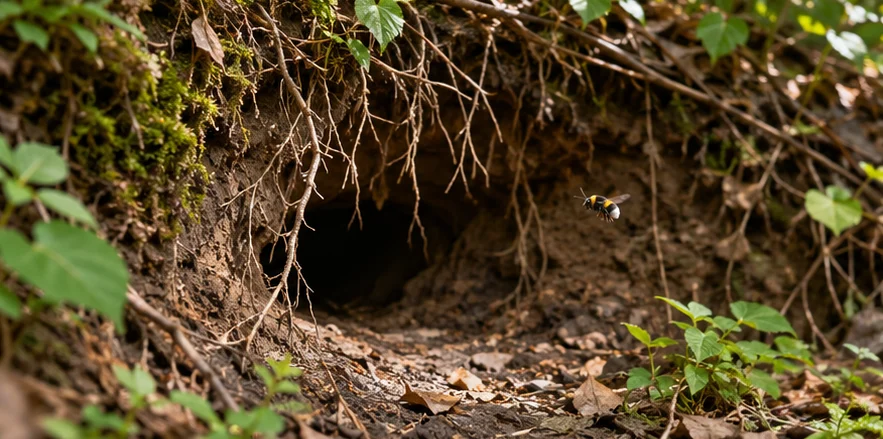
A still image taken for publication may not be a field record at all. If an illustration shows a bee and a shaded bank opening, it can introduce the question visually. The generated header image for this article has precisely that role. Its shadows, root placement and insect anatomy cannot confirm anyone's observation or provide a realistic measure of distance. A real archive distinguishes generated illustrations, licensed reference photos, and actual records even when their subject matter overlaps. Caption that distinction where readers actually see the image.
Think ahead about location data when using photographs. A park or project may want a confidential point to check a report, but a public gallery generally does not need to lead readers directly to a likely nesting entrance. Avoid publishing precise location clues when disclosure would encourage disturbance or contradict a local policy. Keep the full observation and its shareable version designated for their intended audiences. Cropping a publication image and reducing location precision need not discard the evidence for a steward who was authorized to receive it.
Do not extend one opening into a landscape estimate
Counts at a single opening support statements about observed traffic. A larger project interested in nest density would need a defined area, systematic effort and a method appropriate to detection. When finding a nest depends partly on a chance visible crossing, dense vegetation and access restrictions can lead to uneven discovery. Places with the easiest sightlines can look rich in nests even when they are just easier to search. Finding more candidate openings per stroll does not establish that one habitat has more nesting colonies per area. The search design, and the agreement about what counts as a confirmed site, are part of that bigger question.
Researchers can conduct nesting studies with methods beyond informal notes. The USGS summary of a rusty patched bumble bee nest case study explains why nest observations address questions that cannot easily be resolved by observations of foraging away from a nest. This points to complementary scales rather than a universal shortcut. The paper's findings concern a documented study and a particular conservation context. A garden observer is not expected to reproduce its full study methods and should not imitate specialist activities without the required authorization, review and expertise.
The converse also matters: an absence of formal nest reports in a habitat is not an instruction to treat it as unimportant. The habitat could have few nests, low detection, inconsistent past search coverage, or multiple reasons people do not submit records. A useful narrative distinguishes no reports, no surveys and surveys with no detections. If those categories are collapsed on a map, a blank place can carry a misleading claim of absence. A broadly described candidate report can contribute contextual evidence without requiring an ambitious or intrusive survey.
Even a clear positive can change meaning if reused. A single photograph labeled active entrance from one date is not evidence that the same opening supports a nest the following year. A location record can guide a new assessment when permitted, but it should not populate a current dataset by copying the prior status. Date every claim and keep a plain statement of what activity was directly observed. This empowers future readers to reuse the event without extending it beyond its temporal boundaries.
Make the report useful for a land steward
Imagine a public garden receives a note about a possible nest beside a maintenance area. The person reading it may not care how many bee-shaped insects flew down the path. They do care about the opening's operational location, whether directed traffic was actually seen, whether visitors or staff have reason to go near it, and what observations could help find a low-disturbance way to manage the area. Provide the information quietly to the responsible people, with uncertainties and any visibility limits. Do not send a crowd to check the report with no coordination.
Distinguish an observation from an instruction about property or pest control. “I saw two clear entries from the path between these times” describes evidence; “remove this colony” or “it is safe to walk over here” asserts a conclusion the watch did not establish. A close-to-path report may require advice tailored to the particular site. Keep the original notes intact while the relevant manager or qualified program determines a response. If a coordinator requests a protocol-specific submission, follow their guidance on location access and repeat visits instead of assuming visitors should handle the issue directly.
A simple report card can separate the following ideas in short readable fields: observation window, viewpoint, target description, confirmed entries and exits, other near movements, classification confidence, key images and reason the watch ended. Give each record a stable identifier when the same opening is reported more than once. If a steward needs to document it for staff, describe any privacy relevant to exact locations and ownership. There is no obligation to attach a full map to a public summary simply because one exists in the restricted notes.
Finally, make clear when there is nothing more to investigate by ordinary observation. A photograph that cannot confirm identity does not become clearer through editing alone. One useful observer can record an uncertain case and leave it there. Another project may later use the record to look for activity under permission, or may decide it cannot determine more without risk. Evidence gathering is responsible when it can improve the account without disturbing the animal, other people, or protected habitat. A clean stop with good notes is a legitimate outcome.
Decide in advance how to handle two openings
Many root banks have more than one gap. A moving bee may appear in front of two gaps during a short sequence. If the watcher cannot tell which boundary was crossed, log a crossing at an unresolved opening only if crossing itself was visible. If that much is unclear, leave both destination and direction unresolved. Assign stable labels to openings that can be distinguished from a safe vantage, such as upper and lower. Keep the association with the observed target even if the surrounding vegetation changes. Avoid calling the gaps two nests. There may be a connection, no connection, or no nest at either, and an outside watch does not settle the topology.
Consider a hypothetical observation from the path. At the beginning a bee is seen entering the upper opening. Later another bee leaves the lower opening. The movement timestamps and the fall of light across the roots make it tempting to suppose both events came from one tunnel. The record can preserve the sequence without combining species identification, individual identity and opening identity into one unverified explanation. Make a note that the relationship between openings was not investigated. Do not try to trace it with a probe, water, smoke, or any other disturbance. For habitat stewardship, the unresolved possibility itself may be enough to keep both entrances under consideration pending appropriate expert guidance.
The distinction can affect tables as well as prose. A site report can show separate directional counts for each clearly visible opening. A secondary panel can give a combined number of movements at the bank as long as the same crossing did not appear in both rows. If one part of the bank was visible only intermittently, specify whether comparative rates were calculated for a shared window or separate visible durations. A low count for the lower opening is not meaningfully comparable with a higher count for the upper one if the first was hidden for most of the watch. Separating the targets makes that limitation visible.
Suppose an editorial map compresses the spacing between openings to protect location detail. Keep true distances out of its legend unless reproduced accurately. Label the map as a schematic and do not invite readers to infer underground routes from the relative positions of marks on the diagram. For an internal register, a simple coded landmark and rough sightline can be sufficient for authorized staff. For a public report, an area-level description may be all the evidence relevant to the audience. Neither use requires revealing the precise site to everyone.
Keep reportable behavior separate from explanations for it
Two reliable observers can disagree without either missing an event. One might write “bee circled opening three times”; the second might call it “one extended approach.” Both could be right given their choice of unit. A counting protocol needs to say whether its close-pass unit is each crossing of an outer line or the continuous track from first sighting to departure or loss of view. Avoid making the word “pass” do both jobs. If the expected motion is too fast or too hard for volunteers to classify consistently, a simple note about visible nearby activity may be more useful than a number with an unstable definition.
Other motion labels may sound more explanatory than the observations warrant. “Orientation flight,” “guarding,” and “searching for shelter” suggest functions, not just paths. Someone seeing a bee loop beside a low entrance may reasonably wonder about orientation, but a handwritten note with direction, height relative to the opening and where the insect left view is more reproducible. When a program has definitions for particular behaviors, cite the criteria and record which evidence met them. Otherwise offer the behavior as a candidate explanation separately from the directly observed movement.
An editor can test the distinction by transforming one field note into alternative statements. “One bee came out from the visible gap” is an observation, subject to the stated confidence. “One worker left a nest” adds both caste and site function. “The colony had started foraging” adds a larger temporal interpretation. The last two may be plausible and quite different from a reportable measurement. Compare the proposed headline with the earliest step in the evidence chain and remove words whose support cannot be traced. A more cautious headline is not necessarily dull; the tension between a quiet-looking opening and directed movements is already a good story.
Review a seasonal series without making a population claim
Imagine six short visits to the same opening. The first two reveal no directed crossings from the marked view. The next two show a few arrivals and departures. The last two are interrupted when conditions make the location unsuitable for watching. A graph that displays the final two visits as zero would imply a decline that the observer had no opportunity to see. Instead, give the uninterpretable windows a distinct visual symbol or write that they were not comparable. If they include a documented directed event before the interruption, retain it as a valid presence observation without treating the watch duration as complete.
A trend in crossings is not automatically a trend in residents. For the same number of different bees, each could make more trips, or more crossings could be detected under different viewing conditions. Conversely, events can be recorded at the same rate while the group contributing them changes. Those possibilities are not reasons to refuse to summarize observed traffic. They are reasons to give it a proper unit. A stronger claim about the size or trajectory of a colony needs a separate validated design and should not be inferred simply because the figure uses a rising or falling line.
Document the overall observation schedule and windows that were never attempted. A series of daily observations is different from one pasted together only on pleasant days following interesting reports. The latter may be perfectly adequate to document there was activity, but it cannot be treated as a complete season. The notebook can show which days were intended, which could be watched and which supplied a comparable count. This makes clear whether a gap belongs to field coverage, weather or the observation result itself.
If a later viewer says the opening “went quiet,” ask exactly what they mean. A complete clear view with no recorded traffic can support that quiet-window observation. A missing visit does not, and a site obscured by seasonal vegetation presents another case. Preserve the alternatives rather than forcing each season into one narrative. The most useful end product is a dated record of visible evidence that can inform the next qualified review, not a permanently assigned nest status.
Sources and illustration note
- Xerces Society: Bumble Bees: Nesting and Overwintering.
- Xerces Society: Characterization of Western Bumble Bee nesting habitat.
- University of Minnesota Bumble Bee Nest Quest: Nest monitoring.
- Prairie and edge habitats provide valuable nesting resources for bumble bees.
- U.S. Geological Survey: Answering conservation questions by studying discovered wild nests.
- The graph shows invented counts of four entries, three exits and six close passes. The header image is a generated editorial illustration, not documentary evidence.