
| Category | Value (images) |
|---|---|
| Both positive | 8 |
| Both negative | 12 |
| Disagree | 5 |
Illustrative only. Invented values, not taken from a source dataset or an official target. Design initial independent coding followed by adjudication for photographed path damage; keep independent positive and negative agreement, rather than treating consensus as validation.
A reviewer marks a photograph of a path as showing damage. The next reviewer opens the same image, sees the first person's positive label, and agrees. That may be a sensible review of the decision, but it is not a record of two judgments made independently. The second reviewer had information the first did not: what someone else thought the picture showed. Once that label is visible, the workflow cannot recover an independent second judgment by asking the reviewer to ignore it. If the purpose is to measure how consistently people use the rules, save each first-pass score before bringing the reviewers together.
This distinction does not make discussion undesirable. Someone can point out that a dark line is a shadow, another can find a ruler in an uncropped image, and a supervisor can apply a rule to reach a usable decision. Those are ways to resolve a case. They answer a different question from whether two people working under the same instructions would have coded it the same way without discussion. A reliable workflow gives independent judgment and resolution separate places and makes both available to the people who need to interpret the result.
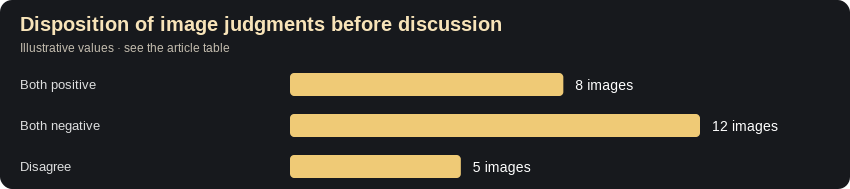
Disposition of image judgments before discussion
The chart and table give the same invented values in images. They describe 25 images with two usable binary first-pass scores under a fictional path-photo protocol. Neither reviewer saw the other's first-pass label before submitting. The values are not from a source dataset, are not a target for any park or project, and do not establish that a particular image showed actual damage. Positive means the image met the stated photographic coding rule in the reviewer’s judgment. Negative means it did not meet that rule in an assessable image.
| Independent disposition | Images |
|---|---|
| Both positive | 8 |
| Both negative | 12 |
| Disagree | 5 |
Twenty of the 25 independently coded images agreed, or 80 percent. That figure combines agreement on positives with agreement on negatives. It does not show whether the reviewers were more consistent in identifying qualifying damage or agreeing on its absence. Nor does the chart show which reviewer called more images positive: the five disagreements could lean either way. For example, Reviewer A could have been positive in three disagreements and Reviewer B in the other two. That is one possible breakdown, not a finding implied by the chart.
There is also a symmetric, class-specific view of these same counts. Positive agreement in this convention is twice the number both marked positive divided by the total number of positive ratings across the two reviewers. Here that is 16 divided by 21, about 76.2 percent. Negative agreement is twice the number both marked negative divided by the total number of negative ratings. Here it is 24 divided by 29, about 82.8 percent. The factors of two arise because each concordant image contributes two ratings of that class, while each discordant image contributes one rating of each class. The original methods paper on rating uncertainty and agreement discusses this non-chance-corrected formulation. The choice of denominator should appear with the result because different fields use different quantities under similar names.
These quantities are about agreement, not sensitivity or specificity. Neither reviewer is designated as an independent truth standard. They can agree on a dark seam and both be mistaken. They can disagree when the image is genuinely difficult or when the rule is too vague. The two class-specific fractions are descriptive for this invented data and are not confidence intervals, evidence of validity, or the final decision after discussion. Keep the underlying counts nearby so a reader can recover what was measured.
Give the reviewers the same question before separating their answers
A rule for a field photograph can ask whether specified visible features are present within a marked area. It does not necessarily ask whether a path is structurally defective, dangerous, in need of repair, or eligible under a particular maintenance standard. Decide exactly which claim belongs to the image protocol. A narrow answer about a visible line or break can be reproducible even when a wider engineering conclusion would need an on-site assessment. Do not use a photo score to imply clearance for public use. Any immediate condition sighting should follow the responsible site's usual process regardless of the review exercise.
The rule can name which parts of the photo count and what evidence is needed. A shadow and an open discontinuity can be difficult to distinguish. Painted lines, surface seams, patches and curb edges might have explicit exclusions. If the project requires a dimension but the frame lacks a suitable scale, say that a dimension cannot be assessed. Do not let a reviewer invent a width from pixels or a guessed size of a neighboring object. A good definition separates visible features from interpretive thresholds and identifies where the evidence ends rather than only where the hoped-for result begins.
Design the first pass so it can actually remain independent
Give reviewers equivalent copies of the eligible evidence and the same written rules. Hide the other's label, confidence, comments and disposition until both initial records are submitted. A filename such as confirmed-crack can reveal more than an ordinary case number. An image marked with another person's arrow can direct attention to a feature even without a category label. Check visible queues, notifications, ordering and thumbnails as well as the form fields. A system can hide the label and still communicate the earlier decision through its arrangement.
Independence here concerns the judgment process, not whether the observations share a subject. The two reviewers intentionally see the same photo, often with the same limitations. They may use the same training and conventions, and they may share systematic blind spots. Thus a successful blind first pass does not give two independent images, two different views of a real path, or a guarantee of correct classification. It lets the study ask whether two unaided applications of the same protocol agree. An application that presents the reviewers with different available metadata may instead be testing two different processes.
Give a reviewer the information legitimately required by the rule while masking earlier conclusions. Sometimes the scoring protocol needs the uncropped image, a location-independent scale marker, or an indicator of which section of the frame is relevant. Removing such material from just one reviewer does not create a fair comparison. If identity or contextual metadata must be visible, document what was shared and why. The aim is not as much masking as possible. It is to avoid one initial score being learned from the other while preserving a fair task.
A training set can be reviewed together, with discussion and agreed examples. Keep it separate from the independent assessment set, especially if the latter is intended to test application to new images. People may remember a difficult training example when they encounter it again. A high score on a reused set is not necessarily evidence of consistency on unfamiliar cases. If some examples were reused deliberately to test recall or scorer drift, give that result a separate description. A shared scoring manual is helpful; a shared answer key defeats a new independent assessment of ambiguity in those same cases.
Check for practical breaches. People may compare work in a chat channel, see a partner's answer in an issue title, or read a progress dashboard with individual decisions. Create a way to declare accidental exposure. Retain affected records with their status and do not count them as independent unless the original timing and evidence establish that exposure occurred only after the submission. If only one batch is compromised, the rest may still be usable. An honest reduction in sample size is better than an artificially independent-looking result.
Preserve the first label as a measurement record
Save the image ID and version, reviewer identifier, time, protocol version, first-pass category and an appropriate note or confidence field. If the reviewer cannot assess the image, preserve that status. A lock or history can prevent downstream changes from overwriting the first independent response. Corrections for a genuine transcription error can be recorded with their own rationale and timing. Do not replace one label silently and later describe the modified field as the original score. An archive should let another person reconstruct the state it had before discussion.
A first-pass record can contain more than two labels even if a chart uses binary complete cases. Common additional states are unreadable, out of scope, partial view and uncertain under the rule. Define how each enters the summary. An uncertain score given after a view meets basic requirements is not the same as a missing file. Two reviewers both flagging an image as unreadable provides evidence about assessability, not an agreement that surface damage is absent. A workflow that demands positive or negative even when neither is justified produces a tidy table at the expense of measurement.
The U.S. Census Bureau Statistical Quality Standards provide an analogy for documenting populations, procedures and review in their own data collection context. They are not instructions to classify paths. The NIST/SEMATECH measurement process characterization chapter gives another useful frame for considering repeatability, reproducibility and possible bias. An image classification project needs a specific definition of what is repeated: two reviewers applying one rule to the same evidence is a reproducibility question. It is different from photographing the site twice or checking interpretation against an independent field reference.
Keep the four cells even if the figure uses three bars
A pair of binary scores has four possibilities: both positive, both negative, A positive and B negative, and A negative and B positive. The chart combines the last two into “Disagree” for a short display. An analysis archive should retain both, because the direction can reveal whether one reviewer called positives more often on this set. In the fictional breakdown of three and two discordances, A's positive marginal count would be eleven and B's ten. Many other splits are consistent with the same chart. It is not possible to reconstruct the marginal tendencies without the original four cells.
Neither marginal total establishes which scorer is better. One might use a stricter rule, have better evidence of a feature, or simply make a different set of mistakes. Looking at independent comments can help identify where the codes diverge. A panel can look for differences tied to cropped views, shadows, ambiguous sections of a rubric, or repeated views of one location. That is diagnosis of the process under review. It should not be phrased as a classification of right and wrong unless the study has credible evidence beyond the two initial judgments.
Class-specific agreement numbers can be especially useful in an imbalanced sample. A reviewer who marks nearly everything negative can agree often by default when few positives are recorded. Overall agreement does not tell readers how well the reviewers agree when at least one sees a qualifying positive. The symmetric convention described above and the full table give a more informative view. Do not import an asymmetric convention without naming which label acts as comparator. For example, FDA guidance on diagnostic-test reporting uses explicitly directional formulas in its setting. It is a methodological contrast, not a rule for parks and not the formula used in the toy numbers.
The positive agreement denominator can be zero if nobody assigned a positive rating. In that situation the result for positive agreement under the chosen formula is undefined, not perfect. The negative agreement may still be computable and high. A similar issue occurs in a set with no negatives. Give the counts and explain that the other class lacked evidence. A benchmark set might deliberately include cases near the positive boundary to learn about performance there, but its overall agreement should then be described in terms of that sampling design rather than projected to a day of ordinary photo traffic.
Adjudicate cases without rewriting the first pass
When both first-pass labels have been submitted, reveal them to the adjudication process according to the plan. The reviewers can discuss differences, a third person can resolve a case, or a responsible reviewer can check extra evidence. Any of these can be a practical way to produce a final operational label. Mark which procedure was used. Record what new material became available, which rule determined the result, and whether a case was sent for another kind of assessment. A resolution is useful when it is traceable; it is not evidence that the original independent labels were identical.
Sometimes discussion finds a straightforward mistake. A reviewer may have looked at the wrong region or overlooked a valid scale note. Preserve the first-pass result and document the correction in the adjudication record. In other cases both reviewers had reasonable interpretations of an incomplete rule. A final label may still be selected for operational consistency, but the disagreement is important evidence about the instrument. Treat repeated ambiguity as information about the rubric, not as a set of embarrassing records to overwrite. A consistent rule improves future work, and its adoption does not erase the reason it was needed.
A third reviewer can perform two quite different functions. They can give an initial independent score without seeing the first two, creating more information about reproducibility under a suitable design. Or they can serve as an adjudicator, read both answers and apply resolution rules. The same person cannot produce the former after carrying out the latter for that case. Put the role in the record. If only disagreements are shown to the third reviewer, their ratings are for a selected subset, not a third independent set over the full collection. Interpret agreement accordingly.
Some cases should stay unresolved. A translated photograph or a crop without scale may not contain evidence needed to settle a score. An adjudicator can document “needs appropriate further evidence” rather than force a conclusion. That status may be the safest and most useful operational output. It should not become negative in subsequent exports. A final action to seek another view is a workflow decision and not a measurement of the path's actual condition.
Keep consensus from becoming its own proof
If an audit compares original reviewers against a consensus made using those same scores, its reference already includes some of what it is supposed to evaluate. The result can describe how the first ratings compare with final operational decisions, but it does not demonstrate independent correctness. This risk arises even if the final panel has an experienced member. The first labels helped shape which cases were discussed and may have contributed to the disposition. Name the comparison as agreement with adjudication rather than accuracy against a truth standard.
Suppose every one of the five fictional disagreements is settled in a meeting. The final file will contain one final label per image, and the reviewers might both accept those labels. The independent disposition remains eight both positive, twelve both negative and five disagreements. Reporting 100 percent independent agreement after settlement would replace the measured process with a different one. Report final completion separately: all five discussed cases received a disposition, with any referrals or uncertainties stated. A procedure can improve operational consistency without retroactively improving first-pass reproducibility.
Validating a photographic rule requires evidence suited to the actual claim. If the task is to classify a visible feature in a picture, independently verified photo information might help. If the claim concerns physical dimensions or the actual state of a path, an appropriately qualified assessment or documented reference may be needed. A reference needs its own scope, timing and quality checks. A photo taken a day later can show that the surface looked different then but cannot automatically establish the earlier state. Even a respected independent observer is not a valid reference for a different target.
Avoid validating only the cases that disagreed unless the analysis explicitly concerns that subset. The original positive agreement cells can contain shared errors, and the negative cells can hide overlooked defects. A verification study that selectively looks at ambiguous or disputed photos cannot estimate whole-set correctness without a design that accounts for the selection. For a methods pilot, a purposive sample of difficult cases can still be useful for learning which procedures fail. Label what that exercise estimates and what it does not.
Show where the image sample came from
A corpus of images can be assembled from weekly inspections, work orders, volunteer reports or a deliberately enriched library of hard examples. Each produces a different proportion of obvious and ambiguous cases. An agreement result depends partly on what was available to classify. If a project uses an enriched set, state that the percentages describe that set. Do not claim the observed positive rate represents ordinary pathways. If many photos show a single damaged segment from different angles, count them as images while acknowledging the limited variety of physical locations.
For a wider reliability study, define the target image population, the eligibility rule and the selection scheme. The consistency of two reviewers on this month's submissions may not predict consistency across other locations, camera settings or changes of season. Keep metadata for relevant groups such as surface type, lighting and source system, if the project can justify and protect it. A chart of aggregate agreement may hide recurring ambiguity under one particular kind of lighting. Subgroup summaries can guide training, but require enough evidence to avoid portraying a few cases as stable percentages.
One should also distinguish two reviewers from a sample of reviewers. If the project uses the same two people on every photo, it is informative about their use of one version of the rubric. It does not establish agreement for all future reviewers. If a study wants to generalize across reviewers, it needs a suitable design for who was chosen and how judgments were assigned. Likewise, shared photographs can yield dependent judgments across neighboring scenes. A formal uncertainty calculation should account for relevant dependence and the sample design. A transparent descriptive tally needs no speculative precision.
A rate among fully assessable photos should not conceal the number for which at least one reviewer could not make the binary judgment. Report planned, obtained and usable paired counts. Give missing reasons and preserve whether the second score was genuinely independent. A study that finds strong agreement among bright, unobstructed photos and many unreadable dark ones has learned something important about its workflow. Do not transform that finding into uniform reliability by leaving the dark cases out of the report. The same applies to image versions accidentally scored under different instructions.
Make revision of the rubric visible
A discussion meeting can reveal a new rule worth adopting. For example, reviewers may consistently disagree where a built seam crosses a suspected surface break. The revised rubric may require a visible discontinuity independent of the seam. Document its effective date, cases motivating it and any change in training. If photos from the original set are rescored, those results describe reapplication or reconsideration after exposure. They are not a new blind initial pass with the same reviewers on those same photos. A fresh compatible sample can answer how the new rule performs on unseen cases.
A rule can change which units are eligible as well as the label they receive. Adding a criterion that certain viewing angles are unassessable may increase agreement among those retained and reduce the number retained. Both changes matter. Report coverage and agreement together, and examine whether the new omissions are confined to a part of the inspection area or source population. An apparently better score can come from excluding hard images rather than making hard classifications more reproducible. That may still be appropriate if the rule was always supposed to require adequate evidence. It is not the same outcome as improved performance on the original population.
Do not assume a rule revision has failed because agreement declines immediately. A more honest uncertainty option could expose disagreements hidden by an earlier forced binary choice, or a broader set of assigned images could reveal additional variation. Examine the actual score transitions and protocol coverage instead of comparing isolated headlines. Make the intended improvement clear: clearer interpretation, fewer forced guesses, increased reproducibility under a defined unit, or a stronger reference. Each implies a different kind of evidence. A good evaluation can show progress on one goal and leave another open.
Run a small rehearsal before collecting the real scores
Give reviewers fictional or training examples that include an obvious positive, an obvious negative, a difficult but assessable edge case, and an image that lacks the necessary view. Verify that both see equivalent evidence and the correct version of the scoring instructions. Test whether they can save an unassessable status without creating a binary value. Inspect whether a first label appears anywhere in the second reviewer's interface, including file names or notifications. This rehearsal is about the workflow, not a source of initial independent scores for the final study.
A useful check can run through a deliberate disagreement. Save the first labels and timestamps, then reveal them to adjudication. Observe whether the final record can be entered without altering either initial score. Verify that reports pull from the intended fields. A final dashboard that selects only the latest label might be adequate for work orders but useless for agreement. An analysis dashboard that silently pulls final corrected values instead of original scores could falsely turn disagreement into consistency. Give the two outputs explicitly different purposes.
Try a case that receives a correction to the image itself. An uncropped replacement could reveal a scale or a marking that changes the classification. The after-correction review should be linked to the new image version. If the first pass was on the old crop, that is what the first ratings measured. Do not keep both records under one version and infer that reviewers disagreed despite seeing identical evidence. For reproducibility, the file version is as important as the time and label. The reviewer should not be accountable for information never presented.
Check how absence of a label travels through the analysis. In a two-by-two agreement table, missing cannot be interpreted as negative by matching empty text to a false value. Test a merged file with an incomplete first pass, an independently agreed negative, and a case settled only after discussion. The first must remain incomplete, the second must count in the proper independent cell, and the third must preserve its independent disposition. An audit on deliberately chosen examples can uncover mismatches without encouraging anyone to sharpen their recollection of a real case retrospectively.
Separate a pilot's difficult cases from a routine sample
Imagine two review collections that both contain 25 images. One was drawn from a routine intake stream under a recorded sampling rule. The second was assembled by a supervisor pulling examples that previous reviewers found confusing. If the second set produces more disagreements, that does not necessarily mean that its reviewers applied the rules less consistently in ordinary work. They faced a deliberately different task. Both collections can be valuable. The routine sample informs performance in a defined stream; the difficult set identifies places where the rubric needs work. Keep the selection record with each and avoid pooling them into one unqualified rate.
An eligibility check should also be reproducible. If a technician screens out photos before reviewers see them, record the rule, the number removed, and the reasons. Some images may not show a path at all. Others may show a path but lack the region required by the question. Removing irrelevant photos is reasonable if it aligns with the target. Removing nearly all borderline photos after seeing that the two reviewers disagreed on them makes the stated rate describe a much easier task. Lock selection or disclose deviations before interpreting the results.
The pre-discussion chart need not include every review state to be honest, but it must explain what is omitted. The illustrated 25 are usable paired binary decisions, not all incoming records. If 30 images were assigned and there were five invalid or unavailable pairs, show that coverage count separately. Some work can still be completed operationally after rechecking the files. Those actions do not add independent ratings to the original denominator. If all 30 eventually get final labels, the project may be complete as a work queue and incomplete as a measurement study. Both statements can be true and useful.
Identify what actually differs between two apparent review systems
A project may wish to compare two interfaces, two versions of the rubric or two review teams. Before running the comparison, decide what changes together with that choice. If one interface shows a highly compressed image and the other shows the original, a difference could reflect available evidence. If one group of reviewers sees the new rubric and all of the old reviewers use another, the rule and reviewers have changed together. A comparison can still describe the systems as deployed, but it cannot isolate each cause without a suitable design. Say whether the question is about a package of practices or a single component.
The same concern applies to ordering. If one protocol is always applied first and the second is applied to the same photos after discussion, the comparison is no longer balanced with regard to prior exposure. A later score can be better informed and less independent. To compare initial performance, plan a design that respects exposure and assignment. If only retrospective data are available, describe the first and second use correctly rather than manufacture independence by changing column labels. The order of knowledge is part of the measurement procedure, not an administrative detail.
Verify the unit the evaluators receive. Identical photographs with different annotations are not the same evidence. Two photos from slightly different times can show genuinely changed conditions. Cropping out a reference mark can make the second score less informed even if the same defect-like line remains visible. Use identical image versions for a claim about agreement on the same evidence. If comparing views is the purpose, document how the views were grouped and state that readers are judging different representations. Neither arrangement can serve both aims by default.
Plan a reference that does not simply echo the panel
An independent reference should be chosen for the defined target. For a task that classifies an image, an independent evidence review may check the feature or its location under the original image conditions. For a statement about physical dimensions, a suitable contemporaneous field measurement might be necessary. Using a later maintenance ticket as the reference could capture decisions made for reasons not visible in the picture. A good reference is connected to the claim, and its limits are recorded instead of being hidden by a gold-standard label. Sometimes no credible reference exists for an old set. In that case the project can still report reproducibility without claiming accuracy.
If a second measurement becomes available only for certain images, inspect the rule for selecting them. Cases with clear agreement can remain wrongly classified together, while ambiguous cases may be disproportionately verified. A follow-up that observes only referred images can describe those referrals and reveal problems with the operating rule. It does not measure accuracy for all received images. Use an appropriate sample of both agreed and disputed cases for a broader check or describe the feasible scope honestly. Treat what could not be verified as a limit rather than count it as presumed confirmation.
Then ensure the reference comparisons preserve timing. Surface conditions can change between a photo and a site check because of weather, work or a difference in the section inspected. A later result might explain the current situation without validating a first-pass score about the earlier view. Record the matching basis and any uncertain transitions. Where the images do not permit a secure link, the project can say the reference comparison was not completed. Maintaining this distinction protects both the photograph's genuine value and the limits of later evidence.
Keep a link between decisions and what was visible
A useful adjudication note can identify the region of the image, the part of the rule in dispute, additional evidence considered and the final status. If the review panel decides not to assign a label, preserve that decision rather than delete the entire record. The initial judgments remain useful about reproducibility, and the unresolved final outcome explains why no operational finding entered the action list. A status vocabulary can therefore support uncertainty twice: once during observational coding and once during resolution. Those are different opportunities to recognize a limit.
Don't repurpose reviewer confidence as an independent second measurement. A reviewer can be highly confident after seeing someone else's explanation, or less confident than another reviewer while reaching the same label. If confidence is recorded independently in the first pass, it might help characterize ambiguous cases. Confidence entered after the discussion serves another purpose. Keep those timestamps and stages distinct. Agreement counts should use the appropriate first-pass labels, while a confidence analysis should say when and how the ratings were obtained.
Write the operational and evidential results on separate lines
For a field manager, the important result might be which images need authorized further review or which cases already have a final disposition. For an analyst, it may be the numbers of usable independent pairs and the full four-cell agreement table. The first reader may not need individual reviewer identities; the second does need stable reviewer and image distinctions to reconstruct the paired comparison. Design reports that serve both without conflating them. Share identifying details only as appropriate for the task. Place names and photographs may have their own handling constraints.
An example headline can be short: before discussion, 20 of 25 usable paired image ratings agreed, including eight both positive and twelve both negative. Five disagreed. Give the symmetric class-specific fractions if useful and explicitly say neither score was treated as truth. Then report that adjudication addressed the operational cases under a separate rule, if it did. A short note should not imply that all cases were ultimately settled if the record only says they were discussed. Keep outstanding referrals and unassessable evidence clearly visible.
When the conclusion concerns a particular style of surface, photo source or revision, keep that scope in the headline or nearby methods. Without it a numerical agreement result can be reused as a general statement of expertise. If the independent effort was compromised by earlier exposure, report the limits rather than promote all second looks to independent observations. A second reviewer can still provide real value after seeing the first score. It is the claim of independence, not the usefulness of the review, that must change.
Where final reviewers also record a recommended action, keep that choice in a distinct field. Two images with the same final photo label might receive different referrals because only one has a usable location note. Conversely, an unclear photo might warrant a field check without being positively classified. Reporting action choices next to, rather than in place of, independent scores lets readers distinguish an operating policy from what the photographs established.
The strongest workflow gives the reader a clear answer to two questions: what happened before anybody saw another person's score, and how did the team decide what to do afterward? The answers can differ. An initial disagreement can lead to a better final result. A final consensus can coexist with weak evidence about independent agreement. Preserve both states and avoid claiming either establishes what lay beneath the photographed surface. That is the difference between a useful second look and a second look mistaken for validation.