| Category | Value (instrument units) |
|---|---|
| Lab-only | 0 |
| Unopened trip | 0 |
| Opened field | 1 |
| Equipment rinse | 3 |
Illustrative only, not taken from a source dataset. Hypothetical responses; the pathways differ, so these are not ordered replicate results.
The field crew goes home with four bottles from a garden runoff channel. The rain was light, the surface looked clear and the labels look neat on the workbench. One bottle comes back from analysis with a small signal for a substance of interest. A second bottle, intended to contain water free of that substance, comes back with a signal too. Now the question is not simply what was in the channel. It is what the trip, sampling equipment, container and analysis may have added to the result. A blank gives the crew a way to start separating those possibilities.
A blank does not need to contain nothing. It contains a material selected to supply negligible target signal under the specified method and its required sensitivity. Nor is every filled bottle a blank merely because the field sheet calls it one. What makes a blank useful is the path it takes, compared with the path taken by the samples whose interpretation you care about. A sealed bottle that accompanies the trip and a bottle opened beside the channel test different things. If they are treated as interchangeable, the analysis may be precise about a question the team never intended to ask.
The language of contamination can be intimidating in a small environmental project. Think of it as an attribution problem. Suppose the sampling process can introduce a small amount of the same substance the team intends to observe. An environmental signal and a procedural signal then arrive in the same result. The blank is an observation of one of those alternative pathways. It is a witness with a limited view, not an automatic correction or a safety verdict. To use it well, define what it witnessed, retain the record and decide ahead of time how to react to its report.
Decide what you need the blank to learn
Start with a particular decision. Perhaps the garden project wants to investigate whether dissolved constituents differ between two runoff routes that leave the same parking area. Another project might be developing a way to compare stream samples collected before and after maintenance on a sampler. A blanket instruction to obtain clean water does not identify the failure that could change the conclusion. Ask whether the concern is dirty containers, reuse of tubing, exposure at the site, preparation or preservation, transport, or something in the analytical process. More than one concern is usually plausible, but the list helps choose controls that actually distinguish them.
Write down the sample pathway before naming its controls. A simple verbal diagram might begin with the container lot and preparation, continue through the site's collection or transfer, and end with preservation, storage, return transport, accession and analysis. Keep a place for reusable equipment and any optional branch, such as filtration. Design a blank by specifying which of those steps it shares and which it intentionally bypasses. A blank that skips the filter offers no direct evidence that the filter was clean. If actual samples passed through two different transfer routes, an equipment blank on one route does not automatically cover the other.
A good pathway also identifies the target for which the blank is relevant. Water that has effectively no signal for one dissolved constituent might not be a suitable blank for another analysis. Container material, preservation, storage and measurement all depend on what will be measured and what the laboratory can support. A general-purpose numbered bottle filled with nearby tap water is not a useful substitute for method-appropriate blank material if tap water could contain the target. Work with the receiving program or laboratory to select the material, supplies and analysis before the first sampling trip. The article's garden scenarios are teaching examples, not a recipe for sampling any specified chemical or hazardous environment.
The USGS guidance on automatic surface-water sampling gives concrete examples where equipment blanks test steps shared with environmental collection. One important implication is that names are secondary to paths. The labels used by field teams and labs vary. Write the path next to the chosen term, especially if a team outside your program will receive the records. The NIST/SEMATECH measurement process characterization chapter provides broader context for characterizing instruments and procedures separately from the changing material being measured. The local documentation examples here are not regulatory requirements from either source.
A sealed trip blank and an opened field blank are not the same experiment
A trip blank in the sense used here is prepared before travel, accompanies the actual containers and stays closed at the sampling site. Its usefulness comes from the fact that it experiences transport and storage without intentional exposure to the local work area or collection equipment. If the trip blank shows a relevant signal, the record gives cause to inspect common packaging, handling or other shared steps. It does not prove the signal was introduced on the road; preparation and analysis can still be shared. It also cannot tell you what happens when a bottle is actually opened beside the channel.
An ambient field blank takes a different route. It can be exposed to a defined part of the field handling process without touching the environmental water or going through the sample-contact equipment. Maybe the important question is whether material settles into open containers at the work area, or whether direct bottle handling contributes to a signal. State what handling was deliberately included, including whether a transfer was performed. Do not call two bottles equivalent when one was open briefly in a protected area and the other sat uncovered where the crew mixed or transferred samples. The observation follows the execution, not the label's ideal scenario.
An equipment blank goes through a specified wetted path or contacts specified surfaces. In a simple scenario this could be a clean volume passed through the collection or transfer apparatus and recovered into a method-compatible bottle. In a more complicated setup the path could involve tubing, pump parts, connections, a splitter and a filter. A full-route equipment blank can tell you whether a signal appears after that combined path, but it may not isolate which component is responsible. A component check can help isolate it later at the cost of covering less of the actual combined procedure.
Laboratory blanks can serve different roles according to the analytical method. For the teaching example, the lab-only comparison stands in for a control without the field trip, processed as the analytical procedure specifies. If it shows a signal, begin by asking the lab what type of blank it analyzed, which batch it covered and how its interpretation affects the environmental results. Do not assume all analytical and container factors were identical simply because the results came back in the same email. A method blank and a bottle-material check, for example, might have different aims. A lab-only reading cannot directly establish what happened during a field sampling trip.
One more distinction concerns material that the blank starts with. If a program retains or tests representative source material, it can sometimes distinguish contamination already in the supplied blank water from contamination added during a later path. The relevant source lot should match the field blanks it is meant to represent. A pleasant-looking jug of clean water is not evidence of a low background for a particular method. Conversely, certifying a starting material does not prove that everything used after opening it remained free of the signal. Treat initial source quality and later exposure as related but separate questions.
Read the chart as four invented procedural clues
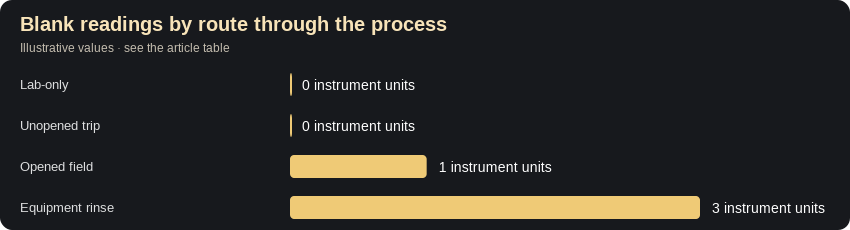
The chart shows a lab-only result of zero instrument units, a sealed trip result of zero, an opened field result of one and an equipment route result of three. These are invented readings in generic units, not environmental measurements, detection thresholds or data taken from either linked source. Zero here is a displayed number in a simplified graph; real analytical reports may say no detection at a specified limit rather than literal zero. The chart has four categories because it asks about four different pathways. The horizontal order is a comparison of handling, not a chronological record of one container becoming progressively more contaminated.
If the underlying method and materials were comparable, this pattern would give a crew a reason to look at the parts of the process the positive controls actually experienced. The opened field route suggests examining exposure or handling not represented by the closed trip control. The equipment result makes the contact path worth a closer check. Neither one identifies a specific contaminant source. Two numbers can differ because of sample preparation, laboratory reporting, variability or other factors not separated by this example. Even with a well-designed series, one set of readings is weak evidence for the magnitude and reproducibility of a suspected source.
Do not subtract the opened bottle's one from the equipment bottle's three and conclude that the equipment contributed exactly two units. That inference would require evidence that pathways are nested in the same way, background additions behave additively, the analysis works comparably and the quantities and timing make the comparison meaningful. The graph establishes none of that. Nor does it authorize subtracting three from every environmental result. It is a diagnostic picture. The reasonable next step is to identify the documented contrast, check the shared supplies and analytical details, and compare new observations under a targeted design.
Imagine a different pattern: a positive trip blank and a field blank with no qualifying signal. That is not a paradox. The blanks may have had different containers or experiences, or results may be variable near the method's sensitivity. Begin with lot and method records, dates, custody and reporting detail, not with a demand that the less exposed route always produce the smaller reading. Interpretation depends on the uncertainty in the observations and the fidelity of the handling contrast. A small discrepancy invites checking before it invites a declaration of cause.
A well-labeled chart includes what was measured, the relevant units and reporting terms, and the intended meaning of each blank. If the lab changes a displayed less-than result into a special code, keep the code through export and label it in the table instead of silently turning it into no substance. Readers need the distinction between no signal reported and zero as an exact physical amount. The accessible table should also let someone compare the blank pathways without relying on distinct colors, a useful safeguard when the chart is printed or displayed on a small screen.
Plan the controls alongside the sample schedule
A blank is easiest to interpret when it is planned at the same time as the environmental samples. Decide which equipment and container lots will be used, which batches or days the controls will represent, and how they will travel. If open-air handling is a concern on the busiest day, do not schedule the only exposed control in the clean staging area a week later. If a suspect contact path spans multiple sites, describe when and where the one selected control enters that path. Cover what could actually shape the eventual interpretation, and state gaps in coverage rather than acting as if a trip blank speaks for the entire project.
A useful plan often samples contrast around transitions. For example, consider a blank after the collection system is set up and before interpreting low-level signals from actual runoff. If a project is particularly concerned about carryover, a planned check following a relevant sequence can test a different question. A fresh-system check and a later-system check are not substitutes merely because both route through the same tubes. Their positions in the sequence are part of the evidence. The right scheduling rule depends on the target, equipment, conditions and agreed laboratory method. Avoid copying someone else's frequency as a universal requirement.
Write down the association between controls and samples. A blank could cover the behavior of one cleaning batch, a particular sampling line, or boxes of the same bottle type that traveled together; those groupings can overlap without being identical. A sample log should identify each field specimen's relevant associations without inventing a one-to-one match if there is none. Recording which readings came before and after a control enables useful follow-up if a suspect device was replaced in mid-trip. A positive blank at the end of the day may narrow attention to one path and window even when it cannot establish which individual samples are affected.
Decide also who reads the report. A pile of numbers sent to someone who does not know that a positional tag identifies shared tubing is not an effective quality control system. A small project can assign one role to check laboratory batch notes, one to reconcile field IDs and another to make or review the decision about use. These roles can be filled by the same person in a very small group as long as the checks remain distinct. If a blank's result could prevent publishing a comparison or relying on it for a decision, document the policy before knowing the result.
A plain checklist can save more trouble than a complex diagram that no one opens. It might prompt the recorder to confirm that the sealed control stayed sealed, note the actual time or relevant event order, mark any deviations and point to the controls linked to each equipment path. Leave room for “not performed” and “performed with a deviation.” A carefully documented deviation can be assessed later. A missing note often leaves the next analyst unable to tell whether a blank was handled exactly as planned or was never collected.
The notebook is part of the control
A record needs a stable sample ID, the intended pathway and what actually happened. Add a field for the blank material lot and container or equipment identifiers when those are relevant. Preserve the sampling date, event order, custody or delivery reference and the analytical batch as far as the receiving lab provides it. A timestamp alone does not identify the route. A paper card that says “blank” beside a time could eventually refer to multiple plausible controls. The intent is not bureaucratic detail; it is the ability to tie a result back to the suspected pathway without interviewing everyone who was there.
Separate planned labels from recorded deviations. A team may arrive at a windy site and choose a sheltered table rather than the original open workbench. If that decision changes which air or surfaces the controls represent, don't retroactively rename the blank to imply the original plan was followed. Keep the planned designation, record the actual location or deviation at the appropriate privacy level, and state how it affects use. The same approach works when a lid is accidentally opened, a cooler has to be transferred or a reusable part is replaced unexpectedly. An imperfect control with a clear trace may still answer a narrower question.
Mark whether a control was ever analyzed. A blank can be planned, prepared, carried, recovered and stored without producing a result. It can also be submitted and rejected because its condition or documentation does not meet the method requirements. Those are not zero readings. A table that marks all of them “clear” because no positive reading arrived changes what the evidence says. Use a distinction the next analyst can query: collected status, accession status and reporting status serve different jobs. If the project keeps a field-only record of abandoned controls, keep that record linked but do not count it among valid analytical results.
Ensure the laboratory can tell which controls it needs to interpret, using the submission conventions it specifies. There may be cases where an independent reviewer is deliberately kept unaware of samples' treatment status, but don't confuse a blinded study design with withholding information the receiving lab needs to run or handle a method properly. Where codes are needed, generate them from an agreed mapping and preserve the decoding table under the appropriate access rules. Accept a realistic burden on the person carrying the bottles: a short waterproof sample ID on the container and detailed context in a protected log often work better than writing a paragraph on each cap.
Add one field for what changed since the previous outing. A good bottle-lot record is valuable precisely because it can expose changes otherwise indistinguishable from changing environmental conditions. If the field team changes both a transfer assembly and the material used for blanks on the same day, then sees a shift in the readings, the comparison becomes harder to interpret. Contrast where feasible, but do not leave known losses of interpretability implicit. Documentation cannot recover a comparison that was never made. It can prevent a poorly supported signal from being communicated as a clean ecological finding.
A clean blank is not a complete certificate
A valid non-detect or a low blank result is reassuring only for the observed pathway, target and method. It does not establish that every environmental bottle was correctly filled, preserved and processed. It does not establish that a procedure is sensitive enough to see every signal of interest. A clean control also does not tell you whether the locations, days and depths selected for collection represent the environment you intend to describe. Contamination control, detection capability and sampling design are different sources of evidence; one cannot stand in for the others.
Think about a crew sampling a broad channel from a narrow bank. Even if every blank is clean, the sample could miss dense material passing along the opposite bank or a short pulse that arrived hours earlier. Conversely, a rough edge on the field forms may be entirely unrelated to a strong observation that multiple independent samples support. Both kinds of imperfection belong in the record, but their effects should be discussed separately. Calling a whole day valid or invalid based on one control can hide where the real limitations lie.
Replicates provide a related but distinct check. Two carefully matched environmental collections can help characterize variability from location, handling or analysis, depending on how they were made. If the point is to check analytical repeatability, separately analyze comparable portions as the method allows. If the point is to observe short-range field variability, repeat the field operation under stated conditions. Neither example answers whether a clean material would acquire the same target signal along a path. A blank and a replicate are not different names for an extra bottle. Define each by the comparison it permits.
A check sample with a known signal asks a different question again: can the process recognize or recover what should be detectable under the conditions of the check? Consult the relevant method for any validation control of this kind. Even an excellent blank series cannot demonstrate recovery of a target from a complex environmental matrix. Reporting general quality as “all controls okay” compresses the details exactly where they matter. A better release notes which checks were performed and which plausible sources of uncertainty they do not address.
Investigate a positive blank without erasing inconvenient data
The first step when a blank raises concern is to preserve the result and check the match. Is the reported ID the same bottle listed on the field sheet? Are the units and target consistent with the samples being discussed? Did the control and the sample use the same relevant analytical method? Is the positive indication above the relevant reporting level, or flagged as tentative under the laboratory's rules? If the answer depends on conventions printed elsewhere in the report, retain those conventions in the data file or explanatory notes.
Next examine groups and contrasts rather than assuming everything shares the same risk. An equipment blank can implicate a particular path, especially if other observations used a separate container system. A concern tied to a delivery or bottle lot could have a wider reach. Compare the chronology with departures from the collection plan. Preserve affected and unaffected groups distinctly while investigation is ongoing. If cause cannot be established, say that. “Potential contribution from the sampling process” is often the strongest honest statement possible from a single control result.
Decide which uses are still supportable. A record of the day's rain and flow conditions may remain informative even when low-level analytical comparisons are held. A large signal that differs strongly from the blank may merit different follow-up than one near the method's working limit, but do not invent a universal cutoff. Applicable quality criteria may depend on the study's objective and the requirements of the method or program. A reader should be able to see whether a result was retained, withheld pending review, qualified, or invalidated, and the recorded reason for each outcome.
A repeat visit can sometimes test competing explanations, but it is not necessarily a rerun of the same environment. A new rainstorm may differ from the original in volume, timing and path, and the site may have changed. The repeat can still test a suspected control failure if the crew designs it around the shared process. Compare before and after checks around an equipment change, or repeat the same handling contrasts under well-described conditions. The new outing should not overwrite the previous results. It adds evidence for or against an explanation and supplies a new opportunity to make a reliable comparison.
Why not subtract the blank and move on? Blank correction may be appropriate in some defined methods where how and when it is applied is established. But a diagnostic field blank is not automatically an unbiased estimate of what was added to each sample. The amount entering the environmental sample can depend on the amount handled, the timing, surfaces already exposed, and what is present in the sample matrix. Subtracting one number from every related reading can produce negative values or false precision while leaving the underlying attribution unresolved. Keep the raw result, and if an authorized method applies a correction, store its formula, conditions and resulting value separately.
Work through a narrow hypothetical investigation
Suppose two collection routes are used on the same morning. The upstream bottles are filled directly. The downstream samples are transferred through reusable equipment. All used matching approved containers and traveled in the same cooler, according to the log. The sealed trip blank comes back below its reporting limit. The ambient blank was handled in the shared staging area and shows a modest indication. A full-route equipment control returns a stronger indication. A downstream environmental sample is close to that stronger result. The project had intended to compare upstream and downstream in this low range.
The immediate takeaway is not that the downstream site is cleaner than expected, or that the upper observation can simply be compared with a corrected lower one. Site and method differ. A stronger signal on the reusable path raises a procedural alternative for at least some downstream observations. The modest ambient indication suggests the shared staging area also deserves attention. The sealed result supplies limited reassurance about the closed path, not conclusive proof of where the other signals came from. The identification problem is serious precisely because the garden's two sites were assigned systematically different handling.
A follow-up can separate some of those questions if the environmental sampling methods allow it. Compare the two routes on comparable material, or run a staged sequence of controls inside each route to isolate contact steps. Preserve information about which controls share materials and which deliberately do not. Ask whether a difference between material lots or laboratory handling still confounds the experiment. Even after follow-up, it may be impossible to rescue the original site contrast. The field notes can make that limit explicit and help plan a stronger comparison the next time conditions are suitable.
The final note for that morning might say that a downstream result was held for low-level site comparison because a matched equipment-route control indicated a potential procedural contribution. That statement does not assign fault to a particular person or imply that real environmental concentrations were zero. It lets a future reader separate what was observed, what raised concern and which inference was postponed. A report can still document the event, controls and observed limitations without presenting a definitive ranking of the two sites.
Use a pathway matrix to prevent mismatched comparisons
A project using more than two types of controls benefits from a small matrix whose rows are actual blank types and whose columns are handling steps. At each intersection write whether the step was included, deliberately bypassed, or uncertain in execution. Among the possible steps are initial supply, filling or transfer, same bottle lot, same storage, field exposure, specific sample-contact surfaces, preservation, laboratory preparation and actual analysis. Don't let the matrix become a replacement for the written explanation of a contact path; use it to make differences obvious at a glance. The matrix can also reveal controls that differ in more than the one step a planner intended to test.
For example, a sealed control prepared at the laboratory might use a different cap from the open field control. If the seals or liners are possible sources, a difference between their readings could be due to those materials, site exposure or something else. A contrast designed to examine exposure needs an otherwise comparable setup where practical. If equipment constraints prevent that, write down the limitation rather than loosely referring to the blanks as identical except for air. No reasonable reviewer expects a small project to hold every possible variable fixed. They will expect it not to claim a clean isolation where the record shows none.
Think separately about contrasts that are meant to be nested and contrasts that branch. In a nested design an added exposure is introduced on top of a deliberately shared base pathway. A branching design may compare a field route and a laboratory route that have no single ordering of added steps. The labels and chart should not imply accumulation in the second case. Even nested exposure steps need not contribute independent or additive amounts: an earlier condition can change a later interaction with the equipment. Write the matrix so a person can inspect the contrast without taking the displayed ordering as experimental proof.
The matrix can make the effort affordable. If three proposed controls share the same pathway and the main uncertainty is at their only uncovered transfer step, move one control to the understudied step instead of collecting a fourth copy of the same kind. If the actual concern is reproducibility, repeat the relevant blank rather than replacing it indiscriminately with a different route. Decide whether you need to see a problem again or isolate a reason for it. A well-designed set can answer both questions over time; no rule requires every small outing to supply every answer at once.
What to include when the results are shared
A brief QC section should describe enough context for an outside reader to reproduce the logic, not necessarily the logistics, of the decision. Name the target, method basis, significant handling contrasts and the relationship of the results to the study's reporting conditions. If the information is not appropriate to list bottle by bottle, include an accompanying private or restricted register with identifiers linked to the summary. Public conclusions should still state material limitations, even if those limitations had to be described without internal names, access routes or operational details.
A good display reports the counts screened as well as the counts with findings. If two matching equipment blanks were analyzed, the phrase “no measured signal in the tested equipment controls” means something modest and defensible. If seven were scheduled but five were never analyzed, the wording should not invite a reader to infer comprehensive coverage. Distinguishing expected, collected, analyzed and eligible counts helps different audiences: a supervisor can spot a fragmented process while an analyst can understand how much actual evidence supported the treatment of a set of sample values.
Retain both the original and qualified values where doing so is allowed and appropriate. The corrected interpretation can be primary in the report while the archive preserves original laboratory terms and any changes. If an export carries an excluded value, the quality field and data dictionary should make it hard to use inadvertently. If an export omits the numeric value altogether, record the reason so that the blank, rejection and true lack of measurement do not dissolve into one interchangeable empty cell. Reproducible plotting requires more than remembering a manual filter that was applied once in the workbook.
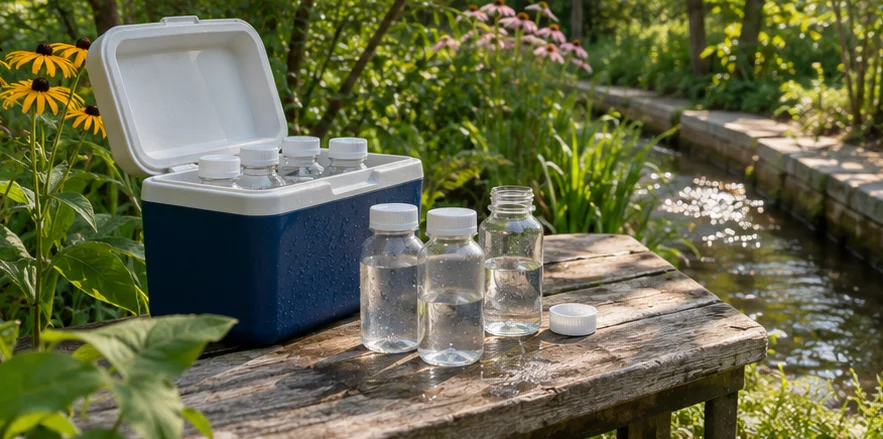
Bring the distinction into captions and text. An illustration of four example controls should say that the values were invented, not imply they were measured outside the garden. A picture of field supplies can be an editorial illustration rather than proof equipment was certified or used in a specific study. A graph of real controls should identify dates or batches, units and reporting conventions. On a small screen the chart caption may be the easiest place to understand why a low blank is not proof that all other possible sources were absent.
For a report that compares several seasons, confirm that the definition of a matched control is stable across editions. A newer method might analyze a path-specific blank for each collection run while an earlier method screened one route per site. Both records can be useful, but a growing count of reported concerns could reflect better surveillance, not a deteriorating field process. Compare findings alongside the number of relevant paths that were actually tested, and note when a reporting limit or container protocol changed. If the available records do not support a like-for-like comparison, show the two monitoring arrangements separately rather than treating their totals as a single trend line. That simple reporting choice keeps an improvement in documentation from being read as a sudden environmental problem.
A small plan to try before the next outing
Begin with one decision that could plausibly change as a result of a tiny sampling signal. Draw the collection-to-analysis path and mark which steps involve shared supplies, exposure or contact. Ask the receiving program what materials and handling it requires. Choose controls that represent the decision's main uncertainties, not the names that happen to be familiar. Decide the groups and event windows the controls will cover, and specify how you will record a missed or modified control.
Before travel, rehearse associating one invented environmental record with its proposed trip and equipment controls. Introduce a deliberate problem: one result is below a reporting limit, another is tentatively reported and a third control is listed but never submitted. Can a teammate identify which of those supplies quantitative evidence, which would trigger review and which supplies no reading at all? If not, revise the sheet or report template while changes are inexpensive. A ten-minute rehearsal on fictional data can reveal more operational ambiguity than an hour polishing a standard-form title.
At the end of the first real outing, plot the control results only after reviewing their actual paths. Do not wait until a surprising environmental result to find out whether the blank material was matched to the method or whether the lab regarded a particular run as valid. Document what the controls demonstrated and what remains untested. If they reveal an unexpected pathway, preserve the findings and change how the next trip will investigate it. That is the strength of a blank: it turns a vague suspicion about the process into a specific comparison you can improve.
Sources
- U.S. Geological Survey, Guidelines for the use of automatic samplers in collecting surface-water quality and sediment data. Primary guidance for equipment, sampling-path and field control concepts; the article's invented graph does not reproduce study data.
- NIST/SEMATECH Engineering Statistics Handbook, Measurement Process Characterization. Background on defining and testing the measurement process, its bias and variability.