| Category | Value (items) |
|---|---|
| Initial draft | 4 |
| Targeted revision | 1 |
| Reviewed version | 0 |
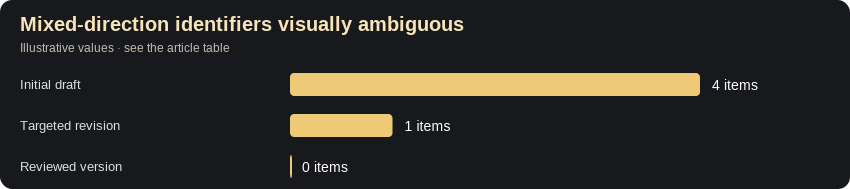
Constructed audit of 4 fixed, distinct cases. First review resolves 3; second resolves the remaining 1. Not observed performance or a conformance score.
A visitor opens a bilingual catalog and finds an entry for a clay bowl. The item is assigned the invented shelf code AB-27-C. In the English catalog the code appears as the editor expects. In a right-to-left edition, the same code is followed by a dash and another reference. Under one layout a separator hugs the wrong item, and under another two segments of the reference look as if they belong to different codes. Nothing crashed. The typography even looks professional at a glance. But the visitor has a practical task: read the identifier, copy it into a message, and find the same object. An ambiguous shelf code defeats that task.
Right-to-left writing does not mean that every character or run should be reversed. A paragraph has a base direction, and particular spans can have a direction that differs from it. A shelf code can be an exact, left-to-right identifier inside a sentence that is read right to left. Punctuation surrounding it can belong to the paragraph, the identifier, or an adjacent token. The right solution starts by deciding which is which in the data and in the markup. It does not start by dragging punctuation around the page until one screenshot looks familiar.
This is a proofing problem, not a request to translate the catalog. Use authorized, invented fixtures and preserve any exact identifiers the institution already owns. Do not infer that the hyphen should change shape or that a pattern of digits should become localized because surrounding prose is localized. An editor owns the announcement that introduces the code; a catalog system owns the code's identity. Give both a correct way to be presented. Then test the tasks the visitor actually carries out rather than relying on how the editor views the underlying string.
Stop treating source order and display order as the same thing
An identifier has a logical sequence, the order in which its characters are stored and exchanged. In this fictional collection the logical string AB-27-C starts with the letter A, then B, then a separator, then the digits two and seven, another separator, and C. That sequence is the key lookup expects. The visual position of those characters and neighboring text is determined by bidirectional layout. It is not evidence that the stored sequence should be rewritten. If a screenshot appears to place punctuation oddly, inspect the logical source and the element's context before changing either.
The Unicode Bidirectional Algorithm explains how character properties and the surrounding context contribute to display order. Broadly, the paragraph direction and runs of different directions interact. Many useful characters, including punctuation, do not behave as simple standalone markers of left or right. Digits have their own directional handling. For editorial review the implication is simple: two examples that look similar in a spreadsheet can reorder differently after they are inserted into sentences. A wholly alphabetic example with no neighbors is not a sufficient representative test for a mixed code in an actual catalog row.
Language and direction answer different questions. A language declaration helps identify the language of a document or passage. A direction declaration establishes base direction in the relevant HTML context. They often go together, but one is not merely a spelling of the other. A right-to-left Arabic page can contain a left-to-right identifier whose characters do not form an English sentence. Declaring the identifier English solely as an attempt to fix its position is the wrong approach. Similarly, setting the layout to right-to-left changes nothing about which language the explanatory text actually uses.
The HTML Living Standard defines the markup mechanisms that matter here, including directionality and elements for handling bidirectional text. W3C internationalization guidance on inline bidirectional markup offers practical examples of isolating opposite-direction phrases. WCAG 2.2 is relevant to meaningful sequence, language identification where applicable, reflow, and related aspects of access. It does not turn a four-case mock visual check into conformance or prescribe one authoring tool for every identifier. Use the sources for the specific mechanisms and checks they describe.
A useful exercise is to put the mock identifier on a sheet with two rows. In the first, write the exact logical characters with their roles. In the second, describe the expected displayed relationship: those characters stay together and read left to right as one code, while the identifier appears in the appropriate place within the surrounding right-to-left sentence. A third line can name the punctuation belonging to the sentence rather than the identifier. This little specification is more useful than a screenshot with no annotations. It defines what should remain stable when the layout adjusts to a narrow viewport or a different content template.
Decide which formatting belongs to data and which belongs to the view
A hyphen can be part of an identity, a visual substitute for a separator, or a punctuation mark introduced by a sentence template. A mock code may use exactly ASCII HYPHEN-MINUS while the surrounding paragraph uses a longer dash for a pause. An editorial typographic transformation that replaces every hyphen with a more attractive character can break the identifier even if the result looks almost identical. If the lookup expects an exact string, check whether the character belongs to the key rather than trying to fix it with an unconditional search-and-replace operation.
The same distinction applies to brackets. The mock identifier BOX-4 contains no brackets. A catalog label may place it in parentheses for readability. In that case the parentheses belong to the presentation of the reference, not to the lookup key. Another system might have a literal parenthesis as part of an official mark. Preserve that one in the identity. Do not make a blanket rule that brackets always live outside the isolated span: include them when they are part of the value or part of the unit whose directional behavior you intentionally define. The catalog's data specification and the surrounding grammar should decide ownership, not the preference of whoever last edited a style sheet.
An institution can explicitly support aliases. A search form might match a code whether the visitor entered a particular local digit variant, optional spaces, or a recognized separator. That is a search policy. It should not silently replace the canonical value printed by the authorized collection or copied for exact lookup in another system. Keep the original and the alias mapping separate, and test both. A design that accidentally alters data on the way to the clipboard cannot claim that all readers see the same reference just because a forgiving in-house search returns a result.
Read the actual code grammar. Some keys start with a known run of Latin letters. Some begin with digits or consist only of digits and separators. Some include Hebrew or Arabic letters. It is reasonable for an institution to define its minted shelf codes as left to right when the grammar supports that, but it is not reasonable to treat every code in a multilingual catalog as necessarily left to right. Unknown contributor text should have a different handling path from a field whose intended base direction is known. Document which is in use for the fixture. Do not use a model or automatic guess to invent a value for a missing record.
A good data handoff can carry an identifier and display-direction convention as distinct fields or document the convention for one known field. Avoid encoding presentation by inserting hidden directional characters inside the canonical identifier. Such characters might be legitimate in some kinds of human-authored text, so wholesale deletion from all catalog prose would be inappropriate. For the mock key, however, the clean identity can be exact and the directional treatment can come from surrounding markup. When importing existing data, investigate unexpected hidden characters against the agreed format instead of either assuming they are harmless or deleting them indiscriminately.
Isolate the whole reference rather than correcting fragments
For a shelf-code field whose direction is known, a deliberately isolated inline with that direction lets the code behave as a unit. An HTML proof might render the field as a bdi element with dir set to ltr, containing just AB-27-C. The surrounding document or section still has its correct base direction. This is an example for the fictional grammar, not a requirement to make the whole row left to right. Preserve the semantic structure of the row and any headings or links that identify it. Do not let an inline formatting fix reorder everything a person would read before or after the code.
Where reliable direction is not known, the automatic behavior of bdi can be useful for separate contributed tokens. Auto detection is not a replacement for knowing what an identifier means. In particular, a short string made only of numbers and separators may not contain a strong directional letter of the kind detection can use. Test it under both paragraph directions and specify an explicit direction when the catalog's rules establish one. This is a reason to include a code like 27-04 in the fixture collection rather than testing only AB-27-C. The numeric-only code may fail in places where a Latin prefix happened to stabilize the visual result.
An ordinary inline span and a directional strategy are different things. Wrapping each segment separately can even make a composite code harder to interpret: the interior separators may no longer belong to the unit the reader needs to copy. Wrap at the boundary of the meaningful identifier. If a compound field intentionally contains two separate identifiers with a sentence separator, use two separately identifiable fields instead. An isolated run is not an invitation to package an entire sentence with a code direction. Readers still need the expected flow of the prose and its punctuation.
Do not use visual override to fake the solution. An override can force a visual ordering regardless of ordinarily inferred character direction, but a normal shelf code is not a puzzle meant to be read backward. Reversing characters in the data, mirroring digits as if they were an icon, and swapping order using visual layout all create a discrepancy between what is seen and what is stored or conveyed. A person who copies the code should get the canonical value, not a visual repair string with its parts in an unexplained order. In the ordinary example the right tool is isolation and appropriate direction, not arbitrary reversal.
For long labels, test where the boundary falls between a prefix, code, and surrounding punctuation. A copy button may have a visible caption that includes an identifier for clarity, while its action still uses the canonical string. If the key itself is a link, keep its visible content and accessible name aligned enough that people can identify and operate it by the apparent label. If the action opens the record rather than copying the key, make that clear from the context or the control name. People should not need to discover through trial and error what each copy or navigation gesture does.
The evidence for a visual fix should include the logical result as well. Read the element's text and compare it to the expected value. Use a plain-text field to check what selected content actually puts on a clipboard, and try the dedicated copy control if there is one. These routes can reasonably differ: selecting an entire sentence also selects its punctuation, while a dedicated copy-code action should return the identifier alone under that promise. A pass on one does not automatically imply a pass on the other. Record which behavior is actually offered and which behavior was tested.
Proof the neighboring punctuation with complete labels
Take an invented example with two identifiers in one note. Instead of beginning the proof at the first letter, read the entire note in the actual locale. Determine whether the comma or semicolon separates the identifiers, ends a sentence, or stands inside a label. Test parentheses around the second reference and consider where the following sentence begins. If a reader can confidently select the two codes independently, the visible relationship is doing its job. If a trailing mark appears between a code's parts, or two adjacent references seem joined by the wrong separator, the revised mock should show exactly which boundary failed.
Typography can make this diagnosis deceptively difficult. Many punctuation glyphs are nearly symmetrical, and some paired marks can appear with mirrored shapes depending on the display context. That is not necessarily a character corruption. Comparing logical data to display, and reading the full passage in the intended language, helps distinguish the two. Do not blindly swap the stored left and right parentheses because a screenshot looked inverted. If a mark is in the actual source in the wrong place, fix it there; if the relationship is correct in the source but visually unclear, correct the context in which the browser resolves the run.
Include leading and trailing punctuation in cases where real templates produce it. A search card may end its title with a colon before the shelf code. A detailed record may add a parenthetical view number after it. A table may leave the code alone in its own cell, while a print caption moves it back into a sentence. Testing a bare identifier in a cell shows whether the cell works; it says very little about the in-sentence case. Even with one code value, the templates are not automatically equivalent because their neighboring characters and base direction differ.
Use reviewers fluent in the surrounding writing system to assess whether the label reads naturally, but do not treat that as a request to rewrite the key or the entire page. Give the reviewer an unambiguous reference string and the intended meaning of surrounding signs. Ask whether they can identify where the key begins and ends, determine which code a note refers to, and copy the intended value. A reviewer may dislike a perfectly stable typography choice without having found an actual identity failure. Separate readability feedback from a mismatch in character order so that each can be resolved appropriately.
A narrow layout exposes ambiguities that wide layout can hide
At a comfortable width, a row may contain a title, a shelf code, and explanatory text all on one line. At high zoom or on a phone, the shelf code might break at separators or the row might become a vertical card with different neighbors. A line break can make it harder to see whether the next segment still belongs to the same identifier. Define the policy according to expected lengths. Short codes can sometimes stay unbroken in a flexible container. Extra-long authorized values require a layout that avoids cutting them off or forcing the entire document into horizontal scrolling. Do not promise a fixed-width one-line badge for content that cannot fit at legitimate text settings.
One path is to move the complete reference into a labeled line within the card as the available width shrinks. Another is to allow carefully considered wrapping while preserving enough visible context and a reliable copy method. A break introduced solely for presentation should not become a literal extra character in the copied value. Do not add soft hyphens or spaces to stored identifiers merely to make browser wrapping easier; if any particular presentational technique changes what is copied in the tested environment, choose another. In a language-specific catalog, even a pretty wrap can hurt if the visitor loses track of the logical beginning or end when looking between lines.
Reflow is not merely a comparison between screenshots at phone and desktop widths. Try text enlargement, browser zoom, a long locale label, and a typical cover image or sidebar width. Inspect the real order when columns stack. A flexible design can relocate punctuation without changing the sentence it belongs to; an ill-conceived card layout might visually reorder whole records. Keep DOM order meaningful, and test on a narrow interface with keyboard and with a suitable assistive technology combination where available. A directionally correct value in a card that the reader reaches in an incomprehensible order does not make the catalog usable.
Mixed-direction identifiers visually ambiguous
The chart illustrates a constructed review of four fixed, distinct mock cases. An item is one visual test case in which the reviewed reader cannot reliably identify the intended code and its punctuation boundary under the defined presentation. It is not a count of quotes, characters, users, failed lookups, browser support levels, or WCAG conformance findings. Logical copy accuracy and speech quality are worthy checks but are separate outcomes unless the audit is explicitly redefined. The values are invented for this worked editorial example.
| Illustrative chart label | items |
|---|---|
| Initial draft | 4 |
| Targeted revision | 1 |
| Reviewed version | 0 |
All four cases are ambiguous in the initial mock. The targeted revision resolves three, leaving one. The final review resolves the last one. At each checkpoint four cases remain in scope, including when zero are ambiguous. The descending bars reflect fixed cases becoming unambiguous, not a decision to drop the worst tests. They also do not show that every layout or every kind of code works in a real catalog. If the figure is shared on its own, keep the denominator, unit, and status as a constructed illustration.
One suitable case register contains a known Latin-prefix identifier adjacent to a separator in right-to-left body text; two different identifiers next to paired punctuation in one note; a numeric-only repository code within a dense card; and a narrow card that wraps after rearranging a label and its code. In the fictional targeted revision, an editor separates the surrounding punctuation from the owned token and applies a stable markup convention, fixing the first three. The narrow view still breaks its final reference in a way that looks like two independent codes. A later layout update allocates a distinct labeled line to the full token in that view. The reviewer reruns all four cases with their original expectations. Nothing in this example claims a specific defect in any named browser.
The same change can resolve more than one audit case. Do not equate the four cases with four root causes or four changes to a style sheet. One model of visual ambiguity counts a scenario once if either the code's component order or the boundary with its neighbor is unclear. A reviewer should record both symptoms when present but count the scenario only once. If one failure remains in the middle version, preserve its case ID and exact expectation. Otherwise the final zero cannot be interpreted: it could reflect either a repair or a changed definition of ambiguity.
Check how assistive technology presents the key
Some readers use speech to hear the code. A voice may pronounce a cluster of letters as a word, read each character separately, express a number as a whole value, or omit some punctuation depending on settings and mode. The exact behavior can vary; it is not enough to specify a plausible utterance in a design document. Try the targeted environment and see whether the visitor can recover the identifier or use a reliable alternative. A brisk reading that says “twenty-seven” may be intelligible in one naming grammar and misleading in another where the difference between twenty-seven and two-seven matters. Decide what your institution expects people to be able to do with the reading.
When exact spoken recovery is important, the catalog can provide instructions or a separate way to copy the code rather than replacing the original value with verbose pronunciation text. A short note might explain that letters stay as printed and separators are included, or provide an explicit spoken rendering in an audio guide that needs one. Keep that explanation next to the code where it is useful. A hidden accessible name that no longer aligns with the visible label might impair someone using voice control. A copy function with an unambiguous accessible name and verified raw output can be more useful than an attempt to make one synthesized utterance serve every possible interpretation.
Check keyboard traversal in the actual row, not just whether focus is visible somewhere nearby. If a record has a title link, a code link, a copy button, and a menu, decide how those relate in the document's reading order. RTL flex alignment by itself should not produce an opposite order from the DOM. The sequence should remain meaningful when read or tabbed through. A person using arrows to inspect the text character by character can encounter different movement conventions from a sighted pointer user. Document the result for the supported platform rather than making one universal claim about all assistive technologies.
A copier or lookup tool must preserve meaning without requiring screen reading at all. If the copy button reports success, ensure that the reported value actually matches the canonical payload and that the feedback identifies the action without unexpectedly moving focus. In a list with several records, “Copied shelf code” can be enough if the visitor knows which row is active; in a more complex view, including the relevant value may clarify which action took effect. Verify where the feedback appears visually and how status is conveyed when focus stays on the button. An announcement that fires for the wrong row creates a new identity problem even if the layout now looks correct.
Language switches can also affect voice selection or when the readout sounds as if a new sentence began. Do not assign an arbitrary language to an identifier just because a specific synthesizer happens to pronounce it desirably in a test. Use valid language settings for the actual prose and document any separately authored speech aid. For representations in two languages on one page, inspect the section boundaries and surrounding sentences rather than declaring the whole document to be one language simply to make a shelf code sound familiar. There may be no generally preferred way to read the code aloud, which is a good reason to preserve an exact text path.
Design exports and printed references as their own contexts
A browser card may use isolation markup that is unavailable in a plain-text export. Copying an entire catalog entry to a text file can remove formatting while retaining the logical string. Decide how that destination should present the surrounding label. A tabular export can put the canonical value in a dedicated field and leave punctuation out of the field. A plain-text record can put a name and code on separately labeled lines if that is clearer in the expected tool. If the export is meant for exact import, validate the code as a field, not only as something a person can recognize in one editor view.
A spreadsheet adds its own interpretation layer. A numeric-only code with leading zeros may be treated as a number by an import tool, while the canonical key still uses those zeros. A hyphenated sequence might be interpreted as a date. This is distinct from bidirectional reordering but can cause the same report from a patron: “The code changed.” Document the intended data type and verify how the receiving software imports it on the supported route. Keep text fields as text where the format permits. Do not insert a decorative prefix into the identity as a workaround that breaks lookup. Correct the import convention or provide a format that preserves the exact value.
Print or PDF may look identical to an on-screen screenshot but behave differently when text is selected or read. Treat the actual exported artifact as its own output. Check whether a text selection returns the key without missing separators, and confirm that the label and code are distinct visually even when copied from a small printed page. If the institution offers an accessible PDF, test the relevant structure in that output rather than inferring that it shares the HTML's behavior. If exact extraction is not supported, provide an available canonical reference route and say what the print artifact was designed to do.
A scan or image may document a handwritten object mark. A useful catalog can preserve the image as evidence and present an editorial transcription for lookup without treating them as the same artifact. Keep a note about uncertain characters if the transcriber could not distinguish a letter from a numeral. Do not change an authorized value into a visually similar form merely to fit an aesthetic convention. The image can be interesting, but the user must have a selectable exact identifier wherever the catalog makes an exact lookup promise. A generated editorial illustration with no actual lettering should never be used as a source for such a transcription.
Establish a proofing cycle that does not require intuition about invisible characters
Before the first rendering test, select a compact fixture set with an expected logical value for each item. Assign fictional stable item IDs that can be compared even when titles look similar. Include a known-direction code with letters and digits, a numeric-only string with an interior separator, two adjacent codes, a value deliberately longer than the available badge width, and an instance with a clear surrounding parenthetical boundary. Keep special acceptance cases separate from the four cases used in the illustrative chart. A practical audit can cover more than the little chart illustrates. Keep the chart's case definition fixed even as the real test plan expands.
Check records with very similar values. For example, AB-27-C and AB-72-C are distinct in this mock grammar. A mistaken comparison can accept one if it checks only the letters and overall length. Deliberate near-neighbors give the reviewer a reason to verify every segment and demonstrate whether a visually reordered value could lead to a different record rather than merely no result. It is useful to name “wrong item returned” separately from “no item found.” Both are errors, but the first can go unnoticed by a visitor who never sees the intended result.
Run the same inputs in more than one context. Start with the fixture value in an ordinary English row and a right-to-left row with genuine surrounding text. Then move it to a card with two inline references, an archive footer, and an accessible copy control. If the catalog uses a search result summary or a downloadable list, test those actual outputs. A browser inspector can help diagnose what element owns each character, but the proof should not depend on opening the inspector merely to read a public shelf code. If a reviewer knows the canonical value in advance, add a colleague who does not know it and ask them to identify it from the page.
Test insertion, not just whole-page authoring. A properly authored document may still include a component assembled from catalog data and supplemental labels. The component might use correct text in the detailed view and a different template for compact results. An extra opening bracket inserted outside the expected span can change which token appears enclosed. An automatic colon added by localization might duplicate the one already included in source copy. Keeping fixtures in the code pipeline and inspecting the composed final document exposes differences that a review of the translation file cannot find.
For each presentation, record four outcomes separately: whether the visual order is unambiguous, whether the logical text matches the source, whether the intended reader can follow the content, and whether lookup reaches the same item. Test a label in a right-to-left paragraph, not an entirely mirrored mockup of a left-to-right page. If a visually ambiguous placement is repaired but the copied value includes two added characters, the visual case can legitimately pass while the copy case continues to fail. Do not give one overall green dot that conceals the distinction. Identify the scope and tool of the test for each result.
Checking characters individually can be useful when punctuation looks identical across fonts. Compare an exported value exactly against the expected record string using a test suited to the institution's stated normalization policy. For the simple ASCII mock fixture, an exact character comparison is enough. A production system might define a different valid equivalence for human-entered text. Keep that policy scoped to lookup or storage as intended and avoid using it to excuse a visual defect. If a value contains unauthorized whitespace at its edge, diagnose which part added it rather than instructing readers to trim everything without knowing why.
An isolated visible key should not encourage a user to share unrelated metadata. A copy control for the exact code should not quietly append the creator, collection location, or an internal note. That restraint makes the feature easier to test and use. A separate “Copy citation” action can include more authorized fields and a standardized order. Treat these as separate purposes rather than making one button supply a surprising mix. Localized text around the code, citation punctuation, and canonical data can all remain independently reviewable.
Diagnose symptoms in the right layer
If the identifier looks wrong in the catalog but copies correctly, inspect the direction and boundary of the visible run first. Verify whether the correct base direction is applied, whether the output represents an isolated code, and which surrounding characters are inside the element. A screenshot can be useful if it actually shows the relation to the sentence. Do not “fix” the backend key if it is already correct. A visual-only issue deserves a solution that does not risk creating a permanent data mismatch.
If the key looks right but copies wrong, check the actual copy route. The button could be using formatted label text or a sibling field from a reused card. An export could include explanatory punctuation. A user selection can include more context than a dedicated control by design. Reproduce the intended route first, then repair the appropriate part. The correct remediation differs from a direction fix. In an app where the copied string is exactly right but the pasted appearance looks wrong in another tool, distinguish the copied data from that tool's rendering and verify lookup with the supported application.
If the current output is only broken at narrow widths, inspect where an actual break occurs and what context moves with it. A visible pixel gap between two segments is not automatically evidence of a space in the source. Truncation with an ellipsis can disguise that a code is longer than it appears. If the public catalog intends the full key to remain available, either provide a layout that fits it or another clearly labeled way to view and copy it. Do not silently abbreviate both the visual label and the copy payload. A legitimate display abbreviation needs a clear relationship to the whole value.
If the wrong item opens despite a correctly read and copied value, check the link destination or lookup rules. A visible code may have been paired with the wrong route when data loaded, or reused list rows may show old values after a filter change. Bidirectional markup does not solve that problem. Add an end-to-end assertion that pairs displayed identity, expected canonical value, and actual destination. For the reader, they are all part of one task. For an implementer, tracing them separately helps avoid repairs in the wrong place.
When reporting a repaired issue, use wording that allows retesting. “In the compact Arabic result card, the separator moved outside the mixed-direction code span, and reviewers could identify and copy the exact canonical value at the tested widths” communicates more than “fixed RTL.” Include the fixture IDs and reviewed settings privately, and leave out unrelated work. Do not claim every translated document works on the basis of one row at one width. A change to the data grammar, template, export, or supported operating conditions warrants retesting the affected route.
Preserve the identifier as a small contract
A catalog entry can contain many facts that readers interpret with context. A shelf code is different: it often has to survive a direct move from page to handwritten note, exported file, spoken confirmation, or lookup box. Its value is only dependable if the person can tell how it begins, where it ends, how it is ordered, and whether nearby marks are part of it. The catalog can support that without changing the surrounding language or teaching the visitor how a browser resolves directional runs.
Keep three artifacts together in the editorial handoff: the defined source value and field grammar, the rule for presenting it among neighboring words and punctuation, and the tested delivery routes. A reviser can then change a sentence or reorganize a card without redesigning the code itself. When a new kind of identifier enters the collection, revisit the grammar decision rather than assuming the old fix automatically generalizes. The useful endpoint is not just a page that looks right. It is a reader who can identify the object, carry the correct reference elsewhere, and return to the same record.