| Category | Value (flowers) |
|---|---|
| Full interior view | 5 |
| Partial view | 7 |
| Interior hidden | 6 |
Illustrative values, not sourced observations. Classes measure visibility, not beetle abundance.
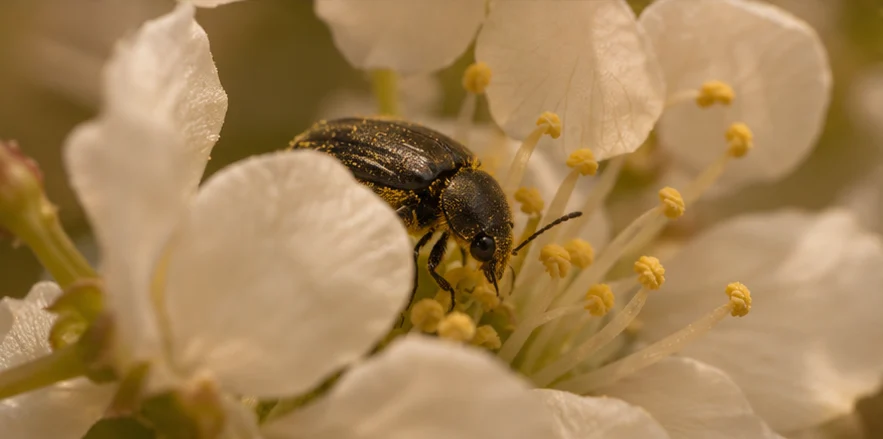
The flower looks empty from the path. A closer look reveals two dark shapes far down between the petals. One moves, stops, and disappears below the level of the opening. Then a little beetle reappears. It is tempting to correct the first observation by writing “one beetle” and forgetting how the original zero was made. The awkward part is what makes the observation useful. You found one beetle because you acquired a better sightline, not necessarily because an empty flower acquired a visitor. You may still have seen only part of the flower. Even your improved count has a boundary.
The problem is not particular to beetles, but their small size and occasional tendency to disappear into floral structures make it plain. An open flower may give a good view of a visitor as it crosses the center. A flower with overlapping petals or a narrow entrance may let you observe the same kind of movement only at the mouth. Another flower may present no useful interior view at a distance that does not disturb it. Counting all three from the same place can standardize the effort without standardizing what that effort can detect. That difference belongs in the record.
A visual count can answer several good questions. How many beetle-like visitors did we see arrive from outside during a specified watch? How many flowers had at least one visible beetle at a scheduled inspection? Which floral form offered the clearest undisturbed view of the focal structures? These are not the same question, and none on its own is a census of hidden beetles. Name one as your main question before you begin. If additional observations are useful, keep them as separate fields so a reader can tell which total represents which process.
The method below is a noninvasive garden or classroom exercise. It does not ask observers to open flowers, shake plants, trap animals, or develop a new species identification key. Its purpose is to teach a distinction that matters well beyond a garden: the state of the thing being studied and the conditions under which you could see it. Where parts remain out of view, remember the boundaries rather than forcing them away.
Define the thing you are trying to count
“Beetles in flowers” is narrower than “beetles near flowers,” but not narrow enough to reproduce. Does a beetle sitting on the outside of a petal count? What about one that walks across the outside of a floral tube without entering? Do you credit a visitor already inside when the clock starts? These choices are not trivial. If one observer counts only insects crossing the opening and another counts any insect on a selected plant, their reported numbers may differ even when they watch the same flower at the same time.
A simple working definition for a snapshot is “beetles visibly inside the focal flower at the scheduled inspection, where inside is the area bounded by named floral landmarks.” The boundary can be the rim of a cup or a recognizable entrance in a folded corolla. For a flower with a broad exposed center and no enclosing rim, draw the region you mean and name it in the caption. Do not force a narrow mouth onto plant anatomy that has none. If the primary goal is to compare forms, setting a testable boundary for each is better than pretending the same word describes identical three-dimensional space.
An arrival watch uses a different operational definition: for example, an incoming visitor becomes a record when it is seen crossing into the focal space from outside. An insect discovered at the opening after the watch began is a presence observation but not necessarily a new arrival. If you see it move from the petal edge into the center, you may have an entry into your focal zone without an arrival from another flower. A project can count either, but it needs a name that makes the distinction visible. A small sketch next to the data form can settle more confusion than a paragraph of labels.
Specify the floral unit too. A broad head may contain many individual florets. If the observer is measuring a patch of individual flowers and silently switches to counting one head as one equivalent flower, the denominator moves. A useful unit might be one marked blossom, one marked head or cluster, or one photographic field with a known number of visible units. A head-level record can be excellent for a teaching exercise; just do not divide it by a made-up number of florets that were never individually scored. If several units occupy a frame, label them in a still reference so detections can be assigned consistently.
The scope of “beetle” is also limited by the view. A glimpse of a dark rounded shape is a candidate, not automatic proof of its order. Reflections, plant structures, fragments, shadows, and other small arthropods can look similar at a distance. Record “unidentified small arthropod” or “unresolved shape” when the evidence warrants it. A sharp view may permit a broad beetle identification without supporting a species name. Whether something is in view, whether it is an animal, and whether it is identifiable as a beetle are judgments with separate uncertainty. Collapsing them removes information rather than clarifying it.
The USDA Forest Service garden guide is a useful reminder that flower-visiting animals are more varied than the obvious bees above the garden. Use agency examples as ecological context, not an identification shortcut. Seeing a beetle at an expected kind of flower is not proof that it belongs to a particular group. Conversely, an unfamiliar insect may be worth keeping in the log even if it never becomes a named record. Photos can help later review, but uncertainty remains a valid result.
Describe the view before announcing a zero
A coverage record starts with the flower. Mark a few parts you expect to be able to examine: near rim, far rim, center, and the lower space visible through the mouth, for instance. Keep them deliberately simple. The point is not to make a botanical inventory but to describe what your observation method actually covered. In a flattened bloom, a short stroke may be the obvious boundary; in a tube, the location of an opening may be obvious even while the bottom is invisible. Write coverage terms that a second participant could apply to the same view.
A full interior view means the designated interior zones were all visible under this protocol. It does not mean the observer could see through opaque tissues, around every stamen, or into every possible gap at microscopic resolution. A partial view means some designated zones could be assessed and others could not. An interior-hidden record means there was no usable view of those zones, even if the petals and entrance were clearly in frame. The scheme can work with more categories, but three are enough to demonstrate why a blank count needs context.
Set a practical minimum for a usable view. Looking into a flower in hard shadow is not useful if a beetle of the intended rough size could not be distinguished against the background. Healthy-looking details around the outer petals are irrelevant to an interior count when the center is a dark patch. Equally, a photograph with high contrast can show a sharp line at the rim and still lack information about the lower space. Describe where the recognition condition was met rather than rating the image as simply good or bad.
Keep view status separate from detection status. A full view with zero detections means you scanned the defined area and did not see a beetle under the stated method. It is a qualified nondetection, not a claim of permanent absence. A partial view with zero means you saw none in the part that could be checked. A hidden view with a blank is not the same as either zero. If you genuinely recorded the outer rim and not the interior, you can still keep a rim result, but the interior result stays unassessed. A spreadsheet that forces every missing measurement into a numeric zero will create a clean-looking but incorrect summary.
Sometimes visibility changes after the session begins. A flower tilts beyond the camera in wind, a leaf drops into the line of sight, or glare moves across the opening as clouds clear. Decide whether the visibility classification represents a snapshot, uninterrupted view over the watch, or the proportion of the watch in which a zone could be assessed. For a simple first exercise use a snapshot for the visibility tally, with clear timing, and begin a separate timed watch for arrivals. For a longer review, note transitions rather than taking the best image of the whole session and assigning that quality to every minute.
Visibility can improve without intervention. A legitimate second look from the path may expose a gap not visible from the first angle. If you plan to compare a fixed view, record the two looks separately or prespecify that a combined view counts. If you are comparing ordinary single-angle visits, silently adding an extra look only for one kind of flower makes the procedures differ. The option to take a second image therefore leads to a choice: are you trying to measure what an ordinary first look includes, or maximize detection under a multiview method? Either is reasonable. They answer different questions.
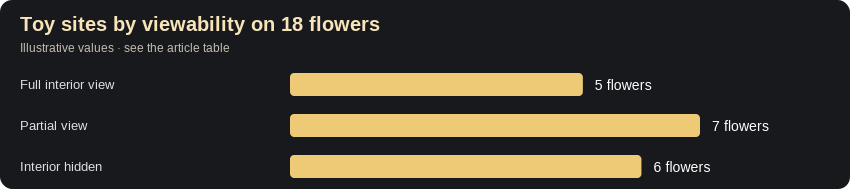
Chart: Toy sites by viewability on 18 flowers
The chart and table are illustrative only. They contain invented counts of flowers, not observations, sightings, visitors, study sites, or beetles. There is one coverage class per hypothetical flower at a defined assessment point. The term “sites” in the chart heading refers to focal viewing locations on the individual flowers, not independent geographic sites.
| Viewability class | Flowers |
|---|---|
| Full interior view | 5 |
| Partial view | 7 |
| Interior hidden | 6 |
These invented counts add to eighteen flowers. Twelve allowed at least some of the designated interior to be seen, but only five offered the defined full view. Thirteen had at least one designated zone out of view. Neither number estimates occupancy: there are no beetle detections in this table at all. It might describe a group of eighteen flowers with many beetles, very few beetles, or none. It describes the observational opportunity, which is the condition under which any later count would be interpreted.
The table can help a group design a useful follow-up. If the main question is entry at the mouth, some of those seven partial views may be adequate, and perhaps the six hidden interiors also have visible openings. If the question concerns where inside visitors spend time, all but the five fully visible flowers may leave an important gap. The right response is to tailor the coverage classification or refine the question, not to assign the hidden flowers a convenient absence. In a real report, make the observation target and classification definition visible next to the figure.
Another tempting move is to compare the number of beetles per flower by using all eighteen in the denominator. That can be a valid rate of reported sightings per assessed flower if it is labeled with that limited meaning. It is not an estimate of the mean number of beetles occupying a flower. Switching to just the five complete views does not magically answer the occupancy question either. That would describe the complete-view subset, which might overrepresent open forms, a particular part of the bed, or flowers at a particular stage. State both the coverage and the selection rule.
Suppose, purely for discussion, that a later recording found visible beetles on three full-view flowers and two partial-view flowers. This added scenario is not part of the chart. Three out of five and two out of seven are the observed flower-level detection fractions for those groups. You would still not know how many of the seven partial-view flowers were occupied outside the visible space, or whether the groups have different true occupancy. The six hidden interiors would contribute no interior detection information. A combined observed fraction could be calculated, but any interpretation would need the coverage breakdown beside it.
A simple figure can expose a methodological problem before the biological analysis begins. Chart coverage first, or present coverage and detections in adjacent but distinctly labeled panels. If flowering forms are one of the main comparisons, a coverage panel by form can tell the audience immediately whether the same zones were accessible across groups. Show counts, not percentages without denominators. A chart with immaculate axes cannot make a tiny set of visible flowers represent all the others; the graph is most informative when it reveals exactly what the data cannot do.
Walk an actual observation session
Pick a small number of marked flowers, ideally chosen by a rule you could repeat next weekend. A selection rule such as every other eligible flower along a short route will not make a garden contain every form, but it can stop the group from approaching only blossoms that are already easy to see or already look occupied. Include eligibility notes such as open stage or accessible path position. Stop short of selecting flowers so close together that one movement cannot be assigned to a particular unit. On a map, neighboring flowers can share a plant identifier without sharing a floral-unit identifier.
At the start of a session, make one reference view that shows the landmark and the focal area. Name the plant as accurately as practical, but you can still label it Plant A and revisit its identity after recording. Set a watch position and write down your approximate viewpoint in language a person can reproduce. “Side view from the path, just below the rim” may be more useful than the exact distance if branches block a straight approach. When comparing two flowers, maintain the approach and units without flattening their naturally different poses.
Perform your snapshot first if that is part of the method. Mark coverage for the focal zones and write the number visible or unassessed. Then, if using a timed watch, start the clock and record the origin of each event you can actually follow. A distinct arrival could be confidently seen even if the visitor immediately disappears. A beetle already present at the start may emerge but does not retroactively become an arrival. Use columns or ticks for presence at start, visible entry, visible exit, movement within the area, and unresolved. You do not need all five for every project, but leaving them distinct avoids confusing presence with activity.
The UK Pollinator Monitoring Scheme's FIT Count instructions are an official example of how a timed flower-insect method defines observation effort and target flowers. The prescribed ten-minute count is part of that particular scheme, not an optimal time for every question or an instruction to substitute this exercise for a formal submission. A dedicated beetle sightline exercise can imitate the useful idea of a fixed watch while reporting its own units, form selection, and visibility protocol. If you want to submit a FIT Count, use the scheme's actual directions rather than a hybrid version.
During a watch, stay out of the line of light when possible. An observer looming above a flower may both shadow its interior and alter the scene being watched. Moving slowly from an agreed path position is preferable to putting a camera directly into an opening. The point is not to demonstrate that a beetle can be found by any means. It is to find out what a stated visual procedure detects without opening, shaking, or moving the flower. If a good view would require stepping into a bed or bending the stem, record the limitation and leave the plant where it is.
Use repeats for a reason
Watching longer is helpful only when the limitation has a time component. A visitor moving briefly across a visible center may be missed in a single snapshot but caught in a steady recording. A beetle concealed under tissue for the entire watch remains hidden no matter how many times you replay it. Before adding hours, determine whether your main problem is a brief sighting opportunity or a blind zone. The former suggests improving continuity, the latter suggests another unobtrusive angle or a more modest question. A lot of visual data can conceal the fact that the useful portion did not grow.
Repeated observations can mean several things. Three consecutive frames from one camera are not three independent visits. Three ten-minute watches on the same flower are repeated samples of one floral unit under possibly different conditions. Three different flowers on one plant extend coverage across forms or positions but still share aspects of the same setting. Three separate patches offer a different range of variability. Label the level at which you repeated the work so that a plot of totals does not imply that hundreds of nearby frames are hundreds of independent patches.
A second angle often yields a richer record, but it requires careful matching. If two cameras simultaneously show a beetle emerge, check whether the time and location correspond before treating the images as two visitors. If one camera shows a beetle moving into darkness and the other shows a beetle entering a nearby zone after a pause, it might be the same animal. Unless there is an unbroken track, avoid confident counts of distinct individuals. A safe alternative is counting events that meet a visible movement rule. Keep probable matches marked as such rather than adjudicating identity from a general resemblance.
Changing the observation angle sequentially raises a distinct problem: the animal may have moved between views. If you first look from the side for one minute and then from above, an extra beetle could have become visible either because of the angle or because it entered during the change. This is not a reason to discard the pair. State the order and delay, and call the result “additional detections in the second look” rather than “beetles hidden from the first camera” unless their movements are directly traced. If the practical question is which approach yields more sightings, alternate order across comparable units where possible.
A fixed camera can be an excellent partner for a human observer without becoming an infallible reference. It supplies replay and retains details that a person might not notice on the spot. But it can miss moments between frames, lose sharp focus during wind, or fail to trigger for a small or slow animal depending on its setup. Human viewers can also shift attention among zones a fixed camera cannot simultaneously resolve. Neither method automatically corrects the other. Ask what each device and person was capable of seeing at the time, and preserve differences instead of merging them blindly.
A pair of primary studies illustrates why matching the instrument to the question matters. The PICT camera trap study tested a modular video system using two plants with contrasting floral characteristics and scored visiting behavior from footage. An alpine flower-visitor study used manual sampling and video together to address complementary questions. These papers do not provide a correction factor for the beetles of an ordinary garden. They show actual research decisions about units, instruments, and observations. The fact that a method was useful at one site should prompt you to ask which parts of its design match your own.
Recognize false positives without treating every dot as suspect
Small animals are hard to see, and that encourages observers to accept plausible fragments. A dark speck may be a beetle. It might also be an anther tip, a shadow on a fold, a bit of debris, or some other arthropod. In the field, most ambiguous marks do not require a definitive yes or no. Record an unresolved observation, along with enough evidence for a second person to review it. A well-supported negative or an honest unresolved candidate is better than a confident event that changes every time someone zooms in.
Motion helps when it has a structure that cannot be explained by a moving flower or a shifted light patch alone. Look for a shape moving against floral landmarks, rather than just against the edges of the image. The whole bloom may swing in wind, or the camera may shift as a hand adjusts. If the speck is fixed relative to an anther through the motion, that tells you something different than a speck crossing a stationary rim. A conversation about “did you see movement?” benefits from specifying movement relative to what.
A replay can show something recognizable before it disappears, but the desire to see more is not a source of new detail. Cropping or sharpening is useful for presenting an already supported feature. Heavy processing can also strengthen shading edges, compression blocks, and other artifacts. Keep the original image and never use fabricated intermediate frames to establish a visit. A captured blur may remain a blur. For the same reason, use any illustration accompanying a report to explain the concept of hiddenness, not to establish what was found in the field.
When working in groups, compare scores on difficult clips before making a tally. Have both observers mark coverage and detection independently, then compare where they disagree. One may see movement while the other agrees an insect is present but does not find evidence that it is a beetle. Those are different disagreements and require different clarity in the instructions. Record how often a claim changes after joint review; the final unified tally should not imply both observers immediately saw every candidate. A small teaching project can do this informally without estimating a formal observer effect from too few examples.
Observer attention is another coverage variable. A teacher who directs everyone to stare at the open center may improve detection there and miss activity at the edge. A volunteer accustomed to watching larger animals may notice a bee first and not see a slow-moving beetle nearby. This need not be blamed on an individual. Rescope the exercise to a manageable field and use fixed prompts for the search. If the question focuses on tiny visitors, make sure they would have been detectable at the distance selected. Better notes about effort often help more than a demand to “look harder.”
There is a genuine trade between widening the view and retaining the detail needed for identification. A wide frame may include every entrance in a patch while rendering the smallest visitors too small to classify. A close frame may resolve the outline of one animal while losing the surrounding units. If the project values both, collect a context image and a detailed image, and state which supplies each piece of evidence. Do not give the wide shot credit for a species identification earned only in the close-up, or give the close-up credit for arrivals outside its crop.
Do not confuse abundance, activity, occupancy, and effect
Abundance asks how many individuals are present in a defined population or area. Activity counts what individuals do, such as entries or visible traversals. Occupancy is about whether a defined unit is occupied, during a specified moment or interval. A beetle can enter a cup twice in a minute, contributing two activity events but only one individual. Two beetles can share one flower at a snapshot, contributing two visible individuals but only one detected occupied unit. Different kinds of summaries can use the same session if they retain these units. A raw record called “beetles” is usually not specific enough to support them all.
True occupancy and observed presence are not interchangeable. A plant may be occupied by a hidden animal even when an observer reports no beetles. One illustrative comparison makes the ambiguity clear. Suppose ten open flowers and ten partly closed flowers truly contain beetles in the same fraction, but the observer sees almost all the beetles in the open flowers and only a few in the others. The observations can look like a biological preference where the difference lies in detectability. Reversing the example is just as revealing: equal sightings could conceal different occupancy if one set of flowers provides a worse view.
Do not “adjust” covered and uncovered interiors by simply multiplying by the inverse of an estimated visible fraction. Insects may not distribute evenly within the flower. The visible rim may be where they enter, while the obscured bottom is where they pause. If the covered space is not a representative slice of where the target animals spend time, a geometric fraction is not a detection probability. A coverage field supports a transparent rough comparison or motivates another view. It cannot create measurements of hidden behavior without additional evidence.
There is a distinction between being detected at some point in a session and occupying an individual flower consistently. Across several checks, an animal may come and go. More detections with longer observation may reflect a legitimate change in cumulative exposure rather than a more sensitive snapshot. If you plan to use a model in which presence is treated as fixed during repeated visits, first consider whether the flower-level state is plausibly stable over that interval. In a small garden demonstration, it may be more defensible to present times and observed entries directly than to estimate a latent occupancy quantity that depends on assumptions the observations cannot support.
Finally, an animal's presence cannot by itself establish what it contributed. It may rest, feed, use the flower as shelter, or move between structures. Pollen can be picked up or delivered under some circumstances, but a silhouette inside a flower is not evidence of delivery. Nor does a hole or missing piece of tissue identify which visitor made it. A garden count is not a trial that attributes pollination, damage, or reproductive outcomes to an insect. If a participant asks what an observed visitor did, return to the sequence it actually performed in view. An accurately described motion is better than a guessed ecological service.
Design a fairer comparison without touching a flower
Suppose a class wants to compare a shallow, upward-facing flower with a folded flower oriented nearly horizontally. Giving all students the same amount of time from above will favor one form's exposed center. Giving each person freedom to find any viewpoint makes sessions harder to compare. There is a useful middle ground: choose a rule such as “observe from the most unobstructed point on the path where the entrance is in view,” record the position, and separately note which interior zones were visible. A second standardized angle, if accessible, can be a separate observation with a separate result. The rule should serve the question you are asking rather than a vague ideal of identical conditions.
Keep form from being the only thing you record about flowers. Nearby plants may occur in different shade, at different heights, or in clumps with markedly different numbers of open blooms. Comparing the single accessible flower at the edge of one patch with a selected flower near the center of another may systematically change the surroundings observed. When possible, pair rounds by approximate time, light, habitat position, or flower stage and repeat across more than one individual plant. Note what could not be matched. A narrow matched comparison can be more useful than a large pile of incomparable observations.
The observation frame is often narrower than the botanical sample. If the path does not allow access to blooms deeper in the bed, the survey does not represent them simply because you can see the planting from a distance. If tiny beetles are not resolvable on the farthest flowers, that subgroup has a visibility limitation in addition to its selection limitation. Be explicit: “flowers accessible from the path, under these conditions,” or “flowers whose entrances could be framed at this distance.” Those claims may sound modest, but they are specific enough to repeat and expand.
Plant stage can create unusual comparisons. A recently open bloom and a fully open blossom may have very different windows into the center while still belonging to the same nominal type. A folded flower might open more during the watch or become less accessible after a change in sunlight. If the class later sees different counts between forms, repeat the observation for similar stages before assuming the difference is caused by the forms themselves. View classification should be recorded at the time of observation, not inferred afterward from the plant's name.
Separate access restrictions from research choices. The design might deliberately prohibit touching flowers; that is an important observation condition. A separate site rule may prohibit stepping off a path; that defines which positions are available. Keeping both in the notes allows a later group to compare its work honestly, rather than asserting the method failed because it could not see a zone the protocol never attempted to inspect. The ethical advantage of noninvasive observation is not that it answers every question. It is that it makes the limits of a low-disturbance answer explicit.
Report what the next observer needs
A reusable field note can fit into one sentence: “Unit A07, one focal flower, north path side, four-minute watch, center and upper near rim visible but bottom and far fold not assessable; one confirmed beetle entry at minute two, one stationary shape unresolved; no claim about hidden occupants.” The four-minute interval in this note is for the invented exercise, not the formal FIT Count. A snapshot record would have a different form: “At the start, one visibly occupied assessed zone, remainder out of view.” Each note is more useful than a lonely one in a spreadsheet because it states exactly why the one was recorded.
Keep a way to audit the exceptional records. A short image identifier, time, and unit usually suffice. Note if the observation was interrupted, carried over from a prior view, or later recoded. If a record is really a false positive discovered in review, keep the original decision and the correction with an explanation. Erasing error history loses a clue about the process. If most corrected incidents involved glare at the far rim, you have a specific target for improving next week's observation rather than a vague impression that everyone needs a better lens.
A short field report can lead with its coverage result. Give the number of flowers assigned to each class and the number in each shape or stage you compared. Then report the detections with their units and denominators. Keep unidentifiable candidates separate instead of letting their interpretation silently change the main count. If you include a rate by time, explain whether the time is total effort, time with a usable view, or both. If you present photographs as examples, describe what they show without implying every flower received the same quality of documentation.
One useful exercise after the report is to ask a reader to predict which new observations would change its conclusions. If the claim is “more visible entries at upward-facing blooms under a fixed path view,” a matched second round could overturn it. If the claim is “beetles prefer upward-facing flowers,” the evidence required is broader and much harder to collect. The first statement does not become uninteresting for being specific. It points to practical next tests involving viewpoints, opening geometry, and sampling. The second statement sounds important but skips those tests altogether.
When a group decides whether to invest in more observation, prioritize the gap with the largest interpretive consequence. If the class only needs a fair count of entrances into a clearly visible opening, it may not need a perfect picture of the lower interior. If it needs to know whether beetles are present at a fixed time, more cameras aimed at the same rim may not answer the question. In some cases the most useful outcome is to change the question from an unmeasurable total to an observable comparison, and to state that choice plainly. That is a stronger result than an unsupported estimate delivered with false certainty.
The initial flower looked empty, and the second look revealed more. Neither look was worthless. The first recorded what a person could see from the path. The second established one detection from an improved position. The unobserved part of the flower remained unobserved. Those three statements can coexist in one clean record. Count what the method includes, show what it cannot see, and name the practical consequence before adding conclusions about the animals inside. That is how a casual view of a flower becomes a useful observation without taking the flower apart.