
| Category | Value (records) |
|---|---|
| Named before | 11 |
| Named after | 16 |
| Unresolved after | 4 |
Illustrative values, not sourced observations. Same 20 original records; 5 labels promoted, not 5 encounters.
On a flower walk, a small bee lands long enough for a volunteer to take two pictures. The bee departs before the volunteer can see much besides a dark abdomen. The note goes into the field tally as an unresolved bee encounter. Days later, a reviewer finds a usable feature in one of those pictures and assigns the record to a narrower group. The garden has gained a better identification. It has not gained a second bee sighting. Yet if every picture, annotation and taxonomic change becomes a row in the same worksheet, a simple count can suggest exactly that.
The distinction is easy to state and surprisingly easy to lose. An encounter records what took place under an observation rule. An identification records what someone concluded about the evidence for that encounter. A picture is evidence, and a second picture can corroborate a single event. A review date tells you when an interpretation changed, not when something visited a flower. In a survey with repeat sessions, preserving those differences keeps the denominator, effort and numbers of field observations intact while the team learns to make more precise identifications.
This article describes a fictional passive field watch with exterior photographs and routine notes, not a collection protocol. There is no need to catch, handle or disturb insects to apply the bookkeeping. The main principle is to link evidence and decisions to an existing record without requiring a new field row every time knowledge improves. In those less common cases where review really does uncover a missed encounter or a double count, change the tally through a separate, documented amendment.
Agree on what counts before the walk starts
Suppose a group schedules a ten-minute watch of a named patch of flowers. It marks an encounter when a visually trackable insect first makes contact with one of the designated flowers. It follows a stated rule for deciding when that observation is finished. Switching to another head while continuously visible could remain within the same encounter in this particular protocol. A new visit after the animal is lost could qualify as another encounter without establishing that a different individual arrived. Other protocols use different units; the point is to write one and apply it consistently. The image count does not settle the encounter count.
Decide whether a visual encounter counts when there is no photograph. If the protocol accepts a clearly observed eligible contact, a no-photo encounter is still a row. If a dataset accepts records only when there is sufficient photo evidence, label that narrower scope; it cannot be used later to claim a tally of all encounters seen on the walk. You can record the existence of a wider observational tally beside a smaller photo-documented subset. The two use different evidentiary rules, and their counts may be useful for different questions.
Set a rule for uncertain behavior near the boundary. A tiny insect hovering irregularly may disappear near a flower without anyone confirming contact. That may be an incidental candidate, not a verified encounter. A confident encounter with uncertain taxonomic identity is different: it meets the behavior rule while not having a narrow taxonomic label. If the field form offers only a single checkbox labeled “verified,” volunteers may use it for both. Split behavioral eligibility and identification status, and let an unresolved record qualify for the all-encounter total when the protocol supports it.
Give each scheduled watch its own ID. Record intended duration, actual usable effort, observation conditions, area and any event-level interruptions. A person who spends a portion of the watch reviewing the camera screen might miss what occurred in the flowers during that time. Record that loss according to the plan; it does not become usable watch time because the pictures already taken were productive. When one observer watches while another photographs, the same interval may still be covered under a paired protocol. What matters is who actually watched and how the effort definition accounts for the role change.
Give the encounter its own identity
An encounter ID can be a simple stable code, assigned as soon as there is a record. It should not rely on a species name, a photo filename or where the row appears after sorting. If a reviewer changes the name, the code should survive. Store the watch ID with it, along with the time or order and what behavior made it eligible. A later export should let a reviewer tell which watch supplied a record without reverse engineering its identifier. If two observers are maintaining separate tallies for an agreement exercise, give their observer records explicit links instead of assuming their codes represent two sightings.
GBIF's sampling-event guidance describes linking event information such as effort and protocol to related records. A small garden ledger can apply that pattern without needing to publish or to mimic every field of an exchange standard. A timed watch can be the sampling event, with several floral encounters related to it. An event is not the same thing as a photograph or a taxonomic decision. An event-level identifier holds records together even when the images and names attached to individual encounters are amended.
Likewise, a local encounter ID is not necessarily a claim about an individual organism. A bee that flies off and returns could contribute two encounters under a stated rule if continuity was lost. You may be able to establish identity in some cases from distinctive markings, but a tally based on simple appearances cannot assume that every new row represents a different bee. If what matters is unique individuals, you need a suitable design and independent identity evidence rather than reuse of a visit count. For this exercise the goal is deliberately more modest: preserve the recorded contacts and their evidence trail.
Do not use row order to synchronize files. One volunteer may add a note between two original rows or sort the watch records differently; image logs are often sorted by file creation rather than capture. A stable code shared across records makes those operations harmless. If the link between an image and a field ID is uncertain, store that uncertainty. The filename may show time only to the nearest second and could be duplicated by another camera. A reviewer should not silently attach evidence to whichever row happens to sit closest in a current spreadsheet.
Link the media without treating it as a new observation
A burst of five photos can belong to one encounter. Keep each file or evidence item identifiable and attach its relationship to that encounter. If a crop is used for reviewing wing posture, keep its relation to the original. If you discard blurred working duplicates for storage reasons, preserve enough context to know what was actually reviewed and which files remain. Avoid counting the number of photos completed as a proxy for field effort. A reflective insect that stayed on one head can generate more files than a whole series of fleeting encounters.
Sometimes an image contains two insects. Do not blindly expand the tally to two because the software found two shapes. Apply the field definition and timing rules to each potential record. Did both show the required behavior in the observation area? Was one already counted in a separate field note? Is the second detectable and distinguishable under the review protocol? It may provide evidence for two existing encounters, or support a separately justified amendment if the protocol allows recovering missed eligible events. Or it may contain an incidental insect that must not change the formal tally at all.
When exporting, a relational join can introduce multiplication even if the source records are correct. Joining a list of three image links and two review decisions to one encounter can create six resulting rows if every image is combined with every review. Counting those rows would exaggerate the total. For an encounter summary select one current identification per eligible encounter and count unique encounter IDs under the appropriate scope. When sharing an evidence table, allow the multiple rows but label them as media or review records. A wide file copy should never become the sole record of the counting unit.
There is also a reverse problem. If media files are reused across records and someone deduplicates solely by image ID, a photograph containing more than one documented eligible encounter might cause one to disappear. Link tables can represent multiple relationships without declaring that every link is independent evidence. Keep the original record of why a link was made, what portion of the file is relevant and how reliably it can be connected. These small notes are useful when an export flattens the relationships and somebody has to reconstruct how the analysis counted them.
Preserve the old and new identifications as dated judgments
Write the field label as originally recorded. It might be a provisional recognizable group or simply unknown bee. A later reviewer can propose a current label at a defensible level and explain why the evidence permits it. Keep the earlier label as history and record the date and review source. Do not rewrite a notebook as though the new identification had been known at the time. That date distinction matters if the group is evaluating which observations novices can resolve in the field and which depend on later expert time.
The USGS Eastern Ecological Science Center's identification resource directs readers to keys and expert review for a difficult identification problem. Its resources are not a promise that every image shows enough. A sharp photograph taken from above can fail to show the structures needed for a narrower identification. A credible expert may legitimately leave the record at a broader level or flag it as ambiguous. Reclassifying a confident species claim to a family or group can improve quality even though it reduces the count of narrowly named records.
If several reviewers disagree, retain the decisions rather than keeping only the latest opinion by default. Set a rule for which identification becomes current: it could be a designated curator's documented decision, an agreement rule or a deliberately unresolved state when evidence conflicts. Keep differences in rank and uncertainty visible. A newer label based on a cropped low-resolution picture might be weaker than an earlier assessment from a fuller record. Curatorial responsibility is not the same as chronological sorting. Explain the basis rather than inventing a certainty score merely to choose one row.
The Darwin Core Quick Reference Guide provides maintained definitions for biodiversity data terms, including event, occurrence and identification concepts. Your internal system may preserve an audit history more detailed than a public export. That is fine. For a published or shared view, map only fields whose meaning fits their definitions, and avoid implying that every local encounter procedure is a standardized individual count. A concise data dictionary and version note help others interpret what a change in label means.
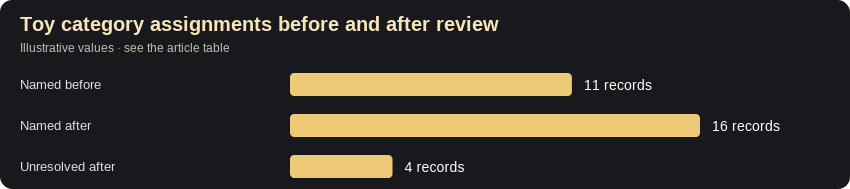
Toy category assignments before and after review
The chart and table show illustrative category assignments for the same twenty fictional eligible records. “Named” here means that the record meets the toy project's planned naming threshold; it does not imply that every record is identified to species. These are invented counts, not data from the source documents or a real field watch.
| Snapshot category | Records |
|---|---|
| Named before | 11 |
| Named after | 16 |
| Unresolved after | 4 |
Before review nine were unresolved. Five of those were promoted under the illustrative naming rule; none changed in the other direction in this example. Eleven named records became sixteen, while nine unresolved became four. The same twenty encounter IDs underlie both snapshots. Fifty-five percent met the threshold before and eighty percent after, an increase of twenty-five percentage points in naming completeness. That is not an increase in encounter abundance. The after bars sum to twenty, but summing all three bars would count part of the same set twice.
If the current labels were grouped by genus, or by some other defensible rank, the number in any one category might rise or fall with no new field effort. That change can be consequential for a biodiversity question, but report it as a new determination on an existing record. The chart does not show whether review corrected any false labels, discovered any undeclared imagery, or helped some observer more than another; those would be separate comparisons. The intended takeaway is the arithmetic identity of the cohort, not a claim about quality gained in a real program.
Count amendments should have a different route
Occasionally review changes more than the label. Two tally rows might refer to the same encounter because one watcher called out the bee while another recorded the same moment without hearing them. A verified continuous video might reveal a missed eligible contact, if reviewing footage is part of the stated protocol. A visual record initially logged as a flower landing may turn out not to meet the contact criterion. Those are possible changes to the inclusion or identity of the encounter record. Let those decisions pass through a tally-amendment process rather than putting them through the rule for naming changes.
Describe the amendment in terms a second person can audit: which original IDs are involved, which event and interval they belong to, why they count as duplicate or distinct, and what evidence and protocol support the change. When merging duplicates retain a pointer from the retired ID to the surviving one. If one record needs to be split, avoid leaving both the parent and resulting rows eligible in the same current count. You can preserve the original raw records while setting the counted view to represent the accepted interpretation. A total is reproducible when those eligibility choices are visible.
For an addition recovered from media, record the actual encounter time or uncertainty in it, not the review date as a new field visit. If the protocol requires real-time observation only, such an addition may not belong in that series at all. Keep it as an incidental evidence record, or start a separately labeled media-assisted series when enough effort exists to define it. Do not selectively scour images from particularly interesting dates and compare their media-assisted counts with unreviewed real-time dates as though observation intensity had not changed. The same file can be legitimate evidence for one dataset and outside the eligibility rule of another.
A reclassification sometimes crosses the project's taxonomic inclusion boundary. For instance, a field group might provisionally tally all qualifying flower-visiting insects while separately reporting a bee subset. If a reviewer decides a recorded insect is a fly, the all-insect encounter total need not change, but the bee subtotal can. If the principal series is explicitly restricted to bees, its inclusion can change under the project's accepted identity and eligibility rules. State exactly which total changed and why. The headline “no new encounter” does not mean every derived taxonomic subtotal stays the same.
Keep evidence of an interruption instead of filling it in
Picture a volunteer looking down after a burst of photographs. They look back several seconds later and see a similar insect on another flower. The photographs can identify both better later, but ordinarily they cannot show that the insect on the second head is the same one or that it arrived during the missing seconds. If the watch definition treats a loss of continuity in a particular way, apply that rule. If the gap makes the record uncountable as a distinct event, document it. Record the interruption in the watch effort rather than trying to invent exactly what happened off camera.
Review may clarify the first encounter using a sharp frame without recovering any field effort. That is one reason to include both an effort record and a media index. The first is about the window in which observations could be made according to protocol. The second concerns preserved evidence. A frame taken before an interruption cannot turn the pause into valid observation time. In an intentionally video-assisted protocol, a continuous and in-scope recording may count as coverage where a distracted watcher did not. Define that method and assess its view limitations before pooling it with direct human watches.
Subtle interruptions are worth noting. A bag temporarily blocks one side of the patch; flowers sway outside the usable view; the second observer briefly sets down the notebook to move out of a visitor's path. A scheduled start and end time cannot establish that all intended minutes were covered. It is possible to log a confirmed encounter during a partly usable session and leave other minutes uncertain. Do not downgrade the existing record just because the full schedule was not met, or describe usable effort as complete because a record happened to be confirmed.
For a future design, assign a recorder if someone must operate optics. That can preserve coverage while keeping the evidence opportunities manageable. Establish who marks event starts and finishes and what constitutes a handoff. Two observers holding different fields of view may see the same insect; raw counts from both are not automatically additive. Conversely if both stop watching at once, neither role can certify what happened. An agreed observation and interruption rule will prevent a later label reconciliation from becoming an improvised reconciliation of field effort.
Provide two views of the same data for different questions
A garden educator may want the labels as known today so visitors learn the most reliable names. A training coordinator may want the labels as first recorded, to assess whether field observers tend to stop at a broad group under particular conditions. A dataset steward may need both plus the review dates and reason for each change. These are different views of the same linked record. Keeping them separate allows the database to get better without destroying evidence of how the program actually operated.
Label export versions and preserve the date on which each was produced. If two reports show different named counts for the same observation season, the reader should be able to distinguish a retrospective determination from additional fieldwork. This is especially useful for comparing changes in photo coverage between years. A later year may have more resolvable records because someone used a better lens or because specialist review was available. Increasing naming completeness is not itself evidence of increasing biological diversity. Where changes in verification affect what can be compared, say so before plotting them as a trend.
For a chart tracking identification improvements, start with a fixed cohort and a clearly stated threshold. A stacked display can show named and unresolved results side by side across two snapshots, provided readers can see that the bars share their membership. If the threshold itself changed from genus to species, don't describe the counts as the same metric. If some records entered or left the cohort through genuine count amendments, show those as separate flows or produce a stable-cohort comparison in addition to the full updated total. Good accounting makes it possible to check whether a change came from classification, scope or field evidence.
Data consumers may use only one table and lose the nuance. Give each row active fields that make the distinction transparent: watch ID and encounter ID, original and accepted label with their respective dates, inclusion state, and any media links appropriate for that export. A note can point to a fuller amendment history without exposing personal or sensitive site details. When sharing outside the project, follow the applicable rules on private locations and photo contributors. Evidence can be withheld or generalized in a public version without pretending that an absent link means no evidence was gathered.
Understand the uneven opportunities for photo review
Photo availability is not a random sample of field events by default. A large bee that stays still on an exposed blossom is easier to photograph than a tiny one moving rapidly behind overlapping petals. The same observer may take many more pictures during slower watches. The naming rate among photographed encounters may therefore say as much about view quality and subject mix as about the expertise of the reviewer. Keep the total eligible encounter count, the number with usable images and the number passing the chosen identification threshold distinct. A single “verified percentage” cannot answer all three questions.
If the goal is to compare observer learning, match the evidence that observers had access to. One person may classify while a specimen is clearly visible in a broad outdoor view, another may work from a cropped image taken at an unfavorable angle. A comparison of their labels says little about skill without those contexts. A practice set of the same appropriately shareable images, presented under consistent rules, can help distinguish disagreements about rank from differences in evidence. Do not promote the practice outcomes into field counts. They are training records linked to examples, not new sightings.
Patterns in the unresolved records can guide the next field effort. If many ambiguous photos are sharp but all show the same angle, a reminder about additional nonintrusive views may be worthwhile where the animal stays visible naturally. If the main confusion concerns whether contact actually occurred, a wider view attending to behavior may be more relevant than closer detail. Some situations will not support an improvement without intrusion. In that case preserve the broader identification and move on. There is no obligation to reach a naming threshold for every encounter, particularly when doing so could compromise the observation conditions or safety.
An automated suggestion can serve as a lead without being an accepted name. Store it as a suggestion with its source and what evidence it saw, and require the normal review before using it in the current label. If an automated system generates several candidates, those entries are alternatives for one encounter, not multiple entities in the field. If an app model is updated tomorrow, its new output is another interpretation at another time. Do not update all historical labels silently or use a later confidence score as if it had been available to a person during the original watch.
Work through an invented reconciliation from notes to report
Suppose a watch recorded two contacts at nearly the same instant. One observer logged the flowering head number and a second photographed a visitor without speaking. There are two provisional IDs. To decide if they duplicate, first check that both clocks and patch definitions match. Then see whether each record links to the same brief action or merely describes a similar insect in a busy scene. If the relationship is uncertain, mark that. A close timestamp is not a uniquely identifying feature. Two distinct contacts can occur within one second, and the same contact can have camera and notebook times that differ.
Imagine the team can confidently establish that those records describe the same contact. Keep both originals in the audit material, put the verified link in the amendment log and exclude the duplicate from the current encounter count. Now suppose one picture supports a broader taxonomic category than both field notes. That is a separate identification revision. Someone reading next month's report should be able to tell that the total dropped because two records were reconciled, not because uncertainty or a rank change made the animal cease to have been seen. Good versioning does not require every edit to have a separate spreadsheet tab, but it requires these edits to have different meanings.
Next compare the change to a case in which the two original encounters were both valid and the same expert later placed both at genus. The named count might grow, with no subtraction from the encounter count. Neither event is intrinsically more important; one changes what was counted and one changes what can be said about a counted record. Separating these possibilities gives the project a more useful seasonal story. It can celebrate improved determinations while maintaining transparent correction of the historical tally.
Make the current determination explicit enough to reproduce
Imagine one record whose first label is “small dark bee.” An image reviewer later proposes a particular genus. A specialist then sees a second view and concludes that two genera are plausible, with no decisive trait available in either file. A chronological ledger can preserve all three statements. The display state can use the broader category with uncertain genus rather than pretending every revision must increase specificity. Write the rank or descriptive group separately from confidence and distinguish what a person endorsed from what an application simply suggested. That structure gives future readers usable information even if they never see the actual images.
Keep the reason for a name change concise but informative. It might say that the reviewer used a clearer view of a feature, recognized that the proposed group did not fit the visible characters or adopted a different name under a documented reference list. The last case is not necessarily a change in the taxonomic identity of the individual; it may be a revision of terminology. A program counting distinct categories can change its totals simply by switching lists of accepted names. Record the version of the reference vocabulary where it matters, and keep an appropriate map between old and new terms rather than treating a synonym as evidence of another species.
Consider what a report of named records leaves out. One hundred encounters might contain twenty labels from a single readily identifiable group and numerous unresolved records from several less recognizable groups. Improving the identification rate may alter the displayed composition without implying a corresponding change in the flower visitors themselves. If the question is which groups appeared frequently, preserve the unresolved counts alongside the identified ones and explain the resolution threshold. If the question is how many different species occurred, a list of observed names may be incomplete and different evidence demands may apply. Counting names is not the same as counting records that have names.
When a result becomes current, save an explicit link to the underlying decision. Do not infer that link from the row with the latest upload date. A reviewer can enter notes days after the actual determination, and a dataset steward can import older expert decisions in a batch after newer provisional comments. Dates answer different questions: when the encounter occurred, when a decision was made, when it was entered and when it became effective for a particular export. A simple system can store fewer timestamps than a research archive, but it should not use one field to represent all of them when that would change the meaning of the report.
Protect the period being compared
Suppose the garden displays June observations in a monthly chart. If its export groups rows by review date, identifications completed in July will look like July encounters. If it groups by encounter date but does not preserve historical snapshots, the June chart changes in place whenever a reviewer finishes. One policy might always show the currently accepted labels for each observation month and tag the publication date. Another might keep each monthly report frozen and issue later versions with a clear correction note. Either can be reasonable if the reader knows which version is being shown.
For a before-and-after comparison of naming, verify that each included ID exists in both snapshots and use the same threshold. If four IDs were amended because they did not meet the encounter rule, decide whether to restrict the completeness comparison to the common eligible cohort. That answers the question of what review did to labels on retained records. Then give a separate ledger showing the changes to encounter eligibility. The full season may have a smaller total and a better naming proportion at the same time. Neither statistic alone explains whether a label changed or whether a record was dropped.
An independently scheduled review can affect comparisons as well. June might have a longer time to accumulate corrections because it was reviewed before a summer break, while August receives only a cursory pass before reporting. You could compare each month after the same elapsed review window or clearly state that a particular report is a snapshot with uneven review completion. A completion graph organized by days since an encounter can help a program see where backlog accumulates. It is a process indicator, not an estimate of the biological composition of those days. The data should remain useful for either purpose without confusing the two.
Keep a few practical failure cases in a review checklist
Look at the file import routine as a colleague would. If a filename appears twice, does the second import generate another media row, link to an existing file or overwrite a prior item? If a new watch has zero eligible encounters, does the export keep its effort record? If a record has no accepted identification, does it remain in the encounter tally? If a new determination changes a group to unknown, does the next snapshot show that change without deleting the old one? Each question corresponds to a plausible way a data system can distort what happened without anybody trying to mislead.
Test these behaviors with invented examples rather than exposing sensitive records just to verify a dashboard. Use one encounter with several frames, one file linked to two eligible observations, one label-only update and one demonstrated duplicate encounter. The intended row counts should be predictable before the test runs. If the returned table disagrees, check what the software counted, not just what it displayed on a chart. A manual check with the same rule used by a reviewer can reveal whether the implementation confuses identity and evidence. The correction then addresses a reproducible problem instead of patching one anomalous number.
Finally, write an explanation suitable for a reader who compares two reports without knowing the data structure. “Five existing records now meet the naming threshold; the number of encounters did not change” is a better sentence than “five new identifications recorded” when timing and counts could be confused. When an actual tally amendment occurs, say what evidence justified it and which scope it affected. Accurate wording is the last layer of quality control. It keeps an improvement in knowledge from looking like an improvement in observation effort or a sudden change at the flower bed.
Hand the record to the next team without a hidden convention
A minimal review policy can say who assigns IDs, which units are counted, how the current name is selected and who can approve an encounter amendment. It can require the reviewer to record uncertain links and preserve the original label. It should explain how to deal with media taken outside the watched area and whether material recovered from an interruption belongs in the formal series. Write this before asking volunteers to combine files. The benefits are practical: fewer duplicate lines, fewer forgotten notes and an easier explanation when a count changes after the field season.
Before distributing a summary, run a simple check. Count the eligible encounter IDs before and after a label-only revision and verify that the two totals agree. Make sure a watch with no recorded encounters can still be represented as a valid watch under the protocol; it should not vanish because an inner join required at least one encounter row. Check that media and identification row counts have their own labels. If an adjusted encounter total differs, list the amendments that account for it rather than hoping the reader will infer the reason from category labels.
The flower at the center of the first photograph will be long gone by the time another volunteer reads its record. They should still be able to tell which watch it came from, why it was counted, which evidence sharpened its label and whether that label has been challenged. No second bee had to appear for that record to become more useful. A well-kept tally preserves the distinction between field effort and retrospective understanding so that both can improve independently.
Sources and illustration note
- GBIF: Best Practices in Publishing Sampling-event data, official event-linking and effort guidance.
- USGS: Identifying Bee Specimens, official identification resources and expert-review context.
- Darwin Core Quick Reference Guide, reference terms maintained by the Darwin Core Maintenance Group.
The toy counts and all field scenarios are invented. Any generated hero is editorial illustration, not documentation of a watch, specimen or taxonomic decision.