| Category | Value (plants) |
|---|---|
| Visitor watch | 15 |
| Fruit data | 11 |
| Seed data | 8 |
Illustrative values, not sourced observations. Invented example for the stated comparison; not a biological threshold, ecological estimate or observed dataset.
A bat passes over the branches of a flowering agave and comes close to a cluster of blossoms. The next time that branch appears in a photograph, it holds developing capsules. That sequence can be the start of a good natural history story. It is not, by itself, evidence that the bat caused the capsules to develop, let alone that it produced the seeds inside. A visit and a reproductive outcome take place on different timescales and can be connected by several events that neither photograph shows.
Two studies in Mexico illustrate why it is worth keeping the evidence separate. A 2000 study of Agave macroacantha compared reproductive outcomes associated with different groups of nighttime visitors. Fruit and seed results did not give the same ranking for every comparison. A 2003 study compared two agaves in northwestern Mexico and found notably different roles for night visitors even between plants with broadly similar flowering structures. The interesting conclusion is not a contradiction between papers. It is that the plant species, the visitor comparison, and the endpoint each belong next to the claim.
What a visitor list can establish
Start with presence. A plainly identifiable animal at a floral branch establishes something important: that visitor was there in the observed period. The record is especially informative if it says whether the animal was passing nearby, turning to the branch, reaching an individual flower, or repeatedly moving among flowers. Each action narrows the question about what it might have done. The same record should say what was not visible, because many visits happen at times or at angles that are difficult to observe.
Contact adds another claim. An animal can enter the space around a branch without touching a flower. It can touch parts of the flower without touching the place where pollen is released or received. A reliable view of contact with reproductive structures adds evidence of potential transfer, but the direction and consequences of transfer may still be unknown. A coat carrying pollen is different from a demonstrated deposit on a receptive surface. If the pollen has not been identified, it may also be a mistake to assign it to the plant nearest the camera.
Avoid assigning a cause from the amount of time an animal is visible. A fast visitor can pass several flowers in a short interval. A slow visitor may stay in front of the same flower, or it may be somewhere in the branch where the point of contact is hidden. Even if visit length is measured consistently, the result describes how long the visit lasted under that definition. It does not measure pollen delivered per visit. If long and short visits turn out to have different reproductive consequences, that is a separate evidentiary step rather than something built into their duration.
An observation is often a visit event rather than an individual animal. One visitor can return repeatedly, disappear behind the branch, or move through several flowers in one approach. Whether that becomes one or several records depends on the study's unit. A species list, count of visits to an inflorescence, count of visits per visible flower, and number of uniquely recognized visitors are all potentially useful. The differences matter when one paper calls a frequently seen visitor abundant and another records how an exposure group affected fruit set. They are not even measurements of the same things.
The visit can be described without being reduced to an effectiveness ranking. A readable natural history account might say that a visitor approached several open flowers and made contact on a particular branch, with the deeper parts of the flowers out of sight. This is more informative than “several pollinations.” It preserves the behavior actually observed and is useful to someone comparing visitation patterns. It also leaves room for outcomes that depend on events another watch did not see.
Reproductive measures have their own denominators
Fruit set summarizes fruit development relative to an identified starting group, often flowers or buds under a paper's convention. It is not simply a count of all fruit visible in a photograph. A complete report names the baseline and the counted stage. A study with an early development check and one counting mature capsules do not automatically have the same endpoint. If a flower or fruit position cannot be located at follow-up, possible causes include blocked visibility, breakage, or inability to identify the position again. That is not the same as a reliable observation that the position failed to produce a fruit.
Seeds per fruit answer a conditional question: for the fruits observed, how many seeds did they contain under the study's definition? A paper using seed set as a fraction may instead divide a count of developed seeds by the number of potential ovules. Neither outcome is identical to total seed production per individual plant. Read the definition used in that study rather than importing a denominator from another. This is especially important where one discussion section uses seed set conversationally and a table names a particular quantity such as seeds per fruit.
Consider a fictional pair of plants with the same number of flowers in the comparison. Five fruits with twenty seeds each yield one hundred seeds; ten fruits with ten seeds each also yield one hundred. The fruit counts and mean seeds per fruit differ, while totals match. Conversely, the same fruit count can conceal pronounced differences in seed numbers per fruit. No numbers in this example come from either study or from the monitoring chart. They make clear why fruit and seed columns should survive a summary even if space is tight.
Counts of developed or fertile seeds do not establish that an equal number of seedlings recruited. Production, viability under a given definition, germination, and establishment are further quantities. A study may be designed to address only one. It is useful to say that a visitor group made a difference to a seed outcome without promising effects on population growth. Inferring demographic consequences responsibly would require evidence on additional stages and on the different ways a population persists.
The number of flowers and fruits available for measurement raises another issue. A vigorous plant may present more flowers and attract more encounters from the start. It may also have more capacity to support fruit maturation. A weak association between visitor counts and fruit production may change after accounting for those differences, and a seemingly strong one can partly reflect the size of the floral display. Measurement at multiple stages can help a reviewer tell whether the observations follow comparable units. It cannot retroactively randomize which plants happened to be most attractive to visitors.
In one agave, fruit results and seed results split
Santiago Arizaga and colleagues' 2000 field study concerned Agave macroacantha in the tropical desert of south-central Mexico. The researchers combined observations of nocturnal visitors with comparisons of reproductive outcomes under different visitor exposure conditions. Flowering stalks exposed to moths but not bats produced about half as many fruits as those exposed to both. The comparison identifies a contribution associated with allowing bats in that setup. It does not show that moths made no contribution or that every fruit on a stalk with both groups was produced by a bat alone.
The comparisons focused on different bat exposures add a particularly useful distinction. The authors did not find a statistically resolved difference in fruiting success among flowers exposed to either of two studied bat species and the ones exposed to the whole nighttime visitor assemblage. However, the fruits associated with the bat labeled Leptonycteris curasoae in the paper contained more seeds per fruit than those associated with Choeronycteris mexicana or the full nighttime group. The historical name is reproduced here as the authors used it, not as a current taxonomic determination of an unobserved animal.
This is an instance where a story based only on fruits and a story based only on seeds would each miss part of what was found. The broader contrast that varied exposure to bats showed a difference in fruit production. The bat-specific comparison did not separate the fruit-set outcomes in the same way, yet it did separate a seed outcome. The reference groups changed as well. The nighttime assemblage is not another individual bat species. Its flower contacts differ in scope from the species-focused comparison, and an outcome under broad exposure is not an average of neatly isolated species effects.
The paper describes separation among individual plants as well as treatment differences. That observation makes it a poor basis for assigning a universal conversion from bat visits to seeds. Even within the study, variation among plants contributes to the result. The analysis should preserve where multiple fruits came from the same individual and where comparisons are genuinely independent. A writer should not lift a seed count associated with one visitor treatment and assign it to every one of that visitor's appearances in the field watch.
There is a subtle difference between a descriptive species ranking and a demonstration of equivalence. If two estimates of fruiting success are not statistically distinguished by a study, the correct summary tells readers the comparison was not resolved. It does not say those bat species are interchangeable under all conditions. There may be small true differences, substantial variation, or a limited measurement window. The observed difference for seeds adds evidence about that endpoint. It cannot retrospectively establish that the other endpoint has exactly zero difference.
Two northwestern agaves, not one regional rule
Francisco Molina-Freaner and Luis Eguiarte's 2003 study compared Agave angustifolia and Agave subsimplex in northwestern Mexico. Both are paniculate agaves, meaning that the flowers are arranged on branched inflorescences. The researchers reported a variety of visitors, including insects, birds, and bats, with greater bat visitation in the study observations of A. angustifolia. Visitor lists overlapped even though visitation frequencies and the contributions suggested by reproductive comparisons did not. The architecture supplied a fruitful hypothesis; it did not establish the same visitor role for both plants.
For the studied A. angustifolia, flowers exposed only to nocturnal visitors had substantially higher fruit set than the flowers exposed only to diurnal visitors, which did not set fruit in that comparison. Fruit set under nocturnal exposure did not differ significantly from the open control. The authors interpreted this result with observations of bats and other contextual evidence as showing the importance of nectar-feeding bats in the study system. Notice the steps: “nocturnal visitors” names an exposure class, while “bats are especially important here” is a synthesis of several kinds of evidence. The first result is not automatically a bat-only result.
For A. subsimplex, the visitor comparisons gave a different picture. Both diurnal and nocturnal exposures could yield fruits, with neither of the two fruit-set comparisons with the open control statistically resolved. The paper separately reported lower seed set for each of those restricted exposures compared with the control. That pattern supports taking both visitor periods seriously without declaring the two visitor periods identical. It does not prove that an exact split of pollination work occurs between day and night, and it does not isolate a single daytime or nighttime species as the sole cause of the seed pattern.
The possibilities are easy to oversimplify. If both the day-only and night-only groups have lower seed set than the open control, it may be tempting to call the difference synergy. That term would require a defined model of what independent contributions predict and an appropriate test against it. These treatment comparisons show what happened when access was restricted relative to open exposure in the study. They do not say how to add the various outcomes as though the same flowers simultaneously belonged to each exposure condition.
Both agaves in the paper were reported to present pollen before the receptive stage of an individual flower under the observed phenology. This reminds us that visit opportunity depends on flowering stage as well as the hours a visitor is available. A branch may hold blooms at different stages at once. Seen in silhouette, a visit gives little evidence of the state of the exact flower touched. As a result, the number of apparent approaches per evening may not speak clearly to the opportunities for receipt or donation without stage and contact information.
The authors discussed the limits of their visitor observations, particularly in interpreting the bat role in A. subsimplex. Their result is not a claim that bats never visit it or that all populations rely on the same assemblage. A short period with few observed visits is a measure of that observation period and its circumstances. Extrapolation to additional seasons or places needs more evidence. Respecting that limit does not diminish the comparison's value: the two plants provide direct evidence against assuming that one floral architecture automatically yields one ecological role for bats.
Toy monitored units by endpoint
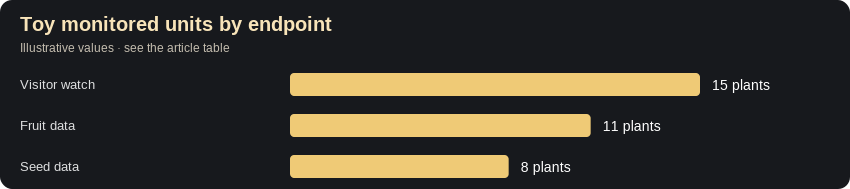
The chart represents invented counts of plants for which particular kinds of monitoring information are available. It is not a chart of the studies, sampled plant abundances, proportions producing fruits, or seeds counted. The unit is plants with records. Each plant may appear in more than one bar. The chart has to keep that possibility visible because the three totals alone do not tell us which records can be linked.
| Endpoint record | Plants |
|---|---|
| Visitor watch | 15 |
| Fruit data | 11 |
| Seed data | 8 |
In the illustration, the fruit-data bar is four plants shorter than the visitor-watch bar, and the seed-data bar is three below the fruit-data bar. These are differences in available records, not losses of fruits or seeds. If the same plants formed a nested series, then eleven of the fifteen watched plants had fruit data and eight of those eleven had seed data. Another dataset with the same bars could have overlapping but nonnested series. The eight seed plants might include plants without a visitor watch, for example. The chart is consistent with both possibilities; it does not label a pattern of attrition by itself.
Summing the bars gives thirty-four plant-by-endpoint counts. It does not tell us there were thirty-four individual plants. If all three groups were disjoint, that would be the distinct plant count; if the fruit and seed groups were both contained in the visitor-watch group, the distinct count would be fifteen. Neither extreme is a claim about typical field designs. A real report ought to supply the linkage information relevant to its claim, especially if the question depends on connecting an individual plant's visitor record to its later reproduction.
The chart is also not evidence of a drop in reproductive success from one stage to the next. A plant can have usable seed data without being a highly productive plant. A watched plant without a seed record may have contributed no seeds, many seeds, or an unassessable number, depending on the reason the information is unavailable. If an observer confirmed that no fruits formed under the defined rule, that is a biological zero for that fruit endpoint. If follow-up could not be done, that is an unknown. The two situations should not be represented by the same entry in a calculation.
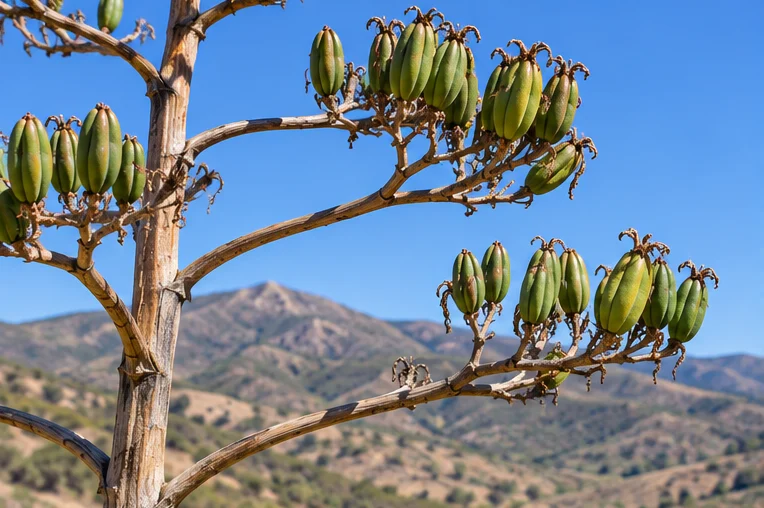
The illustration accompanying this article depicts an agave branch and developing capsules against a generic desert backdrop. It is not an image of either study, a location guide, or a species-identification aid. The image introduces the stage of fruit development. The bars introduce the accounting of records. The idea that a reader might remember the image and the graph better than the prose is a good reason to retain those distinctions in the individual captions rather than only burying them in an endnote.
Read the evidence in order without treating it as one continuous video
The studies largely relied on methods that answer questions beyond what a retrospective natural history viewer can establish. The reason to read the paper is that it tells you what comparison was made and what evidence justified it. The reason to read it cautiously is that one sentence sometimes joins species identity, visit counts, and outcomes measured in different ways. Break the argument into its pieces and look for the strongest evidence behind each one. A synthesis can be convincing without being a frame-by-frame account of a single visitor producing a particular fruit.
For each result, note the plant, place at an appropriate regional scale, interval represented, exposure grouping, and observation unit. Then write the endpoint as a sentence “number of fruits per what?” or “number of seeds among which fruits?” If the paper provides a test against an open control rather than a direct day-versus-night contrast, preserve that detail. A result comparing daytime exposure with open exposure is not a direct calculation for nighttime exposure versus daytime exposure. Having more than one comparison group can answer useful complementary questions without making the contrast interchangeable.
Persisting branches and positions also help avoid a temporal mistake. Nearly all interesting events in the branch will not occur on the same night. Closed buds can open later, flowers can become receptive on another day, and a branch that was difficult to see during a watch can become the easiest one to examine when capsules are larger. If a record compares whole inflorescences across time, make that scale clear. If it links individual flower positions, the link should be more than their proximity within two differently framed photographs. Sequence in a slide deck is not sequential evidence about a known unit.
Conditional outcomes require their own caution. “More seeds per fruit” concerns fruits that exist and were scored. If one exposure yields fewer fruits in the first place, the remaining fruits may represent a different subset of flowers. In some cases a total per plant or per initial set of flowers gives a complementary view of how outcomes combine. It still should not be calculated as the product of group means unless their denominators and weighting make that calculation valid. For instance, plants with fewer fruits can have a different seed distribution than heavily fruiting plants. A clear group summary retains this structure when it matters.
If one paper reports a large difference and another does not, a sound comparison asks whether they tried to measure the same contrast with comparable information. “No significant difference” means the analysis did not resolve one, not that two biological contributions are interchangeable. A difference in the detection of effects across two papers is not itself a test of a difference between them. Cross-study estimates are especially vulnerable when the measured quantity differs: proportion of flowers fruiting, fraction of ovules maturing, counts per fruit, and total seeds per plant should not be ranked on one unlabeled scale.
Even direct records of visitor identity come with scope. An indistinct figure in an image might support a broad grouping and nothing more. Older publications sometimes use names or group boundaries that require care when discussed alongside modern identifications. Naming exactly how the paper labeled its studied animal can keep a literature comparison clear without claiming that a new image identifies the same taxon. The exact identification belongs to the record with suitable supporting evidence. It need not be projected onto every silhouette seen near a flowering agave.
Put effort and uncertainty beside the conspicuous event
A composition of beautiful stills will favor visits that are easy to record. Larger, slower, or closer animals may fill more of the frame. An animal that leaves after a moment may never appear in the set of images chosen for a story. Similarly, daytime photographs might show many visitor kinds in crisp detail while a night recording reveals only a few unidentifiable passes. That contrast can say just as much about the observation opportunities as it says about animal behavior. An archive useful for comparison keeps watch duration, portions in view, and obscured segments as separate information.
Do not turn uncertain identity into zero activity. A plainly visible encounter by an unclassified visitor is still an encounter. It may contribute to a broad count if the counting rule includes it, even though it cannot contribute to a confident bat-species row. A segment where a branch was out of view is not a segment with confidently zero visits. The first kind of uncertainty concerns identity, the second concerns the ability to detect visits at all. Combining them into one blank field makes it harder to know which evidence to recover.
Successful follow-up may depend on where a plant grew or how its branches survived. A plant still visible in clear view later in the season is not guaranteed to be typical of the plants that were watched at flowering. The seed-data group in a real version of the toy chart could be concentrated on a particular set of branches or sites. If so, a description of reproductive outcomes across those plants should not be extended to the entire watched sample without justification. Keeping eligibility and follow-up reasons lets a reviewer identify a narrower but defensible claim.
Time of day also does not identify every animal using a resource. A daylight visitor can be highly visible, and a nighttime category can contain several groups with very different ways of handling flowers. In a study where outcomes differ between day and night exposure, the result identifies an exposure-period contrast. Additional evidence can support a more specific biological interpretation, as in the northwestern study's synthesis for A. angustifolia. The conclusion should tell the reader which part came from the treatment contrast and which from combining it with observations of the visitors.
The practical reward is a stronger conservation story. A claim that certain bats contributed to sexual reproduction in a documented plant system can be both compelling and specific. It does not require calling every agave dependent on a single visitor or treating insects and birds as incidental everywhere. Describing complementary possibilities leaves space for the sort of plant-to-plant and place-to-place variation the research actually uncovered. It also clarifies when a study discusses reproductive production rather than every value that flowering plants provide to different animals.
One observation ledger, three different paths through it
Imagine an archive of already recorded public natural history images. The first path through it is a visitor index. For each encounter the curator records which branch was in view, whether the view clearly established an approach or contact, and how strongly the animal can be identified. If the camera moves while the animal is near two branches, the record can retain an encounter without assigning it to one of the branches. The archive is still informative about behavior. It has simply declined to make an impossible attribution.
The second path is a fruit index. It starts from images of positions where flowers or buds were visible and asks whether those same positions can later be scored at the chosen stage. A branch with numerous capsules might still lack the earlier coverage required for a fruit-set denominator. Such an image is good evidence that some fruits were present and poor evidence of what fraction of the earlier flower positions matured. A record can list visible fruit without placing it in a calculated fruit-set series. That way the useful image survives without consuming a role it cannot fulfill.
The third path is a seed index. For a passive archive, most photographs of intact, developing capsules cannot say what is inside. There may be published seed information from an appropriately designed study, but those rows belong to that study and are not attached to whatever photographed plant looks similar. The resulting database may have a long visitor list, fewer comparable fruit observations, and no independently interpretable seed measurements. That is not a demand to make the third column fuller. It is exactly the information someone should have before deciding what to write.
The three paths help answer questions at different scales. A comparison of visitor categories can use confirmed events even if later fruit evidence is absent, provided its coverage is described. A description of reproductive development can be valuable for plants without detailed visitation records. A question linking both pathways needs an actual join between the relevant units, an appropriate comparison, and attention to unobserved variables. Having long tables with common species names does not make these links. Joining by guesses about identity is particularly misleading when the linked result then looks as tidy as the original entries.
This framework can improve a museum panel as much as a spreadsheet. A panel might show one image of an animal at a flower and another of a growing capsule. The labels can distinguish typical possible transfer, visible contact, and later documented development rather than putting an unqualified causal arrow between the frames. If the images represent different plants or places, the description should say so or make clear they are examples. Viewers can still make sense of the ecological sequence without being asked to believe that the two pictures document the whole chain.
Work through three claims before choosing a headline
Consider the headline “Bats make the most visits.” It calls for documented visitation, a comparable time or exposure denominator, and a unit such as visits to watched branches. Even if true under a certain watch, it does not establish that the visitor was most effective per encounter. The adjective most needs a comparator, and its meaning can change with time of day. An observer who only selected clips that clearly showed bats has not assembled the required comparison with other visitors. Such footage might still illustrate what an identified visit looks like.
Now consider “Bats lead to more fruit.” This is a claim about reproductive consequences. The A. macroacantha paper can support a suitably bounded version in its comparison of flowering stalk exposure conditions. An unrelated fruit photograph cannot. If the design compared simultaneous exposure to moths and bats against exposure to moths without bats, the whole contrast needs to be named. “More fruit with bat access in the studied comparison” is different from “one bat caused every fruit shown.” The former lets the treatment do its evidentiary work without creating individual event assignments.
Finally consider “Bats improve seed set.” The word seed needs a measure. The 2000 study describes more seeds per fruit under one of its studied bat exposures, even though it did not resolve a corresponding fruit-set difference for that comparison. The northwestern study separately discussed seed fractions in its species and exposure comparisons. Generalizing a particular seed metric to absolute population output would add a conclusion the endpoint does not establish. The measure earns a strong sentence if the species, setting and comparison stay attached.
There is a fourth headline worth avoiding: “Butterflies or moths do not matter because bats win.” An observed effect in one comparison is not a comprehensive measure of every visitor's role, and an outcome under open access can involve multiple visitors. The better question is what the study can distinguish about the group left in or left out and under what conditions. The distinction prevents a comparative story about effectiveness from becoming a story that smaller, less visible visitors are worthless. It also avoids replacing the northwestern contrast with a single region-wide slogan.
If the story has room for a small box rather than a large headline, give it three lines with named evidence. In A. macroacantha, the nighttime exposure comparison concerned fruits, while a separate species-focused comparison detected a difference in seeds per fruit. In the studied A. angustifolia, the nighttime visitor treatment and occurrence evidence supported an important role for bats. In A. subsimplex, both visitor periods contributed evidence worth considering, with fruit and seed outcomes giving different levels of discrimination. This is not a league table. It is a reading guide for the two papers.
Make uncertainty useful to another reader
There is a difference between acknowledging uncertainty and making it impossible for a reader to know what happened. Avoid broad boilerplate claiming that everything is unverified. Identify the exact missing step. “No recorded seed outcome for these photographs” is useful. “Species uncertain in this silhouette” is useful. “Exposure comparisons available in a source study but not attempted in the picture archive” is useful. A generic “more research is needed” can be true but tells the reader much less about which claim remains unsupported.
Another useful distinction is evidence about one plant's condition versus inference about a group. A photograph that clearly shows a mature capsule has high evidentiary value for the presence of that structure at that moment. It may have very low value for an average number of fruits across a population. The reverse can happen with a published study's overall measure: the summary may be useful for understanding a population-level contrast without identifying a single photographed plant. Respect each source's strongest claim rather than assigning high or low quality to it for every conceivable purpose.
Independently of those claims, particular body positions on a flower are worth describing for their own natural history value. For example, a view from the side might show the visitor's head in relation to protruding floral parts, while leaving it unclear whether the animal touched the same structures as it moved to a second bloom. A good drawing can preserve the observed relative positions, and a caption can say where the drawing generalizes from published work. Neither needs to give viewers a false impression of what was visible between the two flowers. Time spent considering the geometry is more valuable than adding another imprecise label for success.
The papers also invite readers to think about the difference between an attractive resource and a complete account of plant reproduction. Flowers can offer a reward to an animal even on visits that make little detectable contribution to the plant's sexual output. A visitor can also play a role in that output without being recorded during every observation interval. It is therefore reasonable to ask separate questions about what the flower supplies to the visitor and what the plant gains from the larger pattern of movements. Success from the animal's perspective and success in a plant's fruit or seed record should not be assumed to scale together. Two useful questions have been identified, not two labels for the same result.
No site visit or physical intervention is needed to practice these distinctions. The full papers, their figures and definitions, and appropriately labeled public illustrations already offer substantial material. For a public article, do not provide access directions to sensitive wildlife locations or encourage any reader to handle bats, moths, or plant reproductive structures to settle what the image cannot show. An archive-based comparison can be more productive than chasing a plausible but unsupported connection between a visitor image and a later seed story.
If a source includes supplemental figures, check their legends before copying any number. A single axis might describe a branch-level estimate or an outcome averaged across whole plants. Keeping those levels visible allows a later reader to see how the published values relate to the newspaper-sized version of the story.
The thesis survives a short version: seeing a bat at an agave answers a visitation question. Seeing contact adds a condition relevant to transfer. A study of fruit set measures a later outcome under a defined denominator, and a seed measure addresses a later stage with its own denominator. The Mexican studies show how conclusions change when those rows are kept rather than collapsed. Readers can care about bats and agaves without treating every silhouette as a seed count. It is the separation of the stages that makes the whole encounter worth understanding.