| Category | Value (reports) |
|---|---|
| Day | 12 |
| Night | 8 |
| Unspecified | 4 |
Illustrative values, not sourced observations. Invented example for the stated comparison; not a biological threshold, ecological estimate or observed dataset.
An agave stalk can look like two different places depending on when someone watches it. During daylight, a volunteer may see insects and birds working among the flowers. After dark, an observer at the same plant might detect moths or bats. A morning photograph and a night recording can both be completely accurate without describing the same part of the flowering schedule. Neither tells us, on its own, which visitors accounted for the fruits or seeds produced later. For that question, the calendar has to include floral stage, visitor opportunity, and the design that connects a visit to an outcome.
“Agaves depend on bats” is a claim worth unpicking rather than accepting or rejecting in one stroke. There is strong evidence for important bat pollination in some studied agaves. Other agaves have yielded evidence for meaningful contributions from both daytime and nighttime visitors. Some papers compare windows of access; others compare visitor groups within a single window. Taking one nocturnal result as an account of an entire genus loses the contrasts that originally made the studies useful. Taking one daytime photograph as a refutation makes the opposite mistake.
The examples below use original agave research to show how those distinctions work. The chart is an invented inventory of reports, not a summary of those studies or a recommendation about monitoring animals. A garden team can read the evidence, make scoped and passive observations from authorized locations, and keep separate records for the two shifts. No handling, attracting, capturing, lighting, or disturbing wildlife is needed to practice the reasoning.
Put three calendars beside the stalk
The first calendar belongs to the plant. A flowering stalk is a useful landmark, but it is not a single flower. Buds, flowers at different reproductive stages, and structures no longer available to visitors can appear near one another. The broad flowering season, the dates the individual stalk offered open flowers, and the hours when a particular floral structure could function or be used are different scales. If an observer watches the same stalk twice, the open and relevant flower units can still differ. Record what the flower presented during each watch rather than treating the stalk as fixed exposure.
A second calendar belongs to the visitors. A visit can be recorded at a time of day; a visitor group can also have a broader season of occurrence or activity at the site. The presence of a group somewhere in the region is not proof it appeared at the study plant during the relevant window. Conversely, a reliable encounter during an otherwise poorly sampled period is still evidence about that encounter. Align reports with actual dates and times where possible, and state when the timing is vague rather than reconstructing it from the animal's common reputation.
The third calendar belongs to the project. It tells when observers, cameras, and other passive recording systems could assess the target. A study may have much better daytime coverage, while its most striking footage comes from a few night clips. A person may stop before morning, just as another group begins. Even well-planned sessions can have losses from obstructed views, technical problems, access limits, or bad weather. Show those opportunities separately from detections. A blank line in the night column might mean nobody watched, not that no visitor came.
Three calendars can overlap without agreeing on boundaries. “Dusk” can refer to a clock interval, a time relative to sunset, or a visual impression; “overnight” might include twilight and dawn. A flower's reproductive stage may change within a watch rather than on the daily boundary the schedule uses. The words day and night are acceptable summaries when their underlying intervals are defined. When an original study used a particular schedule, preserve that convention. A new report can make broader groups for display, but must keep the raw times needed to compare the work.
A useful field diagram can place flowering stage, documented watches, and sightings on separate tracks. A mark for a visitor then sits inside its observed window instead of implying continuous coverage all around it. A later fruit survey can appear as a separate outcome date. Do not draw a straight arrow from every sighting to every fruit. An arrow can represent a tested combination in an experiment, or a proposed pathway worth distinguishing, but the symbol should not do causal work the records did not do.
What “visitor” means before the fruit develops
A visitor record is strongest when it describes an event with a boundary. An animal can pass near a flowering stalk, approach particular blossoms, land, hover close enough to probe, or visibly touch a reproductive structure. These are not equivalent measures. A silhouette in transit across a distant background is not automatically a visitor, and a contact in one plane of an image can be difficult to establish from apparent overlap. When a watch has a narrow rule, report which events count and which are left as approaches or uncertain movements.
A confirmed visit is not identical to successful pollination. An animal may approach a flower without touching a part likely to transfer pollen. The position of contact and the stage of the flower matter. An animal can touch an appropriate structure yet carry unsuitable pollen, fail to deliver it, or contribute little to later reproduction. Successful pollen deposition is itself a nearer endpoint than fruit development or viable offspring. A careful writer can mention multiple links without claiming each one was directly observed in a particular case.
This distinction matters when comparing apparent effectiveness. A group that visits many times may have relatively little effect per encounter, while another contributes substantially per visit but appears rarely. A group's cumulative contribution in a study depends on both its encounters and what those encounters do, as well as the conditions in which they occur. A simple ranking by sightings is not a ranking by reproductive contribution. Conversely, a result from a restricted exposure experiment should not be reported as the rate at which a group showed up in ordinary, unrestricted visits.
Keep the denominator close to each outcome. Fruit set can be expressed relative to flowers assessed under a particular condition. A study of seeds may report counts per fruit or a fraction based on the potential seeds or ovules examined, depending on its method. Those values can diverge: treatment groups can form similar shares of fruits but differ in the seed measure. Treat this as information rather than searching for the one label, “pollination success,” that blends them. Read the methods and figure captions closely enough to know which denominator the authors used.
A flowering agave can also matter as a resource for an animal independently of the animal's contribution to plant reproduction. If an animal appears to use nectar during a documented visit, that observation can support a claim about visitation or behavior under its conditions. It does not necessarily show that the plant depends on the visitor. Likewise, naming an important pollinator in a plant study does not establish the reciprocal claim that the animal relies on that one plant species for all its food. State which organism and which outcome the evidence concerns.
A northwestern Mexico comparison keeps two plants distinct
In their original study of two paniculate agaves in northwestern Mexico, Francisco Molina-Freaner and Luis E. Eguiarte examined Agave angustifolia and Agave subsimplex. They reported a variety of visitors at the studied plants and found higher bat visitation to A. angustifolia than to A. subsimplex in their observations. They did not stop at that list. Their comparisons involving access windows and reproductive outcomes helped distinguish the biological importance of the visitors from simple attendance.
For A. angustifolia in the studied setting, nocturnal access contributed strongly to fruit set, while the daytime treatment did not produce fruit in the comparison reported. The authors interpreted the wider evidence, including observations of visitors, as supporting an important role for nectar-feeding bats in the local populations they studied. Notice the sequence of reasoning. The day-versus-night treatment concerns a window that more than one type of animal could use. The attribution to bats is informed by the other evidence; it is not a definition under which every nocturnal event becomes a bat event.
For A. subsimplex, the picture was different. The authors treated both day and night visitors as important, and the reported window comparisons did not detect differences in fruit set relative to the relevant open control. At the same time, their seed measure for each restricted shift fell below the open control. These results should not be compressed to “day and night were exactly equal.” A study can fail to show that particular fruit-set contrasts differ without establishing precise equivalence. And the seed result shows why the choice of endpoint affects the message. Keeping the comparisons specific preserves a stronger scientific story.
The two plants did not form a universal demonstration of what every agave does. They were examined in particular settings and seasons, and the paper describes differences in flowering times, visitor rates, and reproductive observations. A comparison across species and sites can document this variation, but it need not isolate a single reason why the species differ. Geography, overlap with visitor activity, and details of flowering belong to the scope of the conclusion. A species name should be carried with the study result, not dropped as if it were decorative.
There is a good way to summarize the comparison in a public gallery: “At the studied Sonoran sites, the experiments and observations supported a strong nocturnal contribution to A. angustifolia, with bats implicated by additional evidence. For A. subsimplex, both shifts mattered, and seed outcomes did not reduce to the fruit-set comparison.” That is more useful than treating the study as a vote for or against a general claim about agaves. It points the next reader to what was actually tested and names where the result should not be extrapolated casually.
A second agave case asks which night visitors matter
Arizaga and colleagues reported a different plant system in a pair of studies on Agave macroacantha in the Tehuacán-Cuicatlán region of Mexico. The first paper, on floral biology and pollination mechanisms, documents a range of visitors across day and night. In the observation setting, daytime visitors included hymenopterans, butterflies, and hummingbirds, while nighttime visitors included moths and bats. Their observations also related the plants' floral schedule and nectar production to possible visitor roles. That description is strong context for proposing mechanisms, not a tally of seeds won by each group.
The second paper, on the roles of pollinators, presents both observations and experiments concerning nocturnal visitors, including comparisons intended to distinguish the contributions of moths and bats. The authors concluded that nocturnal pollinators were particularly important for the plant in their study and highlighted bats' contribution to successful pollination. They also compared outcomes associated with different bat visitors. This is a finer question than whether day or night was more consequential. The more detailed claim is warranted by the more detailed comparison, not by a general rule about how agaves ought to work.
An account of that study should not imply that the list of daytime visitors was erroneous. A bird or insect can make a genuine daytime visit even in a system with stronger evidence for nocturnal reproductive contribution. “Observed by day” describes an occurrence under specific conditions. “Important contribution to the measured sexual reproductive outcome” requires additional evidence. Using the same label for both can make the studies look contradictory when they answer separate questions. The same care applies to a record of moths alongside bats. Presence together is not proof of equal effectiveness.
Avoid copying historical species nomenclature casually across papers. A paper's methods and results are attached to the specimens and names as treated by its authors. If modern taxonomy is relevant to a new report, check an appropriate authority and explain the relationship rather than silently asserting that every historical name has exactly the modern scope a reader expects. For the main comparison here, the emphasis is on the evidence for groups and specific studied plants, not cataloging current bat ranges. The ecological inference does not require publishing sensitive locations.
These studies also illustrate a useful question to ask of any authority: what comparison would have changed its interpretation? A fruit or seed result under a specific restricted access condition can challenge a stronger claim drawn from raw visits. An ordinary list of appearances cannot by itself tell what reproductive outcome would have been under another condition. It is precisely the difference in design that makes the more specific result possible. Reading the primary papers keeps that distinction visible when the findings become captions or public statements.
Read an access experiment without inventing what was isolated
An access comparison may contrast flowers available only in a specified day window, flowers available only at night, and open conditions. Other controls can help distinguish reproduction requiring transfer from what happens in the absence of visitors under that experiment. Read which controls were used and how outcomes were assessed. If the experiment restricted time of access, it did not automatically isolate one named species. If it distinguished some visitor groups within a period, report the actual contrast rather than assuming every possible visitor was separately evaluated.
A restriction can influence more than the intended category. Practical access differences, handling, shifts in timing, and other conditions matter to interpreting any result. Published research addresses particular alternatives through its own design and documentation; a retelling should not imply that any cover or schedule automatically controls them. A casual garden exercise should be observational. It can read how published studies handled these choices without reproducing exclusion, altering flowers, disturbing wildlife, or operating outside local permissions.
Another mistake is to interpret the effects of the two shifts as numbers that must add to the open result. Pollination events can be redundant, a single fruit may reflect contributions spread across time, and plant outcomes can respond nonlinearly to the visits or pollen received. Flowers under restricted access can also differ in other relevant ways from open ones. Use the treatment results as designed comparisons, not pieces of a fixed arithmetic whole. Finding positive outcomes in both shifts does not specify their additive shares of every fruit produced when both are allowed.
Report the study unit at the right level. Multiple flowers on one stalk can provide repeated observations within a plant, but do not automatically represent many independent plants. If a study allocates conditions within plants, that arrangement matters to the analysis and uncertainty. Several watches on a single species at one site likewise do not cover its full geographic range. A large number of flowers or visits is valuable evidence when tied to its design. It should not be made to support a broader population simply by mentioning whichever raw count sounds most impressive.
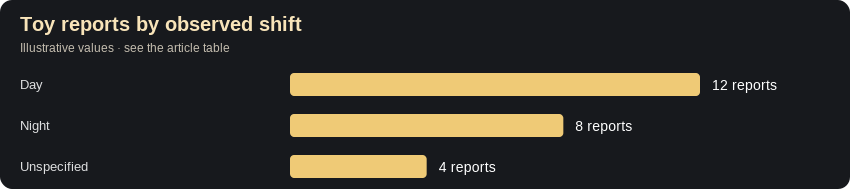
Chart: Toy reports by observed shift
The chart and matching table are illustrative only. They categorize twenty-four invented reports. They are not field observations, an ecological estimate, a biological threshold, or a tally from either agave study. A report is a metadata item in this teaching exercise, not a visit, a visitor, a flower, or an hour of effort.
| Observed shift | Reports |
|---|---|
| Day | 12 |
| Night | 8 |
| Unspecified | 4 |
The three categories sum to twenty-four. Twelve reports indicate day, eight night, and four lack a resolvable shift under the toy record rule. Among the twenty reports with a specified shift, twelve are daytime, or sixty percent. Among all twenty-four reports, twelve are confirmed day, or fifty percent. Both calculations describe the invented archive. Neither estimates the fraction of all visits occurring by day or the contribution of day visitors to fruit formation. The same report might mention multiple events or none, and metadata completeness can vary among observers.
Here “Unspecified” does not mean an intermediate hour, a watch with no visitors, or a record showing both shifts equally. It means the available description did not let the reviewer assign one of the two categories for this toy display. A real archive can have separate categories for paired or spanning watches, and it can retain details for twilight. Keep a separate code for an exact but intermediate time if the study needs one. Uncertainty about which window applies is not a measured third time of day.
If the interpretation changes greatly when the unspecified reports are dropped, inspect why their timing is unknown. A gallery of daylight stills may preserve full timestamps while nighttime clips arrive as copied exports. Missing metadata can cluster precisely where it matters to the comparison. Do not infer the shift from whether the depicted subject looks like a bat or an insect, or from brightness alone. The biological category is one of the things the study wants to compare. Using it to backfill the window can build the expected relationship into the data.
The small table could lead to better archive handling. A team might retrieve missing original timestamps or improve the way it records each watch's start and end. It cannot use these rows to decide which shift is more important for agaves. For a visit rate it would need the counted events and observation effort; for a reproductive comparison it would need appropriately matched outcomes and study design. This is why an evidence audit must plainly identify what it counts, even in a small figure whose numbers seem self-explanatory.
Compare day and night without treating usable effort as equal
A field record should preserve attempted, completed, and usable watch time. Day and night can differ in visibility, background, motion blur, or the observer's ability to classify small or rapid visitors. A theoretically equal duration does not guarantee equal detection. A plant's visible outline may be clear while the relevant part of a flower remains unavailable to see. If one watch supports broad movement records and another supports detailed contact records, state those distinct endpoints and use compatible observations for the particular comparison.
Consider an invented illustration outside the chart. Say a daytime watch records six qualifying approaches over thirty eligible minutes, and a nighttime watch records four over twenty. The observed rates are both one approach per five minutes, even though the counts differ. That equality does not say the actual approach rates were equal, nor does it say the groups were equally identifiable. Dividing by time controls one aspect of observation effort. It does not correct missed movements, differences in flower availability, or changed criteria. A modest descriptive comparison is stronger when these dependencies are visible.
Likewise, observing fewer events during a comparable clock interval can be an accurate result without establishing a direct biological cause. A shorter viewing distance could help identify daytime insects, while a night recording could miss very brief visits. The presence of an animal may be evident even when the flower visited cannot be located. An observer can confidently note a group at a coarse level and keep the finer label unresolved. Resist filling missing video, identification, or exact contact with assumptions about what typically flies at that hour.
Try to document the plant units represented in each watch. If one interval includes many more open flowers than the other, a rate per stalk per watch and a rate per observed flower-minute are different quantities. The latter needs a defensible measure of time and floral opportunity. A snapshot of the whole stalk at the beginning may not be enough when the exposed units change. Do not require complicated estimation for a simple natural-history note, but avoid promising a standardized floral rate without its denominator. An accurate report can state duration and broad flower condition descriptively.
The order of watches can generate systematic differences. If the first team always observes a well-exposed stalk today and the second team observes a different stalk tomorrow, plant and lighting differences travel with shift, date, and observer. Record the order and consider comparable repeat watches where lawful and safe. Having several watches on different dates may be more useful than dividing one hour into many labels and treating them as independent evidence. A repeated count can still be a rich record even when its analysis must keep the dependence visible.
Neither the reader nor the volunteer should be asked to accept risky observations for the sake of a balanced table. Restrict work to authorized vantage points and suitable conditions, and do not approach or disturb nocturnal animals. A project can learn from published work or appropriately documented existing records if direct access is unsuitable. Differences in scope can be stated without manufacturing a comparison. In a classroom, matching fictional plant and watch calendars can teach the same reasoning without any field activity.
Keep the season separate from the watch
Seasonal overlap can affect whether pollination pathways are even available to compare. A plant may flower during a period when observed visitors are present, or during another period when that overlap is weaker. The northwestern comparison is useful partly because its authors described when the plants flowered in the settings they observed. It would be a mistake to take those windows as an unchanging prescription for every location where either species occurs. A study calendar gives specific coverage, not a permanent regional schedule.
Likewise, an absence on one night does not tell you about the season. An observer might see no qualifying visits during a complete watch, and that is valuable as a dated zero for that method. A watch canceled or unable to assess the flower is a different condition. Even with no detections across several watches, a broader absence claim needs evidence that observation timing and detectability suit that inference. Keep the most conservative accurate description: which units were observed, for how long, with what access and visibility, and what was recorded.
Stage classification can also affect the apparent seasonal pattern. A date described as “in bloom” might refer to any visibly open flower, whereas the reproductive study may focus on a defined stage or organ. A visitor recorded on one accessible flower can coincide with many buds and old flowers on the same stalk. If questions differ, so should the calendar fields. An observational label such as “open structures visible” should not be converted to demonstrated pollen release or receptivity just because the view was attractive. The published botanical methods, not the lighting of a photo, support those distinctions.
A practical version of the calendar uses three rows per plant rather than one. The first records the dates and identifiable stages observed. The second gives watched intervals and coverage flags. The third links qualifying visitor events. Where the study also measures fruits and seeds, add an outcome record linked to the appropriate unit and treatment rather than inserting fruit counts under whichever shift was most recently observed. Separate tables can be a clearer representation than one imposing label that tries to carry every stage of the process.
Build a source comparison that does not erase geography or endpoint
A useful reading table has one row per study and focal plant. Give it fields for geographic scope, date range, observation window, visitor groups detected, comparison tested, and outcomes recorded. Record whether the claim concerns a specific location, sampled populations, or a general conclusion argued by the authors. A separate column can hold limitations or reasons comparisons do not line up. This is not an exercise in finding the cleanest slogan. It lets a reader see which differences in conclusions have an obvious reason in study design.
For example, place the Sonoran A. angustifolia entry beside the A. subsimplex entry before importing the separate A. macroacantha studies. The first two demonstrate that one comparison can produce contrasting reproductive patterns across focal plants. The paired A. macroacantha papers then show how descriptive work and a more targeted nocturnal comparison can be linked without losing their different purposes. Together they teach both why day and night should be documented and why a broad visitor window does not identify the most important group by itself.
Look carefully at adjectives such as “dominant,” “important,” and “dependent.” Dominant in the visitation log is a frequency claim. Important in a restricted access comparison is about an observed outcome under that design. Dependence can mean inability to reach a measured reproductive result without the relevant visitor in the studied setting, or it can be a much stronger claim about the long-term success of an entire species. Do not infer the stronger meaning from the shorter word. Write enough of the original outcome and conditions that readers can see which interpretation you intend.
When two studies use different metrics, line up outcomes only where the units actually match. A seed fraction within fruits and the count of fruits per inflorescence are both useful. They should not be directly compared as one percentage called success. Even nominally similar fruit-set figures can reflect different timing, treatment design, or sampled plants. Do not manufacture a large combined effect from a small collection of differently scoped studies. A clean narrative comparison can teach the reader more than a false precision produced by stacking their numbers.
A useful exercise is to mark claims by the evidence they need. “Visited at night” can be checked against a timed field record. “The nocturnal treatment contributed most to measured fruit set under this comparison” requires the treatment and outcome data. “Bats were especially important” needs additional evidence within or alongside the shift comparison. “All agaves rely on bats” would require far broader support than the examples here. If a sentence contains several of those claims, split it until each can be traced to its source.
Make the next observation more useful than the last
Start with a passive, observable objective. A team could document which visible types of encounter occurred at a designated flower group during selected safe windows, while explicitly saying it did not estimate pollination. Establish the field boundary and what counts as a qualifying observation. Preserve exact or bounded time where possible, the flower identity and stage if supported, and observer position. If all the observations come from daytime, that does not make the project useless. It makes it a daytime account that should not imply a completed night comparison.
Store unresolved records in ways that support improvement. An unidentifiable visitor may need a better reference or another noninvasive angle. Unknown shift may need original metadata. A shortened watch may need a more appropriate schedule. An absent reproductive outcome cannot be repaired by improving the image alone. Each limitation points to an achievable next task. A reader who receives “insufficient detail to establish contact” can understand that another view might help, rather than believing nothing was happening.
For any public figure, label generated or editorial images distinctly from documentary records. The wide stalk at twilight suggested for this article can introduce the idea that more than one period matters. It does not establish which agave was measured or which visitor occurred in either study. A documentary image in a report should be captioned with whatever is known about date, site context at an appropriate level, and observed action. A beautiful transition from amber to night blue should not be permitted to stand in for missing observation time.
Avoid copying exact sensitive field locations when a broader description will support the interpretation. A report can identify a region, study site description as appropriate, and plant name without turning the notes into a guide to approaching animals at secluded locations. Respect site access and the limits of the original research. The distinction between a useful method and an intrusive procedure is especially important in nighttime observation. Good documentation should make responsible follow-up easier, not create pressure to reproduce an unsafe or unsuitable situation.
A short archival note can say, “These records compare completed daytime watches with a limited number of night clips. The presence of visitors was recorded at the level supported by the view. No local reproductive outcome or independent estimate of detection was measured.” A second note about the literature can separately explain that published work found contrasts among focal agaves. The two together are more useful than disguising the local gaps with a general statement about dependence. The result helps a reader recognize a real biological question and locate the kind of evidence that speaks to it.
Look for uncertainty that a comparison can actually reduce
A visitor watch and a fruit count can be informative together without matching one recorded individual to one particular fruit. The bridge in a controlled study is usually an assigned exposure or treatment and its outcome, not a visual claim that the animal in the photograph caused the fruit in the next panel. Make that distinction explicit when assembling a story. If one distant camera recorded a bat at a stalk and several flowers later produced fruits, those observations may coexist productively in a field archive. They are not automatically a confirmed chain for any specific flower. A later reader should be able to tell whether the connection came from a shared site, a linked treatment, or direct behavioral evidence.
Pay attention to the time between intervention and outcome in papers as well as in captions. A study deciding whether fruits formed at a stated assessment point is not necessarily also deciding whether all of those fruits remained to maturity or whether offspring established. Some outcomes are deliberately chosen as nearer and more assessable markers. Report them as such. If seed evidence came only from the fruits that formed, its interpretation differs from a measure of total seed production per initially exposed flower. A study can provide enough detail to distinguish those analyses, but a headline can erase the distinction in seconds.
A comparison across studies can reveal a worthwhile missing case. If a reader wants to know whether observed daytime visitors compensate when nighttime activity is low, it is not sufficient to find one plant that had some daytime fruit set and another that depended strongly on nocturnal visitors. That combination does not establish compensation under a shared condition. The relevant evidence would need a defined plant, an appropriate comparison of opportunities or exposures, and measured outcomes under that comparison. In a natural-history article, framing that missing evidence as a question is more useful than extrapolating past the original design.
Some results are best carried forward as research constraints rather than prescriptions. The studies here demonstrate why checking only the most convenient shift can miss important activity and why recorded visitation cannot carry the full reproductive claim. They do not specify a universal pair of hours or suggest changing habitat to make a visitor easier to watch. A thoughtful next study begins by choosing an outcome and preserving the calendar that gives it a fair chance to be observed. The practical value of the literature is in making that design choice explicit.
The next time a caption claims that an agave has only one visitor shift, check what was observed and what was tested. The daylight tally, nighttime observations, and fruit or seed outcomes can all matter, but they are not exchangeable forms of evidence. Keeping the calendar, plant identity, and outcome visible preserves the strongest conclusion in each primary study. It also leaves room for something as ordinary and informative as a daytime visit at a plant whose measured reproductive success depended heavily on night visitors.